
Model and fitment guide | Updated August 10, 2026
Cat 320 Excavator Undercarriage Parts Guide: What to Confirm Before Ordering
A request for “Cat 320 undercarriage parts” is a useful starting point, but it is not enough to confirm a track roller, carrier roller, front idler, sprocket, track chain or track shoe. The 320 name appears across different generations and configurations, including 320, 320 GC, 320C/320C L and 320D references in Caterpillar's current parts material. Accurate sourcing therefore begins with the complete model suffix, serial number or PIN, existing part number, photographs and dimensions.
Quick answer
Before requesting Cat 320 excavator undercarriage parts, photograph the complete machine plate and both sides of the undercarriage. Record the full model exactly as displayed, the serial number/PIN, part name and number, track pitch, link or shoe count where relevant, shoe width, mounting pattern, key roller or idler dimensions, quantity, destination and working condition. Do not assume that a part advertised for “320” fits every 320 series, regional version or serial range.
Why the Cat 320 name alone is not a fitment key
Caterpillar's current parts reference page lists separate documents for 320/320 GC/323, 320/320 GC, 320C/320C L and 320D. The Cat Parts Store also asks users to add a serial number before finding parts that fit a 320 GC. These are practical reminders that a familiar model family can contain meaningful differences.
Possible variables include generation, suffix, serial-number break, standard or long undercarriage, track gauge, shoe option, regional configuration and previous field modification. An old component may also have been replaced with a service assembly that carries a different number from the original build.
Make the identification check safely
Park on stable, level ground, lower the bucket or attachment, apply the parking brake, stop the engine and isolate the machine according to the operation and maintenance manual. Keep clear of the track, raised equipment and pinch points. Never crawl under an unsupported machine or loosen a grease relief valve as part of a visual identification check.
Clean only enough dirt to expose the plate, casting marks and measuring surfaces. Stored grease pressure, heavy component removal and track separation require trained personnel, correct tooling and the machine-specific procedure.
Eight pieces of information that prevent most ordering errors
| Information | What to record | Why it matters |
|---|---|---|
| Brand and complete model | Copy every letter, number and suffix from the machine plate. | “320” alone may omit the generation or configuration. |
| Serial number or PIN | Provide a clear plate photo plus the typed number. | Parts can change at a serial-number break. |
| Part name and position | For example, lower track roller, carrier roller, front idler, sprocket, left or right side. | Different components may be described by similar local terms. |
| Existing part number | Photograph and type the complete number; note whether it comes from the machine or old part. | One blurred or missing digit can lead to a different assembly. |
| Clear photographs | Overall undercarriage, mounting area, old part, wear face and any cast or stamped marks. | Photos reveal mounting and configuration differences that a model name may hide. |
| Requested dimensions | Use a ruler or caliper in the same photo and state the units. | Dimensions provide a second check, but should not replace the serial number. |
| Quantity and destination | State pieces or complete side/set and the destination country or port. | Prevents packaging and quotation assumptions. |
| Working condition | Ground material, typical slopes, hours, symptoms and whether adjacent parts were changed. | Helps evaluate whether a system-level inspection is needed before replacing one item. |
Cat 320 excavator undercarriage parts to identify
Track rollers
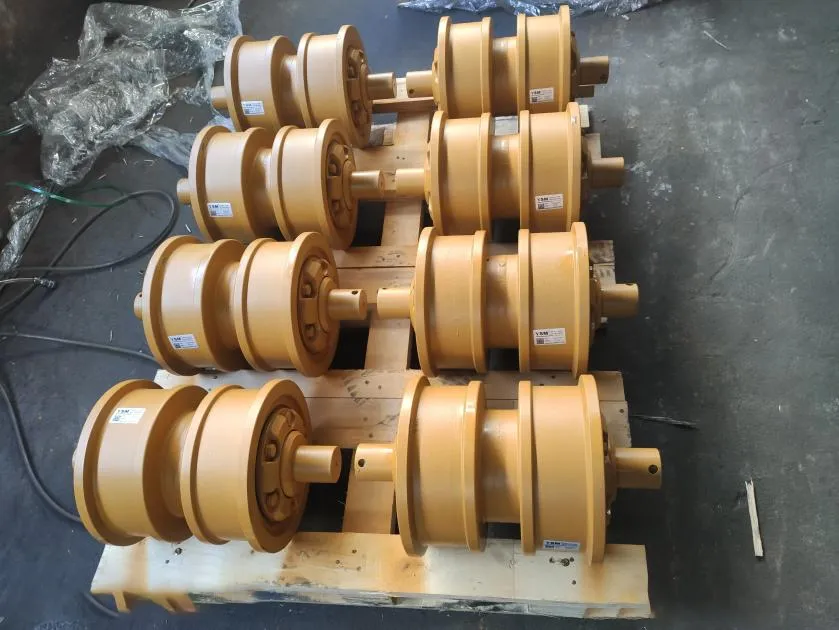
Lower track rollers support the machine through the link rails and help guide the chain. Identification may require the mounting-hole spacing, body length, tread and flange arrangement, shaft or bracket style and overall height. Count rollers on the actual machine rather than assuming a published layout applies to every version.
Oil loss, seized rotation, unusual heat, one-sided flange contact or a deeply changed tread profile are inspection signals. They do not prove that every roller should be replaced without comparing the full set and the chain alignment.
Carrier rollers
Carrier rollers support the upper track run. Record the mounting design, bolt spacing, roller diameter, tread width and any part number. Some configurations may use a different quantity or position. A carrier roller should not be confused with a track roller simply because both are called “rollers.”
Front idler and recoil area
The front idler guides the chain and moves with the recoil and track-adjusting system. Useful checks include overall width, rail-contact surfaces, shaft or yoke arrangement and markings. If the idler sits unusually far forward or backward, investigate chain wear, packing, adjuster condition and the manual's measurement method rather than ordering an idler from position alone.
Sprocket
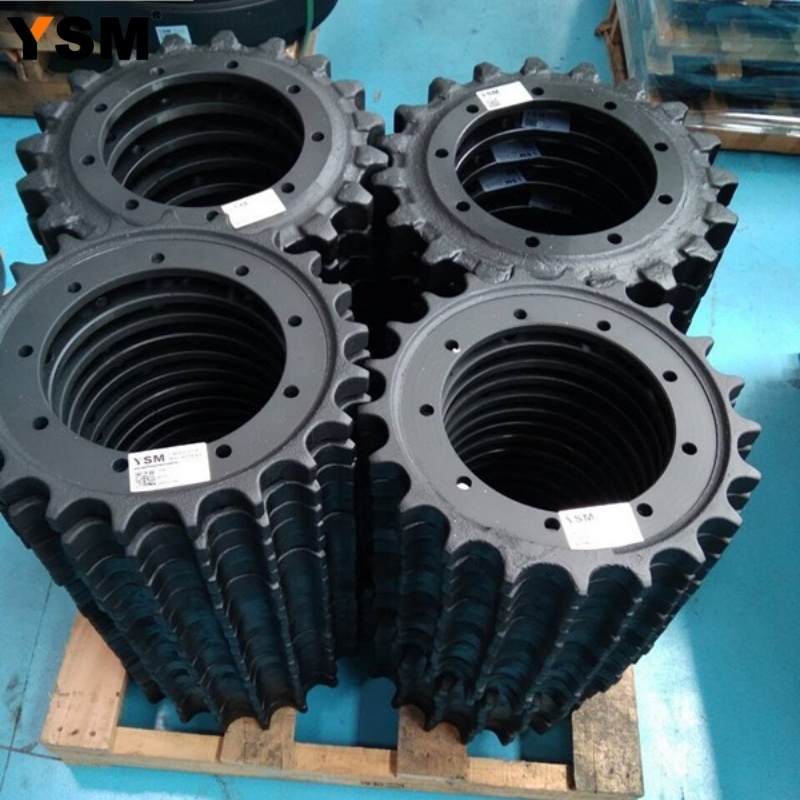
The sprocket engages the track-chain bushings and transmits travel torque. Record whether the machine uses a complete rim or segmented arrangement, tooth count where applicable, mounting dimensions and existing number. Hooking, sharp profiles or unequal contact can reflect interaction with the chain; replacing only the sprocket may not correct a worn pitch relationship.
Track chain or link assembly
For a track chain, confirm pitch using the specified measurement method, link count, master-joint type, shoe-bolt pattern, rail width and existing number. Internal pin-and-bushing wear can increase effective pitch even when individual links do not look broken. Use an OEM wear method or a qualified undercarriage inspection for the replacement decision.
Track shoes and fasteners
Record shoe width, grouser type, bolt-hole pattern, hole spacing, plate thickness in an unworn reference area and the number of shoes. Shoe width and style affect flotation, maneuverability and stress under different ground conditions. Do not select a wider shoe only because it appears to offer more flotation; the complete application and undercarriage must be considered.
Inspect the undercarriage as a wear system
Caterpillar's current excavator undercarriage guidance emphasizes that the system works and wears together. A parts request should therefore describe the surrounding components, especially when a new part would run against a heavily worn surface.
- Compare left and right sides under the same clean, parked condition.
- Check track hardware, cracked shoes, missing fasteners and dry-joint signs.
- Look for rollers that are leaking, seized, loose or contacting one flange abnormally.
- Inspect idler and sprocket profiles for uneven engagement and impact damage.
- Record chain measurements at several locations using one method.
- Check track tension only in the position and condition stated in the exact manual.
- Note travel direction, slopes, turning habits, abrasive material and packing.
A shiny contact path or unusual noise is evidence for further inspection, not a single-cause diagnosis. Alignment, chain wear, shoe selection, packed material, operator technique and a seized roller can produce overlapping symptoms.
How to photograph and measure a removed part
- Clean the part enough to show its shape, mounting faces and markings without grinding away evidence.
- Take one full view from directly above and one three-quarter view.
- Photograph the part number or casting mark close enough to read.
- Place a ruler or caliper in the same plane as the dimension and state millimetres or inches.
- For rollers, include mounting-hole centre distance, tread width, flange arrangement, overall length and body diameter as requested.
- For idlers, include rail-contact width, overall width, diameter and mounting/yoke details as requested.
- For shoes, include overall width, bolt-hole spacing, bolt-hole diameter and grouser profile.
- Keep the old part available until the replacement is confirmed.
Dimensions are valuable cross-checks, but worn surfaces can be smaller than original specifications. State exactly where each measurement was taken and avoid treating one dimension as proof of fit.
Common Cat 320 parts-request mistakes
| Mistake | Risk | Better approach |
|---|---|---|
| Sending only “CAT 320” | Generation, suffix and serial range remain unknown. | Send the plate photo and complete typed model/PIN. |
| Using a marketplace photo as the reference | The pictured part may be from another configuration. | Photograph the machine, mounting area and removed part. |
| Ordering from tooth or link count alone | Pitch, width, mounting and serial differences may be missed. | Combine count with part number, dimensions and PIN. |
| Replacing one worn part without system checks | New and worn mating profiles can interact poorly. | Measure chain, sprocket, idler and roller condition together. |
| Assuming left and right sides match in condition | Slope, turning and loading can create different wear. | Inspect and photograph both sides separately. |
| Assuming an online “in stock” label applies | Availability, quantity and destination may differ. | Request case-by-case confirmation before payment. |
Part-only replacement or a larger track-group decision?
A leaking roller, broken shoe or damaged fastener may justify a targeted repair when the surrounding components remain within the correct service condition. However, advanced chain pitch wear, mismatched sprocket engagement, multiple seized rollers, cracked shoes or broad alignment wear may require a system-level plan.
There is no universal percentage or hour threshold that decides this for every 320. Use measurements from the relevant service information and compare the expected remaining life of mating parts. A qualified technician should assess heavy component removal, track separation and pressurized adjuster work.
Copy this fitment checklist into your inquiry
- Machine brand: Caterpillar/Cat
- Complete model and suffix: exactly as shown on the plate
- Serial number or PIN: typed number plus clear plate photo
- Required part: name, left/right position and old part number
- Photos: machine side view, complete undercarriage, mounting area, old part and markings
- Dimensions: requested key dimensions with units and visible measuring tool
- Track details where relevant: pitch, link count, shoe count, shoe width and bolt pattern
- Quantity: pieces, one side, both sides or complete assembly
- Destination: country and, if known, port or city
- Working condition: soil/rock, slopes, hours, symptoms and recently replaced parts
Frequently asked questions
Do all Cat 320 excavators use the same track rollers?
No. The complete model, suffix, serial range and undercarriage configuration must be checked. A general “320” listing is not proof of interchangeability.
Can a Cat 320 GC part fit a 320D?
Do not assume so. Current Caterpillar reference material separates these model families. Confirm the serial number, part number, mounting details and dimensions for the actual machine.
Is the serial number more important than the old part number?
Both are useful. The serial number identifies the machine build, while the old number can identify a component or later service replacement. Clear photos and dimensions provide additional checks.
Should the sprocket and track chain be replaced together?
Not automatically. Measure both mating profiles and consider their remaining service condition. Advanced mismatch can accelerate wear, but the decision must follow machine-specific inspection data.
Can you quote from a photo only?
A photo may help identify the category, but final fitment needs the complete model/PIN, part number where available and requested dimensions. Pricing and availability must also be confirmed for the quantity and destination.
Technical references
- Caterpillar: Parts Reference Guides - current model-family listings and serial-number-based parts lookup context.
- Cat Parts Store: 320 GC Excavator Parts - current 320 GC categories and “Add Serial Number” fitment workflow.
- Caterpillar: Undercarriage for Excavators - undercarriage system, operating-condition and maintenance context.
- Caterpillar: What to Know About Excavator Undercarriage Maintenance - current daily inspection, shoe-width and track-hardware guidance.
The operation and maintenance manual, parts catalog and service data for the exact machine and serial range take priority over this general guide.
Consult Our Undercarriage Service Engineers
For Cat 320 family track rollers, carrier rollers, idlers, sprockets, track chains, track shoes, track assemblies and related fasteners, send the machine brand, complete model and suffix, serial number/PIN, part name, part number, clear photos, requested dimensions, quantity, destination country and working condition.
Corporate Email: sales@china-ysm.com
WhatsApp: +86-18606961587
Final fitment, availability, pricing, delivery, warranty and supply scope require case-by-case confirmation. No OEM affiliation, universal interchangeability or stock status is implied.