
Bulldozer Undercarriage Wear Guide
Bulldozer Sprocket Segment Wear: Tooth Patterns and Chain Matching
Bulldozer sprocket segments transfer final-drive rotation into the track chain through repeated contact with the bushings. As the segment pockets and tooth faces wear, engagement can become uneven. Rounded surfaces, mushroomed metal, side polish, chipping or cyclic noise are useful inspection signals, but none proves a single cause. Segment condition must be evaluated with chain, tension, alignment, packing and operating history.
Quick answer
Clean the sprocket area, inspect every segment and compare both sides. Record pocket shape, drive-face wear, lateral contact, cracks or chips, mounting-bolt condition and whether the chain seats evenly. Measure the chain and segment by the machine-specific wear procedure. Do not install new segments against a chain with unverified pitch, bushing condition or incompatible wear state, and do not replace one visibly worn piece without checking the complete bolted segment group.
What do bulldozer sprocket segments do?
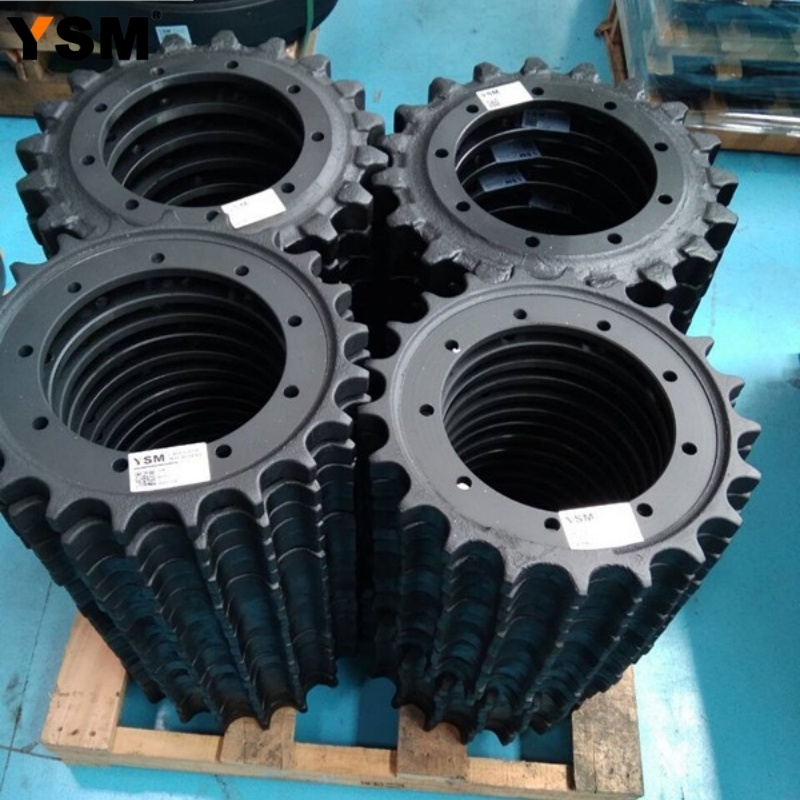
A segmented sprocket uses several curved, toothed sections bolted around a hub connected to the final drive. Together, those sections form the drive circumference. The tooth pockets engage the track-chain bushings so rotational torque becomes track movement.
The sprocket segment is a wear component, but it does not work alone. Tooth pitch, pocket geometry and side clearance must match the chain design. The hub and mounting faces must locate each segment correctly, and the final drive, track frame, guards, rollers and idler must keep the chain on the intended path.
The number, shape and fastening arrangement of segments vary by machine. A photograph of a similar bulldozer is not enough to confirm a part.
Bulldozer sprocket segment wear patterns
| Observation | Possible contributors | Next check |
|---|---|---|
| Rounded or thinned drive faces | Normal accumulated engagement wear, chain condition, direction of travel | Compare all teeth, both sides and the chain wear chart |
| Mushroomed metal in the pocket | Repeated bushing impact, poor seating, severe wear or packing | Pocket profile, bushing contact, tension and debris history |
| Sharp or hooked-looking tooth profile | Changed chain-to-sprocket engagement and advanced wear | Chain pitch, bushing outside diameter and exact wear limits |
| Polish or wear on one side of the teeth | Chain misalignment, guide wear, idler position, frame condition or side loading | Track path, guards, idler slides, rollers and frame alignment |
| Chipped tooth corner | High impact, hard material intrusion, misalignment or abnormal contact | Cracks, chain damage, packed rock and neighboring segments |
| One segment wears differently from the others | Loose mounting, damaged hub face, mixed part, previous isolated replacement | Part markings, mounting bolts, segment height and seat condition |
| Cyclic banging or chain jumping | Segment wear, chain wear, damaged bushing, stiff joint, packing or tension problem | Mark whether the symptom follows a chain joint or sprocket position |
Caterpillar's current dozer-maintenance guidance tells operators to look for mushrooming of iron in sprocket pockets during the walk-around. That is a useful clue, not a universal replacement limit. Exact wear judgment requires the correct measuring tool, reference points and chart.
Why do sprocket segments wear unevenly?
Chain and bushing condition
The bushings make repeated loaded contact in the sprocket pockets. Internal joint wear, external bushing wear, damaged joints and previous pin-and-bushing service can change that contact. One chain type should not be evaluated using another design's wear assumptions.
Track tension outside the machine specification
A track that is too tight increases undercarriage loads. A track that is too loose can alter engagement and increase instability. Packing changes the effective condition while the machine works. Use the operation and maintenance manual for the stated ground condition; do not apply a generic sag dimension.
Mud, clay, rock or frozen material in the sprocket
Packed material occupies space between bushing and pocket, forcing the chain outward and changing contact. Abrasive particles also act between loaded surfaces. Clean the undercarriage at the appropriate interval and stop if trapped rock creates impact or unstable engagement.
Misalignment and lateral loading
Side wear can be influenced by worn guides, a displaced idler, abnormal roller flanges, frame damage or repeated turning and side-hill work. Installing new segments without correcting the chain path can reproduce the same pattern.
Mixed parts or incomplete previous repair
A segment from another part family can look close but differ in pitch, bolt pattern, thickness, offset or tooth profile. Mixing new and heavily worn segments can also create a non-uniform circumference. Review the service history and compare every marking and dimension.
Loose segment bolts or damaged mounting faces
Loss of clamping can let a segment move against the hub, damaging bolt holes and seats. The resulting position error may affect tooth contact. Tightening a loose bolt does not prove that the joint remains serviceable.
Why sprocket segments and the track chain must be checked together
The chain and sprocket form a meshing pair. Nominal pitch, bushing diameter, tooth-pocket form, side clearance and wear state all influence engagement. A new segment set cannot restore a chain with damaged joints or geometry outside its service limits, and a new chain can wear rapidly against an incompatible or badly worn sprocket.
Caterpillar's current pins-and-bushings article explains how dozer bushings contact the sprocket and how service decisions depend on the specific sealed-and-lubricated track design. The described bushing-turn procedure and numerical details apply to the stated Cat application, not to every bulldozer.
Before replacement, record chain type, pitch by the approved multi-link method, bushing outside diameter, link condition and previous service. Inspect whether contact is even across the bushing width. If the chain has multiple dry joints, cracks, abnormal end play or extensive wear, plan the segment decision with the chain decision.
A safe sprocket segment inspection sequence
- Collect the history. Record operating material, travel direction, recent track adjustment, previous chain or segment work and when the symptom began.
- Clean enough to inspect. Remove packed material by the permitted method without directing damaging pressure at seals or joints.
- Perform a stationary walk-around. Look for broken teeth, cracks, loose bolts, metal debris, displaced segments and chain damage.
- Photograph the complete group. Capture both sprockets, each segment joint, the hub, chain entry and exit, and a side view of bushing engagement.
- Compare every tooth pocket. Record rounding, mushrooming, chips, side polish and differences between segments.
- Inspect the chain. Check bushings, links, joints, shoes and fasteners; measure only by the correct chart and procedure.
- Inspect alignment. Examine idlers, guides, rollers, carrier rollers, frame and track path for one-sided evidence.
- Verify track tension. Follow the exact machine procedure under the stated conditions.
- Check the final-drive area. Look for leaks, looseness or damage without dismantling beyond the authorized inspection.
- Escalate heavy work. Segment removal, chain restraint and hub repair require qualified personnel and proper tools.
Do not use tooth sharpness alone as the decision. Compare measured wear with the correct service data and assess the chain at the same time.
Inspect segment mounting bolts and the hub
Record the number and position of segments before removal. Inspect bolt heads, seats and exposed threads for movement, fretting, corrosion, impact or previous incorrect tooling. Check whether adjacent segment ends sit evenly and whether one piece stands proud of the group.
After safe removal, qualified personnel should inspect mounting faces for burrs, cracks, wear steps and elongated holes. A new segment must seat against a clean, serviceable hub. Do not grind the hub or enlarge holes to make an incorrect part fit.
Bolt and nut part numbers, reuse policy, thread preparation, tightening sequence, torque and any angle procedure are machine-specific. Generic fastener values are not a substitute for the service manual.
When should bulldozer sprocket segments be replaced?
Replacement planning is appropriate when measured pocket or tooth wear reaches the machine-specific limit; a segment is cracked, broken, loose or displaced; mounting holes or seats are damaged; engagement is unstable; or the segment set no longer matches a serviceable chain.
Do not assume one visibly worn segment should be replaced alone. The complete group should be measured and compared. Some service procedures require a full matched set so circumference, tooth geometry and material condition remain consistent. Other exact applications may have an approved localized procedure. Follow the serial-specific parts and service information.
Also decide whether the chain remains suitable. Installing a fresh segment group against bushings and joints that are outside specification can create poor seating and accelerated wear. If chain work is planned, confirm whether the correct service sequence includes segment replacement, bushing service or another matched action.
Stop operation immediately for a cracked or displaced segment, broken tooth that affects engagement, loose mounting that cannot be safely contained, repeated chain jumping, severe grinding or metal fragments. Continuing can damage the chain, hub, final drive and surrounding undercarriage.
Maintenance practices that help control segment wear
- Perform the daily walk-around and record pocket, tooth, bushing and bolt condition.
- Clean packed material from the sprocket and frame at the appropriate interval.
- Check track tension as soil and packing conditions change.
- Avoid unnecessary high-speed reverse travel and repeated abrupt direction changes where the job allows.
- Limit avoidable spinning, counter-rotation and side loading.
- Investigate one-sided tooth polish instead of waiting for severe material loss.
- Measure chain and sprocket with consistent tools, reference points and records.
- Keep parts, tightening and undercarriage-service records by machine serial number.
Operating practices influence wear, but they do not replace the exact maintenance schedule and limits in the machine's operation and maintenance manual.
Bulldozer sprocket segment fitment checklist
- Machine brand, complete model, series or suffix and serial number or PIN.
- Sprocket segment part number and all visible casting or forging marks.
- Number of segments in the complete group.
- Teeth per segment, bolt holes per segment and a clear profile photograph.
- Bolt-hole diameter, centre spacing, segment thickness, offset and requested reference dimensions.
- Hub photographs, mounting-face condition and final-drive configuration.
- Track-chain part number, chain type, pitch, link count and bushing outside diameter where requested.
- Photos of tooth contact, chain engagement, left and right undercarriages and machine plate.
- Quantity, whether matching hardware is required and destination country.
Do not rely on base model or tooth count alone. Serial changes, chain options, hub designs and previous conversions can affect fitment.
Frequently asked questions
What does mushrooming in a sprocket pocket mean?
It is displaced or deformed metal at the pocket contact area and is a recognized inspection clue. Its cause and replacement significance depend on chain engagement, wear measurements, packing and the exact service limit.
Can I replace only one worn sprocket segment?
Only if the exact service procedure permits it and the remaining segments, hub and chain measure within compatible limits. Many cases require assessment of the complete matched group.
Should new segments be installed with an old chain?
Not without measuring chain pitch, bushings and joint condition. Age alone is not the decision, but incompatible wear states can produce poor engagement.
Why is one side of the teeth shiny?
Lateral polish can indicate side contact from alignment, guide, idler, frame or operating conditions. Inspect the entire track path before replacing segments.
Are all segment groups on one dozer model identical?
Not necessarily. Series, serial range, market, chain option and previous undercarriage conversion can change the required part. Confirm with complete identification and dimensions.
Technical references
- Caterpillar: Dozer Undercarriage Maintenance — current walk-around guidance, including sprocket-pocket mushrooming, hardware, bushings, rollers and cleaning.
- Caterpillar: Top 3 Dozer Maintenance Tips — current tension, packing and sprocket inspection context.
- Caterpillar: Maintaining Your Dozer Track Pins and Bushings — current OEM explanation of bushing-to-sprocket contact for the stated track system.
- ITM Undercarriage Wear & Care — technical wear-pattern and system-inspection reference.
The operation, maintenance, service and parts information for the exact bulldozer controls safety, tension, measurement, bolt installation and replacement decisions.
Consult Our Bulldozer Undercarriage Parts Team
For sprocket-segment identification, chain matching or factory-direct wholesale enquiries:
Corporate Email: sales@china-ysm.com
WhatsApp: +86-18606961587
We supply bulldozer sprocket segments, track chains, track shoes and related track hardware, and can check matching idlers, track rollers and carrier rollers. Please send the machine brand, complete model and suffix, serial number or PIN, part number, clear photos, requested dimensions, quantity and destination country. Compatibility and availability must be confirmed before ordering.