
Bulldozer Track Chain Service Planning
Dozer Pin and Bushing Turn: What It Is and When It Makes Sense
A pin and bushing turn is a planned track-chain service used on certain fixed-bushing designs. The chain is opened with professional track-press equipment, the components are inspected, and the bushing is repositioned so a less-worn external surface engages the sprocket. The procedure is not suitable for every chain, and it cannot restore worn link rails, excessive internal pitch wear, failed seals or cracked components.
Quick answer
Plan a dozer pin and bushing turn from measured wear—not a fixed hour reading or tooth appearance alone. First identify the exact track design. Then measure external bushing wear, internal pitch, link-rail condition and sprocket engagement; inspect seals, joints, shoes and hardware; and compare the remaining usable material with the correct OEM wear chart. If the chain is too worn, cracked, dry in multiple joints or incompatible with the sprocket, replacement may be more appropriate than a turn.
What is a dozer pin and bushing turn?
In a conventional fixed-bushing track chain, the bushing is pressed into the link and does not rotate freely during operation. The sprocket repeatedly contacts a concentrated sector of the bushing's outside diameter. Over time, that sector loses material while another sector remains less worn.
During an approved turn, the chain is separated and the bushing is rotated—commonly by 180 degrees for the applicable design—so a less-worn surface faces the sprocket contact zone. Pins, seals and joint components are inspected and handled according to the chain procedure. The chain is then pressed back together to specified dimensions and tested.
The popular name can be misleading: the service is not simply turning loose parts by hand. It is a controlled rebuild operation involving press fits, joint geometry, seal integrity, lubricant condition and dimensional verification.
Which dozer track designs may allow a bushing turn?
| Track characteristic | Service implication | Required confirmation |
|---|---|---|
| Conventional fixed bushing in a sealed-and-lubricated track | May have an approved turn procedure | Exact chain family, wear chart, seal and assembly method |
| Rotating-bushing or cartridge-type system | May distribute wear during normal operation and may not use a conventional turn | Manufacturer's service strategy for that system |
| Dry track chain | Service options and allowable reuse differ | Pin, bushing, link fit and lubrication procedure |
| Extended-life or proprietary undercarriage | May use special coatings, seals or retention | OEM instructions and approved tooling |
| Unknown or previously rebuilt chain | Identity and prior machining must be established first | Part numbers, dimensions, markings and service history |
Caterpillar's current small-dozer guidance distinguishes a conventional SALT fixed-bushing design from an abrasion-track design in which the bushing can rotate during operation. This demonstrates why “turn every dozer chain” is not a safe general rule.
Why do dozer track pins and bushings wear?
External bushing contact with the sprocket
The sprocket loads the bushing as it enters, carries torque through and exits the pocket. Travel direction, pushing load, packing and sprocket condition influence where contact concentrates. A flat or reduced external diameter may develop on the loaded sector.
Internal pin-to-bushing articulation
As each joint articulates, internal surfaces carry load. Lubrication loss, seal damage, contamination and accumulated wear can increase clearance and pitch. Turning the external bushing surface does not remove internal wear.
Link-rail and roller-path wear
Link rails run on the bottom rollers and idler. If rail height or width is near its limit, investing in a bushing turn may not yield a balanced remaining service period. Side wear or snaking can also point to alignment or internal-clearance problems.
Operating and ground conditions
Abrasive soil, high impact, packing, frequent reverse travel, counter-rotation, slopes and long high-speed travel can change wear distribution. Records should include application and travel patterns, not only machine hours.
Measurements needed before deciding on a pin and bushing turn
| Measurement or inspection | Why it matters | Common mistake |
|---|---|---|
| External bushing diameter or wear depth at specified orientations | Shows remaining wall and sprocket-contact wear | Measuring only the least-worn side |
| Track pitch across the specified number of joints | Indicates internal pin-and-bushing wear | Measuring one joint or using the wrong track condition |
| Link-rail height and width | Shows remaining running-surface material | Judging rail life from appearance alone |
| Pin and bushing end condition | Can reveal seal loss, end play or retention issues | Ignoring hot, dry or displaced joints |
| Sprocket tooth and pocket profile | Must engage the post-service bushing correctly | Planning the chain without measuring the sprocket |
| Track-adjuster position | Provides context for chain length and available take-up | Treating maximum extension as proof by itself |
| Left/right comparison | Reveals operating, alignment or maintenance differences | Using one side to represent both |
Use the exact OEM or undercarriage-service chart. Wear percentages are calculated from defined new and service-limit dimensions; they are not interchangeable across chain families. The Cat article includes numerical examples for a stated small-dozer system, but those values must not be applied universally.
Record raw dimensions, units, tool type, reference points, chain condition during measurement and technician name. Photographs should show the gauge position so future measurements remain comparable.
When may a dozer chain be a candidate for turning?
A chain may be worth professional evaluation when it is an identified turnable design, external bushing wear is concentrated on the working sector, internal pitch remains within the applicable range, link rails have sufficient remaining material and the joints remain structurally sound.
Other favorable evidence can include:
- No cracked, bent or displaced links, pins or bushings.
- Seal and lubricant condition compatible with the approved rebuild method.
- No widespread dry joints, severe end play or loose retention.
- Sprocket and chain can be restored as a compatible wear pair.
- Track shoes and bolt holes are serviceable or included in the rebuild plan.
- Frame, rollers, idler, guards and alignment do not show an unresolved destructive pattern.
- The expected machine use justifies the labor and matched parts.
These conditions only justify measurement and planning. They do not guarantee that a turn will be accepted after dismantling.
When may a pin and bushing turn not make sense?
A turn may be unsuitable when the chain type does not permit it; the bushing wall, pin or internal pitch is beyond the applicable limit; link rails have little remaining life; links or bushings are cracked; counterbores or press fits are damaged; or seals and lubricant cannot be restored to the required condition.
It may also be a poor plan when:
- Multiple joints are dry, seized, loose or displaced.
- The chain has been mixed from different part families or repeatedly modified.
- Shoe seats and link holes are heavily elongated or cracked.
- Sprocket segments and other running components require a broader replacement.
- The cost of pressing, seals, pins, bushings, hardware and downtime approaches a more complete matched replacement.
- No correct tooling, wear chart or qualified rebuild process is available.
Do not use a fixed operating-hour threshold. Application, soil, machine configuration, direction of travel, maintenance and component design can produce very different wear at the same hours.
What does a professional pin and bushing turn process include?
The exact sequence varies, but a controlled workshop process normally begins with chain identification, cleaning, pre-measurement and marking. The chain is supported and opened at the approved master connection or specified joint with rated press tooling.
Qualified technicians then inspect links, pins, bushings, seals, thrust surfaces and bores. Reusable components are cleaned and measured. The bushing is repositioned according to the design; seals, lubricant and retention features are serviced exactly as required. Pins and bushings are pressed to specified protrusion, end play and alignment.
After assembly, the shop checks joint articulation, chain straightness, pitch consistency, seal condition and master-joint integrity. Track shoes and hardware are installed using the correct clean mounting surfaces, part numbers and tightening procedure.
This description is intentionally high level. Press forces, fixture dimensions, temperatures, lubricant fill, seal installation and protrusion values belong to the exact technical procedure and should not be improvised from a general article.
Match the turned chain with sprockets and the complete undercarriage
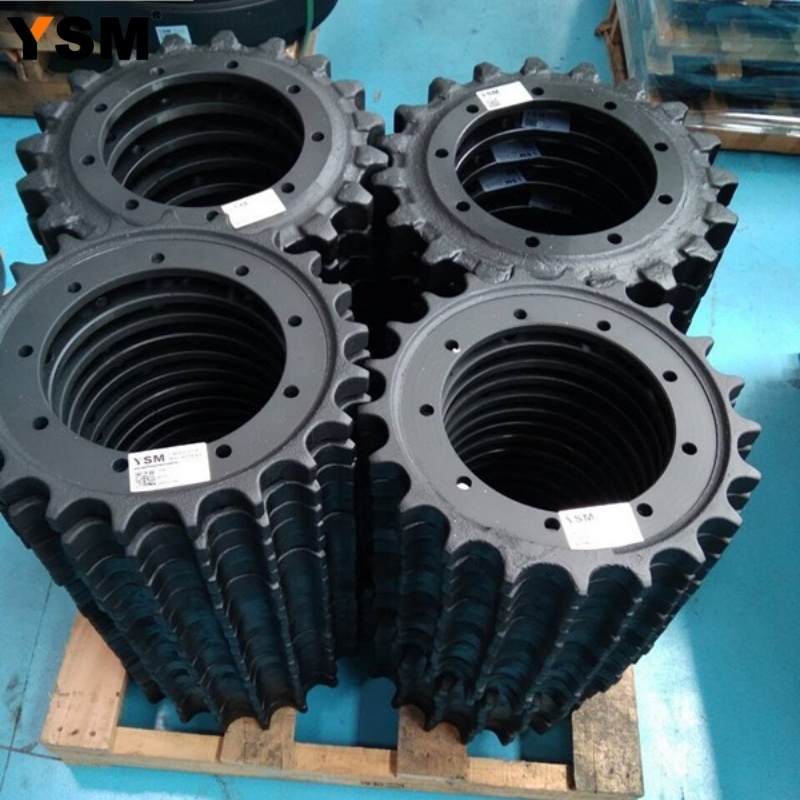
Rotating a bushing presents a different external surface to the sprocket. Existing hooked, mushroomed or uneven sprocket segments may not engage that surface correctly. Measure tooth pockets and side wear, and follow the approved chain-and-sprocket pairing recommendation.
Inspect every bottom roller and carrier roller for tread wear, flange contact, leakage and seizure. Check the idler for ridging, side movement and alignment. Confirm track guides, frame and tensioning system condition. A rebuilt chain running through a misaligned or heavily worn system can develop new side wear quickly.
Track tension must be reset using the exact machine procedure after installation and settling. Packed material can change effective tension during operation, so continue monitoring under actual site conditions.
Information needed for a chain rebuild or replacement quotation
- Bulldozer brand, complete model, series or suffix and serial number or PIN.
- Track-chain part number, chain type and any previous rebuild history.
- Track pitch, total link count and left/right measurements by the specified method.
- External bushing measurements at the required orientations.
- Link-rail height and width, pin and bushing end photographs and joint condition.
- Sprocket or segment part number, tooth-pocket photographs and measurements.
- Track-shoe width, grouser type, bolt pattern and hardware requirement.
- Photos of the machine plate, full undercarriage, chain, master joint, sprocket, rollers and idler.
- Operating material, expected future use, quantity and destination country.
Final suitability for a turn normally requires physical inspection after the chain is removed. A supplier can identify likely parts from evidence, but cannot confirm the internal rebuild condition from model name or exterior photos alone.
Frequently asked questions
Does every dozer track chain need a pin and bushing turn?
No. Rotating-bushing, cartridge, dry, sealed and proprietary systems have different service strategies. Identify the exact chain before planning work.
Is the bushing always turned exactly 180 degrees?
That is a common method for applicable fixed-bushing designs, but the exact position, pin treatment, seals and assembly dimensions must follow the chain procedure.
Can a turn fix a stretched chain?
It does not reverse internal pitch wear. If pitch is beyond the applicable service range, rotating the external bushing surface may not restore correct engagement.
Should sprocket segments be replaced at the same time?
They must be measured and matched with the serviced chain. The exact recommendation depends on sprocket wear, chain design and the approved maintenance plan.
Can pins and bushings be turned in the field?
The work requires controlled chain handling, rated press equipment, correct tooling and measurement. A specialist undercarriage shop is normally the appropriate environment.
Technical references
- Caterpillar: Maintaining Your Dozer Track Pins and Bushings — current OEM explanation of fixed and rotating bushing designs and the turn concept.
- Caterpillar: Dozer Undercarriage 101 — current undercarriage-design and application context.
- Caterpillar: Dozer Undercarriage Maintenance — current system walk-around, chain, sprocket, roller and tension guidance.
- ITM Undercarriage Wear & Care — technical wear patterns and measurement context.
Exact wear limits, turn eligibility, press procedure, sealing, lubrication and chain-to-sprocket pairing must come from the service information for the identified chain and machine.
Consult Our Track Chain and Undercarriage Parts Team
For track-chain identification, rebuild-part matching or factory-direct wholesale enquiries:
Corporate Email: sales@china-ysm.com
WhatsApp: +86-18606961587
We supply bulldozer track chains, pins and bushings as part of suitable chain assemblies, sprocket segments, track shoes and hardware, and can check matching idlers, track rollers and carrier rollers. Please send the machine brand, complete model and suffix, serial number or PIN, part number, clear photos, requested dimensions, quantity and destination country. Compatibility, availability and rebuild suitability must be confirmed before ordering or service planning.