
Excavator troubleshooting | Updated August 11, 2026
Excavator Track Chain Jumping on the Sprocket: Causes and Safe Checks
A bang, lurch or visible chain rise at the drive sprocket is a stop-and-inspect symptom. An excavator track chain may jump or climb because it is too loose, the chain pitch and sprocket profile are badly mismatched, a joint is stiff, debris is packing the drive area, or the running system is no longer guiding the chain correctly. It is not safe to assume that adding grease or replacing the sprocket alone will solve every case.
Quick answer
Stop loading the machine, park on stable ground and lower the attachment. Do not keep driving to “seat” a chain that is climbing a sprocket tooth. After safe isolation, clean the visible undercarriage and check track tension by the exact manual, sprocket tooth and bushing contact, chain pitch wear, stiff or damaged joints, roller and idler guidance, track-frame damage and packed material. Repeated jumping, cracked links, displaced shoes or an adjuster fault require qualified service before operation resumes.
What “jumping on the sprocket” usually looks like
The rear sprocket should pull the steel track chain through regular engagement between its teeth and the chain bushings. A jumping or indexing event occurs when a bushing does not settle into the expected tooth pocket and the chain briefly rises, shifts or drops into another position.
Operators may report a repeating knock, a sudden travel lurch, visible lifting at the sprocket entry point, or a problem that becomes worse during reverse travel or turning. Similar noise can also come from a damaged shoe, loose hardware, packed stone, roller defect or final-drive issue. The observation identifies an inspection area, not a confirmed cause.
Safe preparation before close inspection
Move only as necessary to reach stable, level ground. Lower the bucket or attachment, apply the parking brake, stop the engine and follow the manufacturer's isolation procedure. Allow hot components to cool. Keep clear of the chain, sprocket, idler and track adjuster.
A steel track can move suddenly as stored tension is released. Grease in the adjuster may be under high pressure, and the recoil spring stores mechanical energy. Do not loosen the relief valve, split the chain, lift the machine or remove heavy parts unless trained personnel are using the model-specific procedure and rated support equipment.
Six common contributors to an excavator track chain jumping
1. Track tension is too loose for the current condition
Caterpillar's current steel-track guidance notes that a track that is too loose can index and allow a link to jump sections. Excess slack reduces control of the chain as it approaches the sprocket, especially during direction changes, turning or travel over uneven ground.
Do not judge tension by appearance alone. The measurement position, track temperature, packing and carrier-roller layout affect the result. Clean the undercarriage and use the exact operation and maintenance manual; there is no universal sag value.
2. Chain pitch wear no longer matches the sprocket
Wear inside pin-and-bushing joints increases the effective distance from one joint to the next. The sprocket retains its own tooth spacing and profile, so an advanced pitch mismatch can push the bushings higher on the teeth rather than seating them smoothly. A new sprocket running against a severely worn chain—or a new chain on an unsuitable worn sprocket—may reveal the mismatch quickly.
Measure several chain sections with the correct wear method and compare the sprocket profile. A sharp or hooked-looking tooth is evidence for measurement, not a stand-alone replacement percentage.
3. One or more track joints are stiff
A stiff joint cannot articulate around the sprocket as freely as the other links. It may lift the chain locally and create a knock that returns when that joint reaches the drive end. Dry-joint signs, localized heat, displaced seals, abnormal spacing or a joint that stays angled on the upper run justify professional inspection.
4. Packed material or a trapped object changes engagement
Clay, frozen material, stone, scrap or wood can fill sprocket pockets or restrict the track frame. Packing may also tighten the track during work. Clean the system safely and look for impact marks before adjusting anything. Repeated packing may require a change in cleaning frequency, work route or guards—not simply more track grease.
5. The chain is not being guided in a straight path
Worn roller flanges, seized rollers, damaged track guards, an idler alignment problem, bent shoes, frame damage or severe side loading can shift the rail path. The chain may approach the sprocket off-centre and climb one side of a tooth. Compare the left and right undercarriages and inspect polished contact paths.
6. Incorrect or mismatched components
A chain with the wrong pitch, link count, rail width, master joint or shoe mounting arrangement may appear close enough until it is loaded. The same applies to an incorrect sprocket tooth count or offset. Confirm the complete machine model and suffix, serial/PIN, old part numbers, measurements and photos before replacing parts.
Use the pattern to choose the next check
| Observed pattern | Possible contributors | Next safe check |
|---|---|---|
| Jump occurs during direction change | Excess slack, pitch mismatch, stiff joint or load reversal. | Measure tension and chain pitch; mark and inspect individual joints. |
| Knock repeats once per chain circuit | Stiff joint, damaged link, bent shoe or localized debris. | Keep the machine stopped; identify the repeating section during controlled professional inspection. |
| Knock repeats once per sprocket rotation | Damaged tooth group, foreign material or sprocket mounting issue. | Inspect the complete tooth circle and mounting after isolation. |
| Chain climbs mainly on one side | Misalignment, guide/roller wear, bent frame or persistent side loading. | Compare rail paths, roller flanges, idler alignment and guard contact. |
| Problem began after new sprocket installation | Worn-chain pitch mismatch, incorrect sprocket or installation issue. | Verify part numbers and dimensions; measure chain and mounting. |
| Problem began after track work | Incorrect link count, wrong tension, master-joint issue or mismatched parts. | Review work records and complete fitment data before more travel. |
| Jump appears only in packed mud | Pocket packing or condition-dependent over-tension. | Clean completely, measure by the manual and improve debris management. |
No row confirms a failed part by itself. Several conditions often occur together on a worn undercarriage.
A practical undercarriage inspection sequence
- Document the symptom. Record travel direction, turning, slope, ground material, load, temperature and whether the sound repeats.
- Photograph both sides. Capture the complete track frame, rear sprocket, front idler, upper run and lower rollers.
- Clean visible packing. Remove accessible material without entering pinch points or damaging seals.
- Check track tension. Use the machine's exact parked condition, measurement points and limits.
- Inspect sprocket engagement. Look for bushings riding high, uneven contact, chipped teeth, pocket packing and side polish.
- Inspect chain joints. Look for cracks, dry-joint signs, displaced seals, stiff articulation and unequal spacing.
- Inspect rollers and idler. Check leakage, seizure, looseness, flange wear, abnormal heat and alignment contact.
- Inspect shoes and fasteners. Check bent plates, cracks, loose or missing bolts and unusual side wear.
- Check the adjuster area. Note grease leakage, idler position or damaged guards without releasing pressure.
- Escalate measurements. If the cause is not obvious, obtain a full undercarriage wear report and professional alignment/travel tests.
Why “just tighten the track” can be the wrong repair
If a clean track measures below the manual's slack range, correct adjustment may be part of the repair. But adding grease without measuring can over-tighten the chain, load joints and sprockets, waste power and conceal a worn-pitch problem only temporarily.
The apparent sag may also be influenced by packed material, a failed adjuster seal, restricted idler movement, incorrect link count or a stiff chain section. If tension changes quickly after adjustment or the idler position is abnormal, diagnose the adjuster and complete running system before returning the excavator to work.
Which parts may need replacement?
The inspection may identify one damaged item, but chain and sprocket engagement must be evaluated as a pair. Possible replacement categories include:
- track chain or complete link assembly;
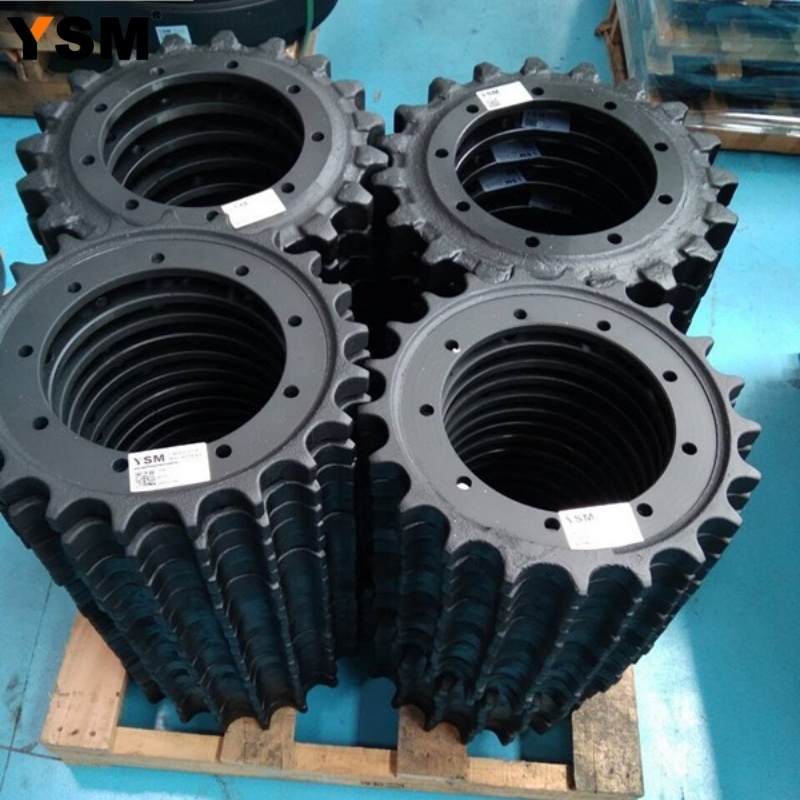
- sprocket or sprocket segments, depending on design;
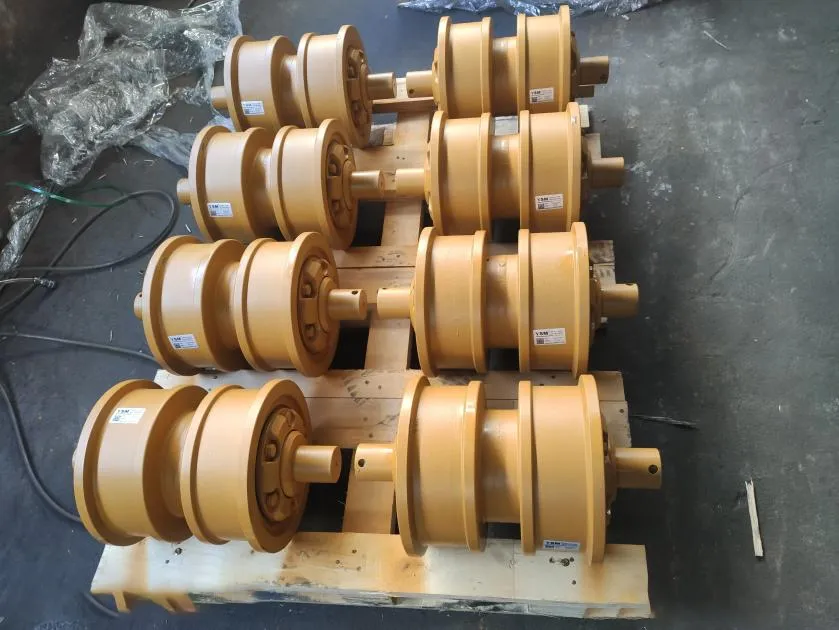
- track rollers or carrier rollers that are seized, leaking or out of profile;
- front idler or related guiding components;
- track adjuster or recoil components after qualified diagnosis;
- damaged track shoes, bolts, nuts or master-joint hardware;
- track guards or guides where the exact machine uses them.
Replacing only the sharpest-looking part may leave the underlying pitch, alignment or tension problem unchanged. Compare measured remaining condition and the expected interaction of new and worn surfaces.
Common mistakes to avoid
- Continuing to travel under load because the chain “only jumps in reverse.”
- Standing next to a moving sprocket to locate the sound.
- Adding grease before cleaning and measuring the track.
- Replacing a sprocket without measuring chain pitch.
- Assuming a new chain fits because the link count matches.
- Ignoring a stiff joint, seized roller or one-sided flange contact.
- Using a universal sag value copied from another excavator.
- Ordering from the model name alone without the serial/PIN and dimensions.
Fitment data for track-chain and sprocket inquiries
Send the following information before requesting replacement parts:
- machine brand, complete model and suffix;
- serial number or PIN, typed and shown in a clear plate photo;
- part name, position and existing part number;
- photos of the complete undercarriage, sprocket engagement, chain markings, master joint and mounting area;
- track pitch, link count, shoe count and shoe width using the requested method;
- sprocket tooth count and mounting dimensions where applicable;
- quantity, destination country and required supply scope;
- working condition and symptom: material, slope, travel direction, noise pattern and recent repairs.
Compatibility and availability must be confirmed from the complete model, serial number, part number, clear photos and requested dimensions before ordering.
Frequently asked questions
Can a loose excavator track jump the sprocket?
Yes, excessive slack can allow indexing or jumping, but worn pitch, sprocket profile, stiff joints, debris and alignment must also be checked.
Will tightening the track stop the jumping?
Only if measured tension is actually outside the correct range and no other fault remains. Over-tightening adds load and may accelerate wear.
Should I replace the sprocket when I replace the track chain?
Measure both mating components. A severely worn sprocket can harm a new chain, while a new sprocket may not mesh correctly with a chain whose effective pitch is advanced. The decision is condition- and model-specific.
Why does the chain jump only in reverse?
Direction reversal changes the loaded track run and contact pattern. Slack, uneven wear, a stiff joint, alignment or operating load may become more visible in one direction. It still requires a complete inspection.
Can I keep working if the track has not come off?
Repeated climbing or banging can precede derailment or additional component damage. Stop and determine the cause rather than using continued operation as a test.
Technical references
- Caterpillar: How to Maintain Cat Steel Tracks - current guidance on proper tension and loose-track indexing/link jumping.
- Caterpillar: Your Six-Step Excavator Maintenance Checklist - track tension and inspection of shoes, pins, chains, idlers, sprockets and fasteners.
- Caterpillar: What to Know About Excavator Undercarriage Maintenance - daily joint, hardware, sprocket and shoe checks.
- Volvo Construction Equipment: Excavator Tips to Minimize Wear and Tear - track-tension and operating-load context.
- Komatsu: Undercarriage Maintenance Tips - cleaning, correct adjustment and measured wear monitoring.
The operation and maintenance manual, parts catalog, wear charts and service procedures for the exact excavator and serial range take priority over this general guide.
Consult Our Undercarriage Service Engineers
For excavator track chains, sprockets, track rollers, carrier rollers, front idlers, track adjusters, track shoes, assemblies and related fasteners, send the machine brand, complete model and suffix, serial number/PIN, part name, part number, clear photos, requested dimensions, quantity, destination country and working condition.
Corporate Email: sales@china-ysm.com
WhatsApp: +86-18606961587
Final fitment, availability, pricing, delivery, warranty and supply scope require case-by-case confirmation. No universal interchangeability, OEM status or inventory claim is implied.