
Excavator Bottom Roller Troubleshooting
Excavator Track Roller Oil Leak or Normal Sweating? Inspection Guide
A dark mark around an excavator track roller does not always prove that the roller has failed. A small amount of lubricant can sometimes leave a thin, dust-bound trace near a floating seal, while a true leak stays wet, returns after cleaning or develops into drops. The correct decision comes from a repeatable inspection of the clean roller, its rotation, temperature, tread and flange wear, mounting, track-chain contact and the rest of the undercarriage—not from one dirty photograph.
Quick answer
Clean the suspected area, record where the oil appeared and observe it again after a controlled operating period. A light film that becomes dry and is quickly bound by dust may be normal seal sweating on some roller designs. A roller that remains freshly wet, forms a new track of oil or drops, stains the shoes after standing, runs hotter than comparable rollers, makes noise, develops a flat spot or stops turning needs qualified investigation. Do not drill, heat, refill or open a sealed roller in the field unless the exact service manual provides an approved procedure.
What does an excavator bottom track roller do?
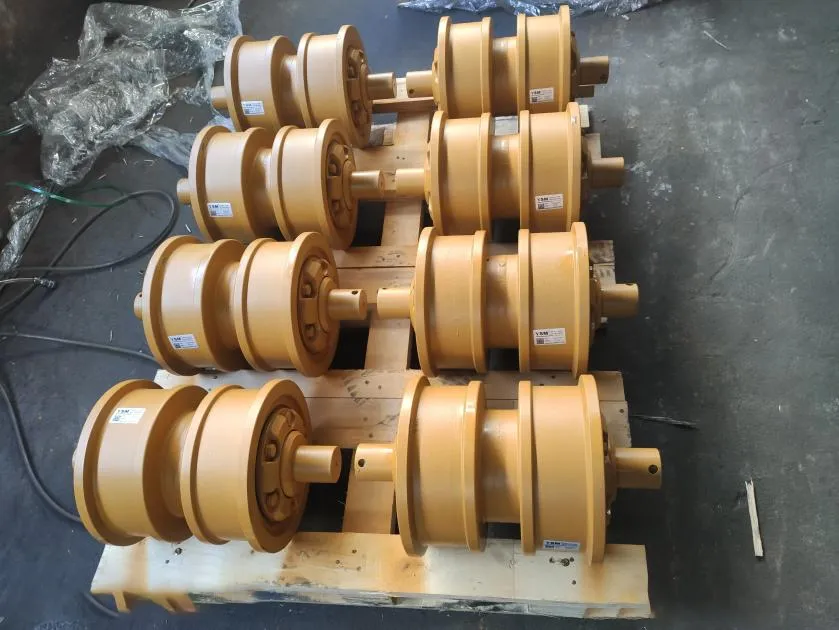
Bottom rollers—also called track rollers or lower rollers—are mounted beneath the track frame. Together, they carry the machine's operating weight onto the track-chain rails and help guide the chain through the lower run. This makes them very different from carrier rollers, which support the lighter return run above the frame.
A typical track roller contains a roller shell, shaft or axle, internal bearing or bushing surfaces, lubricant, mounting brackets and a sealing system. Many designs use metal-face floating seals energized by elastomeric rings. The faces operate with a controlled oil film while excluding abrasive soil and retaining the roller lubricant.
The roller works in mud, sand, water, shock and high contact load. Its outside tread and flanges wear against the chain rails, while the internal surfaces depend on correct lubrication and sealing. An external oil trace therefore deserves attention, but its pattern and progression matter.
Roller designs, oil quantities, plug locations, repairability and allowable leakage criteria differ. Some rollers are serviced as complete units; others have workshop procedures. The exact part and machine service information must control the decision.
Track roller sweating versus an oil leak
A Wirtgen product-support manual hosted as a John Deere company document distinguishes normal “sweating” from leakage. It explains that a floating-ring seal operates on an oil film, so a slight trace can appear under normal loading. It also describes a true leak as remaining wet and, at a more advanced stage, forming drops that can leave visible oil on the shoes after the machine stands.
| Observation after cleaning | Possible interpretation | Next action |
|---|---|---|
| Very light trace near the seal; dust binds it; area becomes dry | May be normal sweating for that roller design | Photograph, mark the area and monitor under the manufacturer’s criteria |
| Fresh wet line returns and stays wet | Possible active leakage | Compare after a defined operating period and arrange qualified inspection |
| Drop forms at the seal, bracket or plug | Stronger evidence of leakage | Stop unnecessary operation and identify the exact source |
| Oil collects on the shoe or ground after standing | Advanced or persistent loss is possible | Plan removal, repair evaluation or replacement |
| Dark stain is dry, thick and mixed with old mud | May be historic oil, grease or contamination from elsewhere | Clean completely and establish a new baseline |
| Visible fluid is watery, smells like fuel or comes from above | May not be track-roller oil | Trace the fluid to the machine system before ordering a roller |
These are screening clues, not universal pass/fail limits. A machine manufacturer may define its own inspection method. Ambient heat, wash water, recent service, dust level and operating time affect appearance, so document the conditions.
Where can fluid around a track roller come from?
Floating-seal area
Oil between the roller shell and bracket flange can originate at the floating metal-face seal. Contamination, damaged seal faces, incorrect installation, loss of elastomer loading, impact or abnormal internal movement may disturb sealing. The outside appearance alone does not reveal which internal condition is present.
Shaft or bracket sealing area
Some designs include an O-ring or other seal between the shaft and bracket. A wet path may follow the bracket rather than the rotating shell. Clean the complete end, not only the lowest drip point, because gravity moves oil away from its source.
Filling or inspection plug
If the roller has a plug, leakage can come from its threads or sealing surface. A loose, damaged or incorrectly sealed plug is different from a failed floating seal. Do not tighten it to a guessed torque or remove it before identifying the roller and approved procedure.
External machine leaks
Final-drive oil, hydraulic oil, grease from the track adjuster, engine fluids, wash products or spilled service oil can run along the frame and collect on a bottom roller. Dirt makes source tracing harder. Begin above the wet area and follow clean metal back to the highest fresh point.
Historic contamination
A previously replaced hose or overfilled component can leave residue that remains for weeks. Old deposits may soften after washing and look new. Cleaning and time-stamped photographs prevent an unnecessary roller replacement.
A practical clean-and-observe inspection sequence
- Record the as-found condition. Photograph the roller end, bracket, track frame and shoe below it. Note the date, machine hours, recent washing, material and temperature.
- Identify the roller position. Number the bottom rollers from the same end on both sides so records remain comparable.
- Park and isolate. Follow the operation and maintenance manual and site lockout procedure before approaching the undercarriage.
- Clean without damaging the seal. Remove mud and old oil with approved materials. Do not direct aggressive pressure into the seal area or scrape precision surfaces.
- Inspect the stationary roller. Look for cracks, loose or missing mounting hardware, damaged guards, plug condition, trapped debris and fresh metal contact.
- Establish a dry baseline. Use a clean cloth and, where permitted, place a clean absorbent card or pad below the suspected area while the machine stands.
- Operate only under a controlled procedure. Keep all people clear. Run the machine for the period and condition specified by the service plan; do not create an arbitrary high-load test.
- Reinspect consistently. Photograph the same angle and check whether the trace dried, returned, stayed wet or formed a drop.
- Compare neighboring rollers. Look for differences in oil pattern, temperature, rotation evidence, tread wear and flange contact.
- Escalate persistent findings. A continuing leak or associated heat, noise or seizure warrants qualified removal and testing.
Do not wipe the roller repeatedly without recording progression. The difference between a one-time film and continuous replenishment is one of the most useful observations.
Why does an excavator track roller develop a true oil leak?
| Possible cause | Evidence to look for | Related check |
|---|---|---|
| Abrasive contamination at the seal | Persistent wetness with packed fine material or scoring | Cleaning practice, mud guards and work environment |
| Impact or deformation near the seal guard | Dent, displaced cover or fresh strike mark | Rocks, demolition debris and guard clearance |
| Seal-face or elastomer deterioration | Leak returns from the seal area after cleaning | Age, temperature, material compatibility and service history |
| Incorrect assembly or contamination during repair | Early leak after rebuild or installation | Cleanliness, approved tooling, end dimensions and parts identity |
| Plug or shaft O-ring problem | Wet path begins at plug or stationary bracket joint | Correct seal, threads, surface and tightening procedure |
| Excessive internal clearance or damaged bearing surfaces | Heat, noise, wobble or uneven rotation with leakage | Workshop teardown and dimensional inspection |
| Overload from tension, misalignment or packing | Similar wear on chain rails, flanges or neighboring components | Track tension, idler/roller alignment, frame and operating conditions |
A leak may involve several causes. For example, a stone can deform a guard, disturb the seal and then allow abrasive slurry to accelerate damage. Replacing the roller without correcting the trapped-debris or alignment condition can repeat the failure.
Check the complete undercarriage before blaming one roller
The bottom rollers share load with the track chain, idler and sprocket. If one roller has a different effective diameter, is seized or is mounted out of line, the chain may not contact the remaining rollers evenly. Conversely, a worn or misaligned chain can accelerate roller flange and tread wear.
Measure track tension according to the exact excavator manual after removing packing. Too-tight and too-loose tracks both change component loading. Never copy a sag number from another machine or adjust tension only because a roller is wet.
Inspect link-rail height and wear pattern, pin and joint condition, idler alignment, carrier rollers, sprocket profile, shoe width, track guards and frame mounting. Compare left and right. A new roller installed among heavily worn rollers can carry a different share of the load, so the service plan should consider the complete roller set and chain condition.
Check whether the wet roller is at a position exposed to more debris or impact. Repeated failure at the same location can point to a guard, frame, travel habit or application issue rather than random component quality.
When should a track roller be monitored, repaired or replaced?
Continue structured monitoring
Monitoring may be appropriate when the trace is slight, becomes dust-bound and dry, does not progress, and the roller has no abnormal heat, noise, rotation, tread, flange or mounting finding—provided the manufacturer’s criteria allow it. Record the inspection interval and trigger for escalation.
Remove for workshop evaluation
A persistent fresh wet path, drop formation, repeated shoe staining, suspicious plug leak or unclear source can justify removal and a qualified leak test. Workshop procedures may include cleaning, controlled rotation, pressure or vacuum testing, teardown and dimensional inspection, but the method and pressure are design-specific.
Repair where an approved process exists
Some rollers can be rebuilt with specified seals, O-rings, internal components and lubricant. Successful repair depends on reusable shaft, shell, bracket and sealing surfaces; correct parts; clean assembly; approved tooling; fill quantity; and final testing. A field refill is not a substitute for repairing the loss path.
Replace when the unit is unsuitable for repair
Replacement may be necessary when the roller is sealed as a non-serviceable unit, structural or wear surfaces exceed limits, internal components have seized, the seal area is damaged, or a compliant repair cannot be verified. Match the replacement’s configuration and dimensions and inspect mating parts before installation.
Common mistakes to avoid
- Calling every dark mark a failed floating seal without cleaning and rechecking.
- Ignoring a roller that stays wet because it is still turning.
- Using touch alone to compare temperature or approaching a moving undercarriage.
- Adding grease or an unknown oil through a modified plug as a permanent repair.
- Heating a plug, seal or roller shell without an approved procedure.
- Replacing one roller without measuring the chain rails and neighboring rollers.
- Assuming single-flange and double-flange rollers can exchange positions.
- Ordering from a short machine model or photograph only.
Information needed when ordering an excavator track roller
Prepare the equipment brand, complete model including suffix, serial number or product identification number, required roller position, existing part number or casting mark, clear overall and seal-end photographs, requested dimensions, quantity and destination country.
Useful dimensions can include overall length, roller tread diameter, flange arrangement and diameters, mounting center distances, hole diameter, bracket width and any plug location. Use the supplier’s requested drawing because measurement reference points differ.
Also state whether the machine uses standard, narrow, wide or special shoes; whether the roller is single- or double-flange; the number and arrangement of rollers; and the condition of the chain rails. Machines sharing a familiar model name may use different undercarriage groups across serial ranges.
Compatibility and availability must be confirmed from the complete model, serial number, part number, clear photos and requested dimensions before ordering.
Frequently asked questions
Is a small oil mark on a track roller always a leak?
No. Some floating-seal systems can show a light oil trace or sweating. Clean the area and judge whether it dries or is continuously replenished, using the manufacturer’s criteria.
What is the clearest sign of a persistent leak?
A fresh wet path that returns after cleaning, remains wet, forms drops or repeatedly stains the shoe is stronger evidence than a dry dust-bound mark.
Can I refill a leaking roller and keep working?
Do not improvise. A refill does not correct the leak path or contamination, and many rollers require specific oil, quantity, sealing and test procedures. Obtain the exact service information.
Can mud make the roller look as if it is leaking?
Mud can retain historic oil, receive fluid from above and hide the true source. It can also obstruct rotation and damage sealing areas. Clean first and trace the highest fresh point.
Should all bottom rollers be replaced together?
Not automatically. Compare dimensions, remaining wear, position, chain condition and load sharing. A mixed set may be acceptable only when the manufacturer or undercarriage specialist confirms the wear balance.
Is a hot roller proof of oil loss?
No. Heat is an inspection signal. Packing, internal damage, misalignment, track tension and chain contact can also contribute. Compare similar rollers under the same conditions and use qualified diagnosis.
Technical references
- Wirtgen America Product Support Manual: Oil Leakage Assessment of Track Rollers — distinction between persistent leakage and functional sweating, and possible leak locations.
- Caterpillar: What to Know About Excavator Undercarriage Maintenance — current excavator undercarriage inspection, application and manual-reference context.
- Caterpillar: Your Six-Step Excavator Maintenance Checklist — current cleaning, tension and complete-component inspection guidance.
- Caterpillar: Dozer Undercarriage Maintenance — roller cleanliness, rotation and system-wear context; no dozer-specific dimension is applied to excavators.
- ITM: Undercarriage Wear & Care — roller, link, alignment and complete-system wear reference.
The operation and maintenance manual and service data for the exact excavator and roller take priority over this general educational guide.
Check Excavator Track Roller and Undercarriage Fitment
For track rollers, carrier rollers, front idlers, sprockets, track chains, track shoes and related hardware, send the machine brand, complete model and suffix, serial number/PIN, part number, clear photos, requested dimensions, roller position, quantity and destination country. Our team can review the identification information before a parts proposal is prepared.
Corporate Email: sales@china-ysm.com
WhatsApp: +86-18606961587
Final fitment, availability, pricing, delivery, warranty and supply scope require case-by-case confirmation. No universal interchangeability is implied.