
Crawler Excavator Maintenance
Excavator Undercarriage Mud Packing: Why Tracks Tighten and Wear Faster
Wet clay packed into an excavator undercarriage is more than a cleaning problem. Material can occupy the working clearance around the track chain, rollers, idler and sprocket, making the track behave tighter as the shift continues. It can also hide loose hardware, restrict a roller, add abrasive slurry and prevent a useful walkaround. The right response is to clean safely, inspect the complete system and check tension by the exact machine procedure—not to release grease or replace one part on sight.
Quick answer
If an excavator track appears tighter after working in mud, first stop on stable level ground and isolate the machine according to the operation and maintenance manual. Remove packing with approved tools while the track is stationary, then inspect both sides and measure track tension in the specified machine position. Do not adjust a mud-packed track to an arbitrary sag value: when the material is removed, the same chain may become too loose. Persistent tightness, a roller that will not turn, heat, metal debris, oil leakage, a dry joint or a track running against flanges requires qualified inspection.
Why does mud packing matter to an excavator undercarriage?
A track chain needs controlled slack and clearance as it travels around the sprocket, idler and rollers. Mud pushed into those spaces is repeatedly compacted by the moving chain. Caterpillar's dozer guidance explains the underlying system effect clearly: packed material can tighten a track and increase wear on moving components. The exact response on an excavator depends on its design and the material, but the same mechanical principle is relevant.
Packing does not literally shorten the steel chain. Instead, it can take up free space and force the track outward from normal contact paths. This raises load in joints and at the bushing-to-sprocket, link-to-roller and link-to-idler interfaces. A track that was correct when clean may therefore behave too tight after wet material accumulates.
Mud can create a second wear mechanism. Fine mineral particles suspended in water form slurry that moves across exposed steel surfaces. As water drains or evaporates, abrasive solids remain in pockets and gaps. Hardened clay can then resist roller rotation or break away in lumps. A frozen mass may lock components after an overnight temperature drop. The severity depends on soil composition, moisture, temperature, guards, travel pattern and cleaning interval.
Packing also blocks inspection. A layer over shoe bolts can hide loosening; material around a roller can conceal an oil leak; and clay in sprocket pockets can disguise abnormal tooth contact. Cleaning is therefore both a wear-control task and the first stage of diagnosis.
Where does material commonly accumulate?
| Location | Why packing matters | What to inspect after cleaning |
|---|---|---|
| Rear sprocket and final-drive pocket | Material is compressed as bushings enter and leave the teeth; track tension can change during the shift | Tooth profile, side contact, cracked or bent teeth, final-drive leakage and trapped stones |
| Above bottom rollers and inside track frame | Clay can hold debris against link rails and may restrict a roller | Roller rotation, flange wear, leaks, loose mounting and rail contact pattern |
| Carrier roller and upper frame shelf | Debris can build until the chain rolls over material instead of a freely rotating roller | Free rotation, flange contact, leakage, mounting and upper-chain alignment |
| Front idler and track-adjuster area | Packing can resist normal recoil movement or conceal abnormal extension | Idler side wear, slide alignment, leakage, recoil space and adjuster position |
| Between link, bushing and shoe openings | Wet fines and stones cycle through joints and hardware areas | Dry or stiff joints, seal area, cracked links, shoe separation and loose bolts |
| Track guards and rock guards | Guards may retain material in some soils instead of allowing it to escape | Bent guards, correct clearance, loose fasteners and polished interference marks |
The side with the most visible clay is not automatically the most worn side. Travel direction, slope, turning habit and material flow can distribute packing unevenly. Photograph and inspect both undercarriages from the same positions.
Common symptoms—and why one symptom is not a diagnosis
| Observation | Packing-related possibility | Other causes to rule out |
|---|---|---|
| Track appears tighter later in the shift | Clay has occupied clearance around the frame or sprocket | Measurement position, temperature, adjuster issue or incorrect earlier setting |
| Rhythmic thump or increased travel resistance | Hardened lumps or a roller prevented from turning | Stiff joint, damaged roller, bent guard, sprocket wear or foreign object |
| One area feels hotter after operation | Restricted roller or increased sliding contact | Bearing failure, dry joint, brake/final-drive issue or alignment problem |
| Fresh polished marks on link sides or flanges | Packing has pushed the chain off its usual path | Idler/roller alignment, bent frame or guard, excessive side loading |
| Track becomes loose after cleaning | An earlier adjustment may have compensated for packing | Internal chain wear, grease leakage, failed adjuster or measurement error |
| Track comes off | Packing and changing tension may contribute | Excessive looseness, worn guides, alignment, damaged idler/roller or operating technique |
Do not reduce a derailment, noise or hot roller to “just mud.” Packing may be the trigger, a contributor or only the material hiding an existing defect. The useful test is whether the observation disappears after safe cleaning and correct measurement, and whether any damage remains.
Wet clay, abrasive slurry and frozen packing behave differently
Sticky clay
High-plasticity clay adheres to frame shelves and is compacted in layers. It may be difficult to remove once dry. Operators should watch the undercarriage during the shift rather than assuming an end-of-week clean is adequate.
Sand-and-water slurry
Thin slurry may drain more easily but carry hard particles through exposed interfaces. A machine can look relatively clean while the contact surfaces still show accelerated abrasion. Inspect rail, roller and bushing patterns rather than judging only the amount of visible mud.
Organic or demolition debris mixed with mud
Wire, roots, cloth, plastic or sharp fragments can wrap around rotating components and hold clay in place. Do not pull entangled material by hand. Isolate the machine and use an approved removal method.
Freezing conditions
Water-bearing mud left overnight can freeze around rollers, shoes and the frame. Starting travel against frozen material may overload the drive and undercarriage. Follow the cold-weather procedure for the exact machine and remove packing before shutdown where the site requires it.
A safer excavator undercarriage cleaning and inspection sequence
- Choose the location. Use firm, level ground with drainage and enough clearance. Comply with environmental rules for contaminated soil and wash water.
- Park and isolate. Position the attachment, controls and machine exactly as the manual and site isolation procedure require. Prevent unauthorized start-up.
- Record the as-found condition. Photograph both sides, note material type, recent weather, travel direction, any noise and whether the track changed during the shift.
- Remove loose material from outside the hazard zone. Use manufacturer- and site-approved long-handled tools. Work from stable footing; do not place any part of the body between the track and frame.
- Expose inspection points. Clear the sprocket pockets, roller areas, carrier-roller shelf, idler and visible hardware sufficiently to inspect them. Do not damage seals, hoses, coatings or grease fittings.
- Use washing equipment cautiously. If the manufacturer and site permit water cleaning, control pressure and direction. Avoid forcing water and abrasive particles directly into floating seals, electrical connectors or joint sealing areas.
- Inspect before any adjustment. Look for leakage, trapped objects, components that do not turn, loose hardware, dry joints, cracks and fresh contact marks.
- Measure in the specified condition. Follow the exact manual for machine position, travel preparation, measurement points and acceptable range.
- Record the clean baseline. Document the final tension, adjuster position and defects. This makes the next muddy-shift comparison useful.
There is no universal cleaning interval. Cat's current excavator checklist recommends removing collected dirt and debris during shift maintenance, while its dozer guidance says frequency depends on the material. A short wet-clay task may require more attention than a longer shift in free-shedding sand. Base the interval on observed packing and the machine manual.
How should track tension be checked after mud removal?
Track-tension procedures vary by excavator size, undercarriage type and manufacturer. They may specify machine travel before measurement, a raised or grounded position, a particular span, and a sag or clearance range. Some systems also require a defined amount of grease release or addition. Use the operation and maintenance manual for the full model and serial range.
Do not copy a dimension from another excavator, a dozer article or an online video. Even machines of similar operating weight can use different track frames, carrier-roller arrangements and measurement locations. A generic “two fingers” or “several centimeters” rule is not a service specification.
If the clean track is out of range, determine why before adjusting repeatedly. Check for grease leakage at the adjuster, abnormal idler position, seized joints, damaged recoil components and accumulated chain wear. Track adjustment changes position; it does not repair wear or a failed seal.
When checking during a muddy project, use a consistent record: same machine position, same measurement method, similar material condition, left and right values, adjuster exposure and photographs. Trend data can reveal whether packing changes the apparent tension or a mechanical fault is progressing.
What parts should be inspected once the mud is removed?
Track chain, pins and joints
Look for dry, hot or stiff joints; seal-area leakage; displaced pins; cracked links; and abnormal gaps. Measure pitch using the approved multi-joint method when wear assessment is due. Mud alone does not prove the chain is worn out, and external cleanliness does not prove internal joints are healthy.
Bottom track rollers
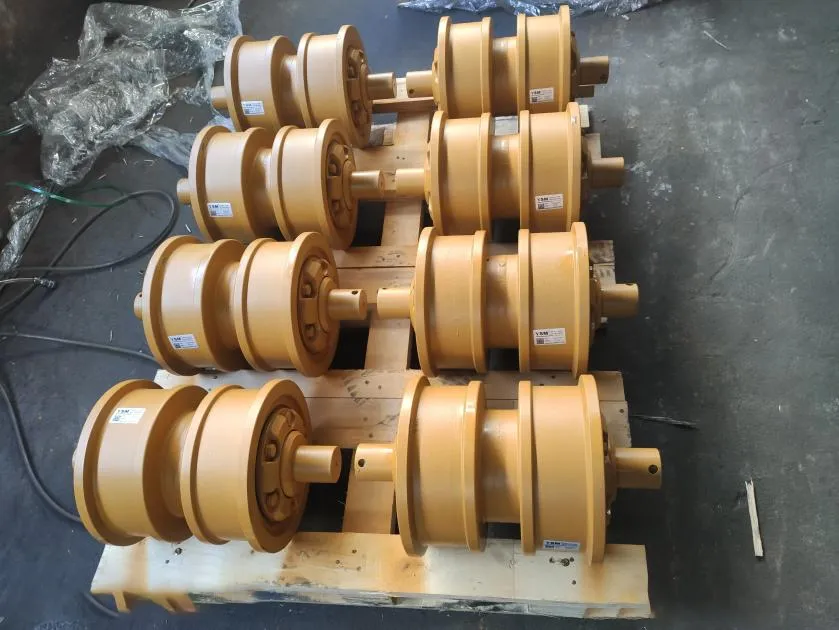
Check for oil leakage, loose mounting, damaged flanges and uneven tread wear. A roller that does not rotate should be investigated rather than assumed to free itself after cleaning. The chain sliding across a stopped roller can accelerate rail and roller wear.
Carrier rollers
Remove material from the upper frame shelf and verify the carrier roller is not clogged or leaking. Examine whether the upper chain runs centrally and whether flange contact is balanced.
Front idler and track adjuster
Inspect side wear, ridge formation, slide condition, alignment and recoil clearance. Grease around the adjuster may be normal residue, spillage or a leak; clean it and trace the source before deciding on parts.
Drive sprocket
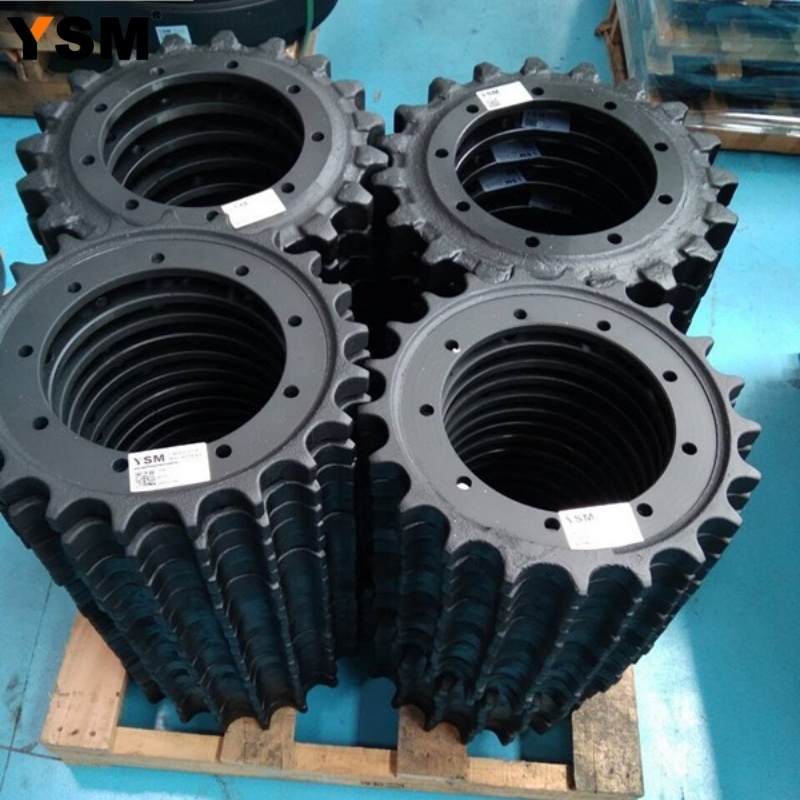
Clear every accessible pocket and inspect tooth shape, root contact, cracking and lateral polish. Chain pitch and sprocket wear develop as a system. Replacing only the visibly sharp component without measuring its mating chain can produce poor engagement.
Track shoes and hardware
Clean bolt heads and nuts so missing, loose or damaged hardware can be seen. Inspect bent or cracked shoes, grouser wear and separation between shoe and link. Use only the specified fastener procedure and torque for the exact hardware; do not tighten through heavy clay or reuse damaged components without approval.
Guards, frame and final-drive area
Look for bent guides, cracked mounts, packed debris, loose fasteners and fresh interference marks. Inspect final-drive leakage separately from water or mud staining. Correct the retention source as well as removing the material.
Operating habits that can reduce mud-related undercarriage stress
- Plan travel to reduce unnecessary distance, high-speed travel and repeated reverse cycles.
- Avoid spinning the tracks, aggressive counter-rotation and repeated turns in one direction where the job allows.
- Use the narrowest shoe that still provides the required flotation and stability for the application; excessive shoe width can increase leverage in firm or rough ground.
- Watch for a rapid change in engine load, track sound, visible sag or material discharge during the shift.
- Alternate working orientation when practical so one side does not receive all slope and turning load.
- Include packing observations in shift handover: material, location, cleaning performed and unresolved symptoms.
Do not deliberately run the track to “self-clean” while people are nearby. Any manufacturer-approved movement for inspection or tension equalization must be performed from the operator's position with the exclusion zone clear.
When should the excavator be stopped for qualified inspection?
- A bottom or carrier roller does not rotate, leaks oil or becomes abnormally hot.
- The track remains outside specification after cleaning, or the adjuster will not hold its position.
- A pin has moved, a link or shoe is cracked, or multiple joints appear dry or stiff.
- The chain rides against roller, idler or sprocket flanges with fresh heavy side contact.
- The track repeatedly derails, jumps at the sprocket or produces metal fragments.
- A guard, frame, idler mount or recoil component is bent, cracked or obstructed.
- There is final-drive leakage, unusual drive resistance or a new severe noise.
Stopping early can preserve diagnostic evidence. Continuing until the mud clears itself may turn a restricted roller, loose shoe or alignment problem into a chain-and-sprocket repair.
Information needed when undercarriage parts are required
After inspection, parts may include track chains, track shoes, shoe bolts and nuts, sprockets, front idlers, bottom rollers, carrier rollers or related track hardware. Availability and fit cannot be confirmed from operating weight or a short model name alone.
Prepare the equipment brand, complete model including suffix, serial number or product identification number, required part name, part number if available, clear overview and detail photographs, requested dimensions, left/right quantity, total quantity and destination country. For a chain or sprocket enquiry, include pitch measurement, link count, shoe width, mounting pattern and current mating-component condition where requested.
Different production ranges can use different undercarriage groups. A photograph that “looks the same” is not sufficient evidence of interchangeability. Final fitment should be checked against the machine identity and dimensional record before quotation or installation.
Frequently asked questions
Can packed mud make an excavator track too tight?
Yes. Material compacted into the frame, sprocket and roller areas can occupy clearance and make the track behave tighter. Clean and measure it by the exact machine procedure before adjusting.
Should I release track-adjuster grease before cleaning?
Not as a general response. The adjuster contains stored pressure, and releasing grease is a model-specific service procedure. Cleaning first helps show whether packing, an incorrect setting or a mechanical fault is involved.
Is a pressure washer safe for every undercarriage?
No universal answer applies. Follow the manufacturer and site rules. Control pressure and direction, and avoid driving abrasive water into seals, joints, connectors or other protected areas.
Why is the track loose after the mud is removed?
The previous setting may have been made while material occupied clearance, or the clean measurement may reveal chain wear or an adjuster problem. Inspect and use the specified procedure rather than restoring the mud-packed appearance.
Does cleaning stop all undercarriage wear?
No. It removes one contributor and enables inspection. Ground conditions, alignment, tension, operating habits, shoe selection and component condition still control wear.
Which parts should be replaced together?
That decision depends on measured remaining life and compatibility. Chain and sprocket engagement, roller and idler wear, shoes and hardware should be evaluated as a system instead of replacing the dirtiest or most visible item automatically.
Technical references
- Caterpillar: What to Know About Excavator Undercarriage Maintenance — current daily inspection, application and tension context.
- Caterpillar: Your Six-Step Excavator Maintenance Checklist — dirt-removal and component-inspection guidance.
- Caterpillar: Top 3 Dozer Maintenance Tips — OEM explanation of packing, tighter track behavior and moving-component wear; dozer-specific dimensions were not transferred to excavators.
- Caterpillar: How to Check Dozer Track Tension — supporting evidence that undercarriage layout changes measurement; no dozer dimension is used here.
- ITM: Undercarriage Wear & Care — wear, alignment and hydraulic-excavator tension reference.
- Hitachi Construction Machinery UK: Undercarriage 101 — recent 2026 context for adapting tension within the correct specification in muddy conditions.
Always give the operation and maintenance manual, service data and safety instructions for the exact machine priority over a general article.
Consult Our Undercarriage Parts Team
For excavator track chains, track shoes, sprockets, idlers, track rollers, carrier rollers and related track hardware, send the equipment brand, complete model and suffix, serial number/PIN, part number, clear photos, requested dimensions, quantity and destination country. Our team can check the information before a parts proposal is prepared.
Corporate Email: sales@china-ysm.com
WhatsApp: +86-18606961587
Final fitment, availability, pricing, delivery, warranty and supply scope require case-by-case confirmation. No universal interchangeability is implied.