
Excavator Undercarriage Parts Guide
Excavator Undercarriage Parts Explained: Names, Functions and Wear Signs
An excavator undercarriage is a connected drive, support, guidance and ground-contact system. The sprocket drives the track chain, the front idler guides it, bottom rollers carry the machine, carrier rollers support the upper track run, and track shoes transfer traction to the ground. Understanding these relationships makes inspection, fault reporting and parts ordering more accurate.
Quick answer: what are the main excavator undercarriage parts?
The main service parts are the drive sprocket or segments, track chain or link assembly, track shoes and fasteners, bottom track rollers, upper carrier rollers, front idler and the track adjuster with recoil spring. Track frames, guards and guides support or protect the system. The final drive supplies torque, but it is a separate drive component rather than a routine wear part in the same category as rollers, chains and shoes.
How an excavator undercarriage works as a system
The travel motor and final drive rotate the drive sprocket. Sprocket teeth engage the track-chain bushings and pull the chain around the undercarriage. The front idler guides the chain at the opposite end, while the adjuster moves the idler to establish the model-specified track sag. A recoil spring allows limited movement when the track encounters impact or packed material.
Along the lower run, track rollers transfer machine weight into the chain rails and shoes. Carrier rollers support and guide the upper return run so it does not drag on the frame. Track shoes bolt to the links and create the ground contact needed for traction, flotation and stability.
Because these parts share loads and contact surfaces, a visible symptom at one component may have more than one cause. A damaged roller, incorrect track tension, packed debris, misalignment or worn chain geometry can alter loads elsewhere. A complete inspection is more reliable than replacing the first worn-looking part.
Excavator undercarriage parts names and functions
| Component | Main function | Common inspection points |
|---|---|---|
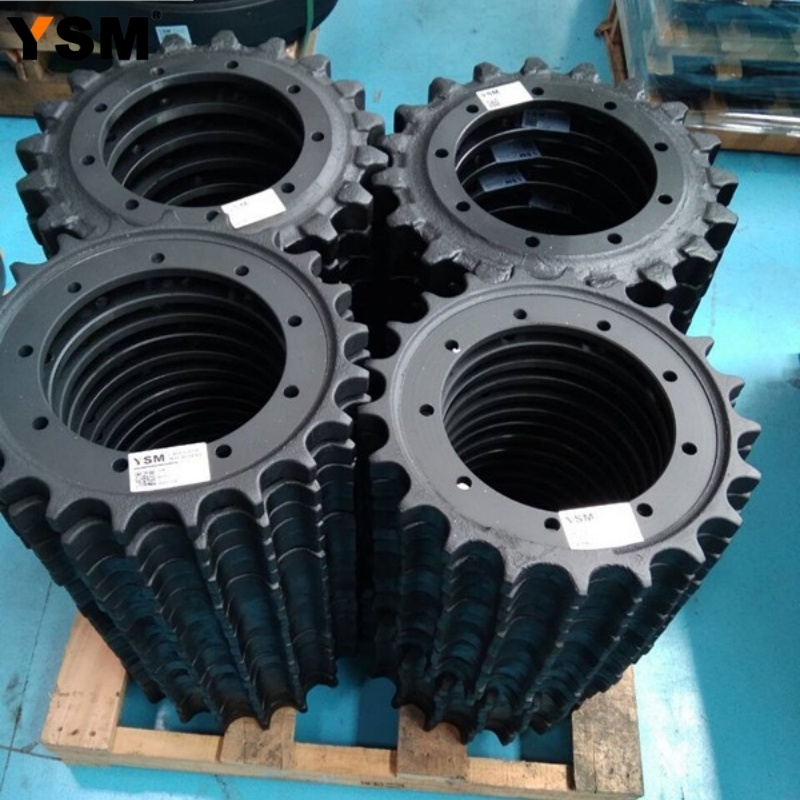
| Drive sprocket or sprocket segments | Receives torque from the final drive and engages the track-chain bushings to move the track | Tooth profile, cracks, loose hardware, uneven pocket wear and matching with chain pitch |
| Track chain or link assembly | Forms the continuous load-carrying loop around the sprocket, idler and rollers | Rail height, pitch growth, pin and bushing condition, dry joints, side wear and master joint |
| Track shoes | Bolt to the links and provide ground contact, traction, flotation and protection | Grouser wear, bent or cracked plates, shoe width, bolt seats and missing hardware |
| Track-shoe bolts and nuts | Clamp each shoe to the track links | Correct specification, looseness, movement marks, damaged threads and seating surfaces |
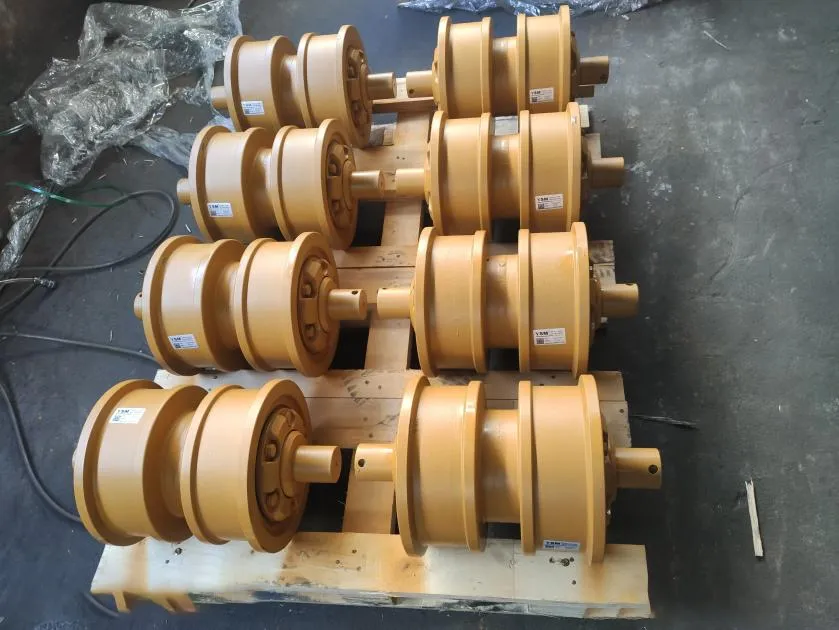
| Bottom track rollers | Carry the machine's operating weight and guide the lower chain rails | Oil leakage, flange and tread wear, rotation, abnormal heat, noise and alignment |
| Carrier rollers | Support and guide the upper return run of the chain | Oil leakage, seized rotation, tread wear, flange contact and material packing |
| Front idler | Guides the chain around the front of the frame and moves with the adjuster | Tread and flange wear, side clearance, leakage, alignment and smooth movement |
| Track adjuster and recoil spring | Positions the front idler for correct sag and absorbs some shock loading | Grease leakage, damaged cylinder or rod, restricted movement and model-specific sag |
| Track frame | Mounts the rollers, idler system and guards and carries structural loads | Cracks, deformation, damaged mounts, debris buildup and left-right alignment |
| Track guards and guides | Help control chain alignment and protect components in applicable configurations | Bending, missing bolts, rubbing marks, clearance and suitability for the application |
Component count and construction vary. Some excavators use a one-piece sprocket, while others use replaceable segments. Carrier-roller quantity, track guards, shoe profile and chain type also depend on the model, serial range and undercarriage option.
Track roller vs. carrier roller: what is the difference?
A track roller, also called a bottom roller or lower roller, sits below the track frame. It carries a large share of the machine's operating weight through the lower chain rails. Its tread and flanges must guide the chain while operating under impact, contamination and continuous rolling contact.
A carrier roller, also called a top roller or upper roller, sits above the track frame. It supports and guides the upper chain run. It does not carry the machine's ground load in the same way as a bottom roller. Ordering the wrong roller because both are called simply “rollers” is a common communication error.
When requesting either part, identify its position, mounting style and dimensions, and send a full-side photo of the undercarriage. A machine may use single-flange and double-flange bottom rollers in different positions, so one roller reference may not describe every position.
Why the sprocket, bushings and chain pitch must be considered together
Sprocket teeth repeatedly enter and leave the spaces around the track-chain bushings. As pins and bushings wear internally, the effective chain pitch can increase. The contact pattern then changes, and sprocket teeth and bushings may wear faster or engage less smoothly.
Installing a new sprocket against a severely worn chain, or a new chain against a badly worn sprocket, can create poor contact and concentrate loads. This does not mean every repair requires a complete undercarriage replacement. It means the technician should measure the mating components and compare them with the applicable service limits before choosing the repair scope.
Why track tension matters
A track that is too tight increases loads and friction throughout the system. A track that is too loose can increase impact, unstable engagement and derailment risk. The correct sag is not a universal number: it changes by machine, undercarriage design, carrier-roller arrangement and sometimes working conditions. Always use the procedure and value for the exact model.
Common wear signs and what to inspect next
| Observed sign | Possible inspection areas | Why a diagnosis needs confirmation |
|---|---|---|
| Oil around a roller or idler | Seal area, tread/flange wear, rotation, temperature and nearby debris | Residue can come from another source; clean and recheck before condemning the part |
| One roller is hot, noisy or not rotating | Roller seizure, bearing condition, packed material, chain alignment and track tension | Heat is an inspection signal; safe temperature comparison and manual procedures are required |
| Hooked, pointed or uneven sprocket teeth | Sprocket profile, chain pitch, bushing wear, tension and left-right wear pattern | Visual wear alone does not establish remaining service life |
| Squealing, dry joint or one hot pin end | Pin-and-bushing lubrication, seal condition, pitch and adjacent joints | Do not touch components immediately after operation; they may be dangerously hot |
| Track repeatedly loses alignment or comes off | Track sag, idler and roller flanges, guards, frame alignment, chain side wear and operating surface | Derailment is a system symptom, not proof that one named part is faulty |
| Loose shoes or shiny movement marks | Bolts, nuts, link mounting faces, shoe seats, tightening procedure and damaged holes | Repeated loosening may require more than simply retightening worn hardware |
| Uneven left-right or inner-outer wear | Operating pattern, slopes, turning direction, frame alignment, rollers, idler, guards and shoe choice | Different ground loading or travel habits can imitate a component fault |
Important diagnostic principle
Wear marks show where contact occurred, but not always why it occurred. Record the machine hours, ground conditions, travel pattern and whether the symptom appears on one side or both. Clean the undercarriage before comparing components, then measure rather than relying only on photographs.
A practical excavator undercarriage inspection order
- Park and isolate safely. Follow the machine manual and allow hot parts to cool.
- Clean the system. Remove packed soil and stones without directing damaging pressure at seals.
- Take full-side photos. Photograph both complete track frames before close inspection.
- Check track sag. Use the exact OEM procedure and working condition specified for that machine.
- Inspect shoes and hardware. Look for bent plates, cracks, missing bolts and movement around bolt seats.
- Inspect chain rails, pins and bushings. Compare both sides and note dry joints, pitch growth and side wear.
- Inspect sprocket engagement. Check tooth profile and the contact pattern with bushings.
- Inspect rollers and idler. Check leakage, tread and flange wear, alignment and free rotation where the approved procedure permits.
- Inspect frame, guards and adjuster. Look for cracks, bending, rubbing, leakage and restricted idler movement.
- Measure and record. Compare measurements with service limits for the model rather than using a universal replacement rule.
What information is needed before ordering undercarriage parts?
Model names alone are often insufficient because different serial ranges and optional undercarriages may use different parts. For a fitment check, prepare:
- machine brand, complete model and serial number or PIN;
- a clear machine nameplate photo;
- part name and installation position;
- part number or casting/marking photos, if available;
- full-side photos of the left and right undercarriages;
- close photos of mounting style, flanges, bolt holes and wear surfaces;
- requested key dimensions using a supplier measurement sheet;
- quantity, operating conditions and destination country.
For track chains and groups, also verify pitch, shoe width, shoe-hole pattern, link configuration and total link count. For rollers and idlers, mounting dimensions and flange geometry are important. For sprockets, confirm whether the machine uses a one-piece sprocket or segments and verify the matching chain specification.
Parts that can be checked as a coordinated undercarriage package
For suitable excavator and bulldozer applications, our undercarriage team can check track rollers, carrier rollers, front idlers, sprockets or segments, track chains, track shoes, complete track groups and related track fasteners. The recommended scope depends on measured wear and fitment data; it should not be assumed that every component must be replaced together.
Compatibility and availability must be confirmed from the complete machine information, part references, photos, dimensions and quantity before ordering. Parts that look similar are not automatically interchangeable across brands, models or production generations.
Frequently Asked Questions
What carries the weight of an excavator in the undercarriage?
The track frame and bottom track rollers transfer machine loads through the track-chain rails and shoes to the ground. Load distribution changes with machine position, attachment, working radius and ground conditions.
Is the front idler the same as the drive sprocket?
No. The front idler is normally a smooth guide wheel that moves with the track adjuster. The drive sprocket has teeth that engage the chain bushings and is driven by the final drive.
How can I tell a track roller from a carrier roller?
Bottom track rollers are mounted beneath the track frame and carry the machine through the lower chain rail. Carrier rollers are mounted above the frame and support the upper return run.
Can one worn roller damage other undercarriage parts?
A seized, leaking or badly worn roller can disturb chain guidance and load distribution, but the total effect depends on the machine and condition of the remaining system. Inspect track tension, alignment, chain rails and adjacent components before deciding the repair.
Should sprockets and track chains always be replaced together?
Not automatically. Their mating wear must be measured. A heavily worn chain and new sprocket, or the reverse, may engage poorly, so the repair decision should consider chain pitch, bushing condition, tooth profile and service limits.
Can I identify an undercarriage part using only a photo?
A photo helps identify the part family and visible mounting style, but final fitment usually requires the complete machine model, serial number, part number and key dimensions. Quantity and destination country are also needed for a supply check.
Technical references
- Caterpillar: What to Know About Excavator Undercarriage Maintenance
- Caterpillar: Your Six-Step Excavator Maintenance Checklist
- Caterpillar: Undercarriage for Excavators
- Hitachi Construction Machinery: Undercarriage 101
These references support general component and inspection principles. The operation manual, parts catalog and service data for the exact machine remain the authority for safety, dimensions, adjustment and wear limits.
Consult Our Excavator and Bulldozer Undercarriage Parts Team
For track rollers, carrier rollers, front idlers, sprockets or segments, track chains, track shoes, complete track groups and related track fasteners, we can help check suitable parts for many mainstream excavator and bulldozer applications.
Corporate Email: sales@china-ysm.com
WhatsApp: +86-18606961587
Please send the machine brand, complete model, serial number or nameplate photo, required part name, part number, clear photos, key dimensions, quantity and destination country. Compatibility and availability must be confirmed before ordering.