
Hitachi Zaxis-7 crawler inspection and parts planning
Hitachi ZX250LC-7 and ZX250LCN-7 Undercarriage Inspection Guide
Hitachi ZX250LC-7 and ZX250LCN-7 undercarriage parts should be identified from the complete model, serial number, original market, and installed crawler. The official UK product page groups the two models, while the European brochure distinguishes their configurations. Shared brochure coverage does not establish that every roller, chain, shoe, or mounting arrangement is interchangeable.
1. Confirm which ZX250-7 reference applies
Start with the machine plate and applicable documentation. Record LC or LCN, the serial number, market, attachment arrangement, and previous crawler work. Do not shorten the request to "Hitachi 250" and expect a reliable parts match.
The official UK page and standard European brochure are the model references used here. A US -7H preliminary specification, Japanese ZX240-7 family, earlier -5/-3, demolition straight-boom machine, or super-long-front machine should not be silently substituted for them.
This independent educational guide is not affiliated with or endorsed by Hitachi. Brand and model names identify the equipment. Sales information helps establish context; it does not replace a serial-specific parts catalog or service manual.
2. Use component counts as a cross-check, not a parts order
The checked standard European brochure groups the ZX250LC/ZX250LCN crawler with the following per-side counts. Verify the actual machine and applicable documentation before treating any difference as a defect or selecting parts.
| Component | Brochure reference per side | Still required for an inquiry |
|---|---|---|
| Upper rollers | 2 | Exact part and support arrangement |
| Lower rollers | 9 | Position, profile, mounts, and reference number |
| Track shoes | 51 | Shoe and chain identity, mounting, and actual count |
| Track guards | 3 | Location, shape, mounting, and configuration |
A matching count does not prove that an installed chain or roller belongs to the correct group. Conversely, an unexplained difference deserves investigation into documentation, previous repairs, conversions, or an incomplete count.
3. Establish a repeatable inspection record
Secure the excavator on firm level ground, lower the attachment, and follow its exact isolation instructions before close inspection. Clean the relevant areas and photograph both full crawler sides before taking component close-ups.
Give every finding a side and position. Record the date, operating hours, symptom, actual measurement if available, reference method, photograph, and next action. Mark uncertain causes as pending assessment instead of filling the report with assumed diagnoses.
Ask the operator when the symptom appears: after travel, in a particular material, during turns, or after an earlier repair. Keep those observations separate from the workshop conclusion. A clear history can narrow the investigation without pretending to prove the cause.
4. Review chain, shoes, and drive contact as a system
Chain identity and condition
Record markings, construction, connection arrangement, actual count, damaged links, and abnormal articulation. Obtain the correct measuring procedure for pitch and rail wear. Do not transfer a chart from another Hitachi generation.
Shoes and mounting joints
Record width, grouser profile, plate and mounting condition, loose or missing hardware, elongated holes, cracks, and movement marks. Establish whether the proposed repair concerns loose shoes, a bare chain, or a complete assembled track.
Drive engagement and guidance
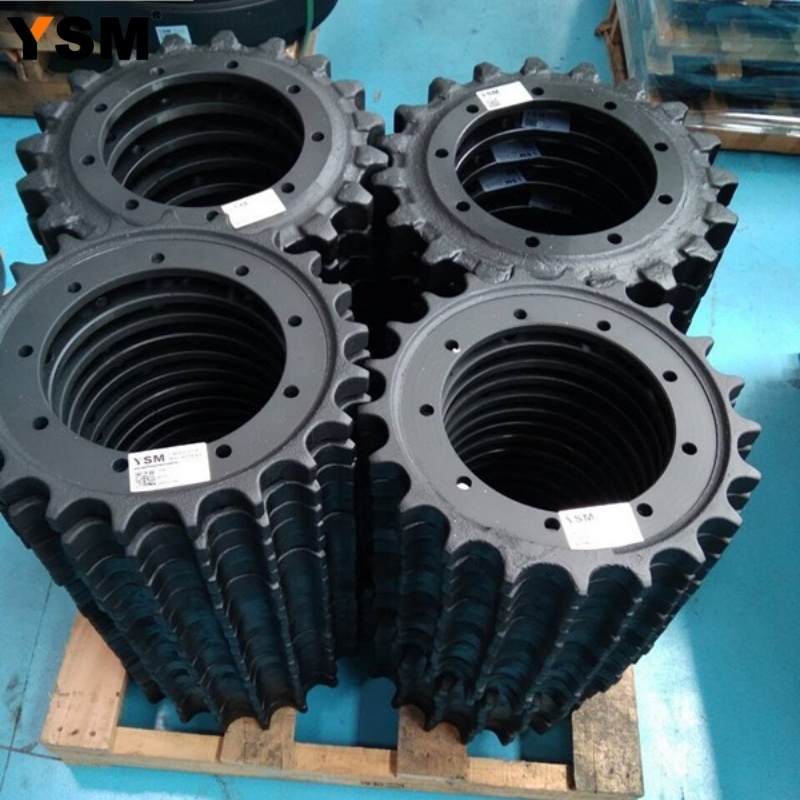
Include the sprocket and nearby guidance in the assessment. Look for abnormal contact patterns and damage, but do not diagnose a pitch mismatch from one photograph. Confirm the exact parts and relevant measurements before deciding which components belong in the replacement scope.
5. Give rollers, idlers, guards, and mounts their own checks
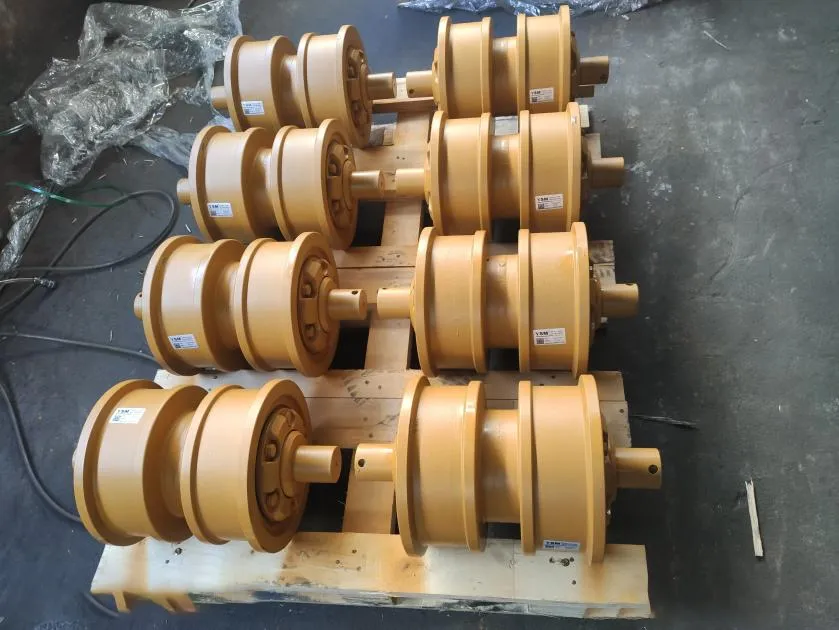
For a suspect bottom roller, photograph the side profile, both end mounts, installed position, and markings. Record the specified tread and flange measurements with the correct reference. Leakage, a flat running area, contact marks, or loose mounting are signals for assessment, not proof of one internal failure mode.
For upper rollers, retain the support and mounting details. For idlers, show the wheel together with its relevant support or guide arrangement. State whether the requested item is a wheel alone or a more complete assembly.
Inspect guard condition and mounting rather than assuming that more guarding or less guarding is always better. Do not remove or modify guards to make a substituted component fit. Frame or mounting damage may require attention independently of the replacement part.
6. Treat track adjustment as a stored-energy task
The European brochure describes grease-operated track adjusters with shock-absorbing recoil springs. This explains why a visual tension check must not become casual disassembly. Do not loosen, cut, heat, or dismantle a recoil assembly during a walk-around.
Use the exact manual for machine positioning, measuring location, adjustment procedure, limits, and precautions. A brochure does not provide a universal sag value or safe pressure-release method. If adjustment will not hold or the permitted range is in question, arrange qualified service.
General dealer guidance from SMS Equipment emphasizes complete inspection, cleaning, and correct manual-based adjustment. Use those principles without importing a Komatsu service value into a Hitachi crawler. Working conditions and repair history should remain attached to every reported measurement.
7. Prepare an inquiry that can be verified
- Full model, serial number, original market, machine-plate photo, and destination.
- Requested part name, installed location, part number, and quantity.
- Chain construction, actual count, connection, shoe width, and mounting pattern.
- Roller profile, support or end mounts, hole centers, mounting width, and relevant offsets.
- Idler guide arrangement, sprocket mounting evidence, and guard details when relevant.
- Inspection readings, measurement photographs, previous substitutions, and working material.
Ask the supplier to distinguish a confirmed match from a candidate still awaiting catalog or dimensional verification. Define included brackets, bolts, nuts, and assembly work. Do not approve a match only because an advertisement lists LC and LCN together.
The useful outcome is a traceable connection between the machine, the installed part, the inspection finding, and the proposed replacement. That is the basis for a reliable ZX250LC/LCN-7 crawler repair plan.
Frequently Asked Questions
Are ZX250LC-7 and ZX250LCN-7 crawler parts interchangeable?
Do not assume so. Verify the exact item from the serial-specific documentation, installed assembly, part reference, mounting geometry, and required dimensions.
Can the European brochure counts be used for every ZX250 machine?
No. They are reference counts for the described configurations, not a universal rule across markets, generations, special fronts, or field conversions.
Can a -7H or older -5 part listing be used for a -7 inquiry?
Only with confirmed applicable replacement evidence. Keep every suffix and generation intact until the exact match has been established.
Where should the track-sag and bolt-torque values come from?
Use the exact operation, maintenance, and service information for the machine and installed component. This guide does not provide universal settings.
Technical references
Check ZX250LC-7 or ZX250LCN-7 Undercarriage Supply Options
Our China-based manufacturing and wholesale supply team can review a defined parts inquiry after receiving the complete machine identity and installed-component evidence. Relevant items for individual fitment review include:
- track rollers and carrier rollers;
- idlers and sprockets;
- track chains, shoes, complete track assemblies, bolts, and nuts;
Corporate Email: sales@china-ysm.com
WhatsApp: +86-18606961587
Compatibility and availability must be confirmed from the complete model, serial number, part number, clear photos, and requested dimensions before ordering. Include quantity, destination country, and working conditions.