
Excavator Track Chain Fitment Guide
How to Identify an Excavator Track Chain: Pitch, Link Count and Fitment Checks
An excavator model name is a useful starting point, but it is not enough to identify every track chain. Machines within one model family can use different undercarriages by serial range, market, shoe width or application. A reliable parts enquiry combines the machine identification plate with physical chain measurements, clear photographs, visible part numbers and the condition of mating sprockets, rollers and idlers.
Quick answer
To identify a steel excavator track chain, record the brand, complete model, suffix and serial number or PIN; count every chain link; measure pitch using the correct multi-link method; record shoe width and bolt pattern; photograph the link profile, pins, bushings and master joint; and note all stamped or cast numbers. Confirm left and right sides and compare the proposed chain with sprocket, roller and idler dimensions before ordering.
Start with the excavator identification plate
Photograph the complete plate so the manufacturer, model, suffix, product identification number or serial number and market information remain readable. Do not crop away prefixes or suffixes. Compare the plate with the service record and machine structure, especially when the machine has been imported or rebuilt.
Record whether the undercarriage is standard, long, narrow, wide, low-ground-pressure or another approved configuration. Note whether the machine uses steel shoes, bolt-on rubber pads, rubber tracks or a special application package. A chain listing that names the same base model may still belong to another serial range or configuration.
Also record any previous conversion or field repair because the installed chain may no longer match the machine's original factory configuration.
Where an OEM parts catalogue is available, use the exact serial range to identify the original chain and alternative approved assemblies. Treat internet listings as leads, not final proof.
Track-chain terms buyers should know
| Term | Meaning | Why it matters |
|---|---|---|
| Pitch | Distance between corresponding centres of adjacent track pins, commonly verified over several intervals | Must match chain and sprocket geometry |
| Link count | Total number of chain links around one complete side | Determines assembled loop length with pitch |
| Rail height and width | Dimensions of the link surface that runs on rollers and idler | Affects guidance, load path and component matching |
| Bushing outside diameter | External dimension of the bushing that engages the sprocket | Influences sprocket contact and wear pairing |
| Shoe bolt pattern | Number, diameter and centre spacing of holes attaching each shoe | Must match track shoes and hardware |
| Master joint or master pin | Designed connection used to open and close the chain assembly | Identification and service procedure vary by design |
| Sealed or sealed-and-lubricated track | Joint construction and lubrication system | Changes chain design, maintenance and replacement choice |
How to measure excavator track-chain pitch
Pitch is normally defined from pin centre to pin centre, but measuring one worn joint can produce a misleading result. Use the exact OEM procedure where available. Professional methods commonly measure a span across several pitch intervals on a straight, correctly conditioned section of chain, then divide the total span by the number of intervals.
- Clean enough of the chain to see the pin centres or specified reference points.
- Position or tension the chain exactly as the service procedure requires.
- Select a straight section and mark the first and last reference pins.
- Count the pitch intervals between those reference points, not merely the visible pin heads.
- Measure the total centre-to-centre span with a suitable steel rule or tape.
- Calculate average pitch as measured span divided by pitch intervals.
- Repeat at another section and record every raw measurement.
Do not publish one fixed number of links or one wear limit as universal. Measurement length, track loading, reference points and allowable wear depend on the chain design and service data. Heavy wear, stiff joints or damaged pins can create inconsistent readings.
State the unit clearly. Cross-border enquiries often mix millimetres and inches. Include a photograph showing both endpoints and the tool scale so the supplier can verify how the number was obtained.
How to count excavator track links correctly
Clean one side of the chain and mark a single starting link with chalk or removable paint. Move around the complete loop in one direction and count each full link once. Use photographs or a second person to verify the count. Do not count only track shoes unless every shoe and link relationship has been confirmed and no shoe is missing.
Record the left and right counts separately. They should not be assumed identical on a repaired or modified machine. A difference requires investigation, not immediate correction. Check whether a link was removed, a replacement chain was installed, or the undercarriage differs from the original specification.
Link count and pitch work together. Two chains can share the same pitch but have different link counts, and two chains with the same count can have different pitch and link geometry.
Measure track-shoe width and mounting pattern
Measure the overall shoe width at the specified location and identify whether it is single, double or triple grouser, flat, rubber-padded or another design. Record plate thickness and grouser height if they are part of the enquiry. Shoe width affects flotation, transport width and load on the chain.
For the mounting pattern, record the number of holes per shoe, centre-to-centre spacing in both directions, hole diameter, seating style, bolt diameter and visible hardware markings. Photograph the underside or mounting face when safely accessible. Worn or elongated holes can distort measurements, so use several shoes and compare them.
A shoe that looks correct from above may not seat on the proposed link. Do not order by width alone.
Record the link profile, rail and bushing dimensions
Track links with similar pitch may have different rail height, rail width, bushing outside diameter, pin diameter, link offset, shoe seat and bolt pattern. These differences affect roller, idler and sprocket contact.
Use calipers, micrometers or depth gauges suitable for the dimension. Measure at the location shown in the applicable drawing or wear chart. Separate new-part identification dimensions from wear measurements: a heavily worn rail or bushing may no longer represent the original nominal size.
Photograph the link from the outer side, inner side, top, shoe seat and bushing end. Include a scale reference without covering the feature. Record whether the chain has dry, sealed, grease-lubricated or oil-lubricated joints when identifiable from reliable parts information.
Use part numbers and photographs as combined evidence
Search for stamped, cast or forged markings on links, shoes and master components. Clean them carefully and photograph the full part plus a close-up. Record every character exactly, including spaces, prefixes and suffixes. Do not assume a casting number is the complete sales part number.
One number can be superseded or shared across related assemblies. Confirm it against the machine serial range and dimensions. If the marking is incomplete, provide several photographs with side lighting rather than guessing missing characters.
A useful photo set includes the nameplate, full left and right undercarriages, sprocket, idler, roller path, chain side profile, pin and bushing ends, master joint, shoe top and mounting pattern.
Check sprockets, rollers and idlers before ordering a new chain
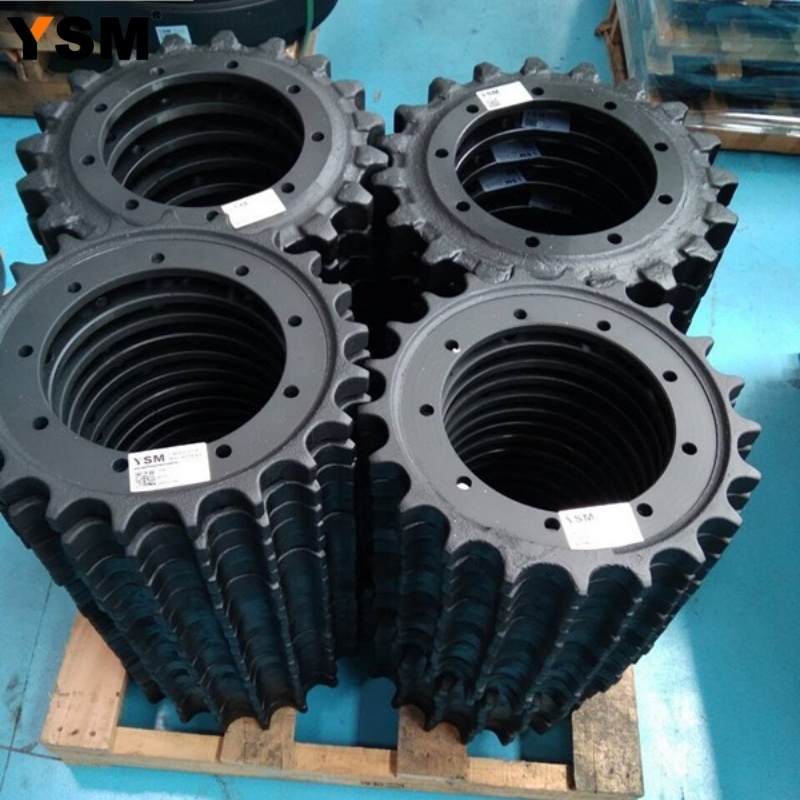
The sprocket must match the chain pitch, bushing diameter and engagement profile. Count sprocket teeth where required, photograph the tooth form and record whether it is one-piece or segmented. Thin, hooked or uneven teeth may not engage a new chain correctly.
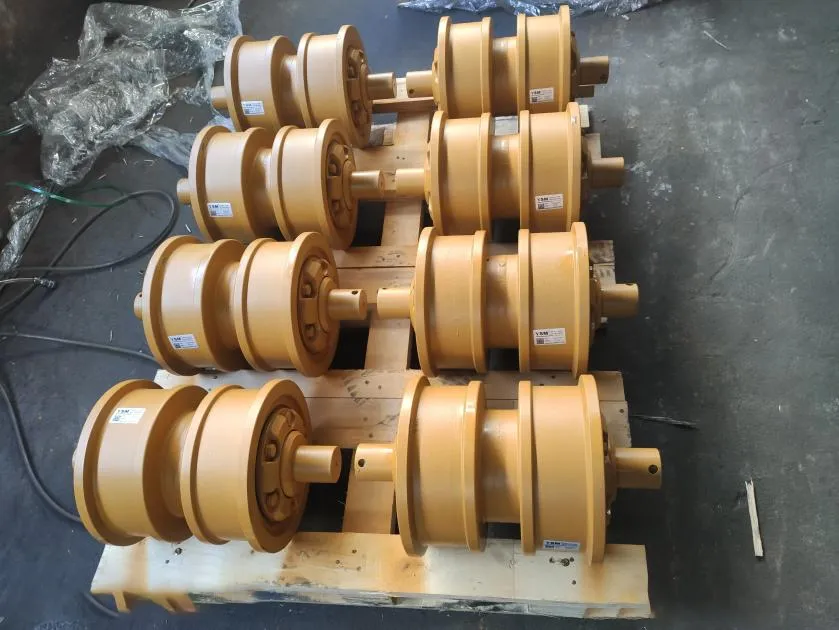
Roller and idler treads guide and support link rails. Measure relevant tread and flange dimensions and inspect for leakage, flat spots, ridging and side wear. A link rail that is too wide, narrow or differently offset may not run correctly even when pitch appears similar.
Inspect track guards, idler slides and frame clearance. If the machine has been modified, record those changes. A new chain cannot correct a bent frame, seized roller or misaligned idler.
Common excavator track-chain identification mistakes
- Ordering by model name only: serial ranges and undercarriage options can differ.
- Measuring one worn pitch: local pin and bushing wear can distort the result.
- Counting shoes instead of links: missing or unusual shoe arrangements can create errors.
- Using shoe width as the chain size: the same width can be mounted to different chains.
- Ignoring units: millimetres and inches must be labelled and converted carefully.
- Guessing a worn part number: send multiple photos and supporting measurements.
- Ignoring the opposite side: repaired machines may carry non-matching assemblies.
- Ignoring sprocket wear: a new chain and worn sprocket can engage poorly.
- Assuming universal interchange: similar appearance does not prove fitment.
Track-chain information required before ordering
| Required information | Preferred evidence | Purpose |
|---|---|---|
| Brand, full model, suffix and serial number or PIN | Complete nameplate photo | Establish serial-range fitment |
| Track-chain part number | Clear marking and full-part photo | Cross-check catalogues |
| Pitch and link count | Measurement photos and marked counting start | Verify basic chain geometry |
| Shoe width and bolt pattern | Dimensioned photos or drawing | Confirm shoe mounting |
| Link, pin and bushing dimensions | Caliper photos and raw values | Separate similar chains |
| Sprocket, roller and idler condition | Full photos and wear measurements | Plan compatible replacement |
| Quantity and destination country | Written enquiry | Prepare the correct commercial review |
We can review track chains or track links, track shoes, track groups, sprockets or segments, track rollers, carrier rollers, front idlers and related fasteners for suitable excavator and bulldozer applications. Compatibility and availability must be confirmed from the complete model, serial number, part number, clear photos and requested dimensions before ordering.
Frequently asked questions
What is excavator track-chain pitch?
It is the repeating pin-to-pin spacing of the chain. For identification and wear checks, it is often measured across several intervals using the applicable service method.
Is link count the same as track-shoe count?
Not always safe to assume. Count physical chain links and verify the shoe arrangement, especially if shoes are missing or the assembly was modified.
Can two excavator models use the same track chain?
Some applications may share parts, but fitment must be confirmed by serial range, part number, dimensions and mating components. Similar operating weight does not prove interchangeability.
Why measure several pitches instead of one?
A longer span reduces the influence of one local measuring error and shows average joint spacing. Use the exact number of intervals and chain condition required by the service method.
Can I identify a track chain from photographs only?
Photos help, but machine identity, pitch, link count, shoe pattern and key dimensions are normally needed. A casting number or visual profile alone may be ambiguous.
Should I order sprockets with a new track chain?
Measure and inspect the existing sprockets. Replacement depends on tooth profile, engagement, chain condition and the maintenance plan, not an automatic rule.