
Model and undercarriage-system identification
Komatsu D85EX-18 Undercarriage: Conventional vs PLUS Inspection Guide
A Komatsu D85EX-18 may be discussed with a conventional lubricated track arrangement or the optional PLUS Parallel Link Undercarriage System with rotating bushings. Those descriptions are not interchangeable parts labels. Before measuring wear, planning a repair, or requesting components, identify the exact machine, serial range, and installed track system. Then inspect the chain, rollers, idler, sprocket segments, shoes, guards, and suspension as one system.
1. Identify the exact D85EX-18 before inspecting parts
Komatsu's current D85EX-18 page describes a large low-drive dozer with an oscillating equalizer bar and pivot shaft, lubricated rollers and idlers, seven lower rollers per side, and single-grouser shoes in the listed standard configuration. It also describes the PLUS rotating-bushing undercarriage as an option. Related D85EX, D85PX, EXi, PXi, waste-handler, regional, and serial-range configurations should not be treated as automatically identical.
Record the complete model and suffix, serial number or PIN, regional version, shoe width and type, blade and rear-equipment configuration, and any readable numbers on chains, rollers, idlers, or sprocket segments. Photograph both track groups. Ask whether the undercarriage has been converted, partially rebuilt, or assembled from mixed sources. A past repair may be more relevant than the original sales specification.
This is independent educational content and is not affiliated with or endorsed by Komatsu. The brand, model, and PLUS name are used only to identify the equipment and system discussed.
2. Conventional versus PLUS: what the labels mean
A conventional sealed and lubricated dozer track uses pins and bushings that articulate as the chain travels around the sprocket and idler. Maintenance and repair decisions depend on the actual design, measured wear, and service information. Some conventional systems may have a pin-and-bushing turn strategy, but that is not a universal instruction for every chain or wear condition.
Komatsu describes PLUS as a Parallel Link Undercarriage System with rotating bushings and states that its design does not require a conventional pin-and-bushing turn. This does not mean the system is maintenance-free, immune to wear, or compatible with every conventional component. It still requires cleaning, inspection, measurement, correct tension, and system-matched parts.
| Question | Conventional lubricated track | PLUS rotating-bushing system |
|---|---|---|
| Can the label be confirmed by model name alone? | No. Confirm the installed chain and serial information. | No. Verify the actual installed PLUS arrangement and records. |
| Should a pin-and-bushing turn be assumed? | Only if the exact system, wear condition, and service guidance support it. | Komatsu describes PLUS as not requiring a conventional turn. |
| Can individual components be mixed between systems? | Do not assume interchangeability. Check the complete system, part numbers, dimensions, and authorized technical data. | |
| Does either system eliminate inspection? | No. Inspect wear, seals, joints, engagement, tension, and mating parts. | No. Inspect rotating-bushing behavior, wear, seals, engagement, tension, and mating parts. |
The table is an identification guide, not a parts catalog. Serial breaks, revisions, and conversions require machine-specific confirmation.
3. D85EX-18 undercarriage inspection checklist
Park on stable, level ground, lower the blade and ripper, apply the parking controls, shut down the machine, and isolate energy according to the exact manual. Keep people clear of the track path. The recoil spring and grease-adjustment system contain stored energy; adjustment and disassembly require trained personnel and the approved procedure.
Clean both track frames
Remove enough mud, rock, clay, waste, ice, or packed soil to reveal moving and contact surfaces. Packing can restrict rollers and idlers, alter measured tension, block drainage, or hide cracks and leakage. Record the ground material because it helps explain changes between inspections.
Track chains and joints
Look for cracked links, damaged seals, stiff joints, abnormal side wear, uneven rail profile, bushing damage, and inconsistent articulation. On a claimed PLUS system, verify the installed design from reliable identifiers rather than assuming every visible bushing behaves like a PLUS bushing. On any system, localized heat or noise calls for wider inspection of tension, packing, alignment, seals, and mating parts.
Track rollers and carrier rollers
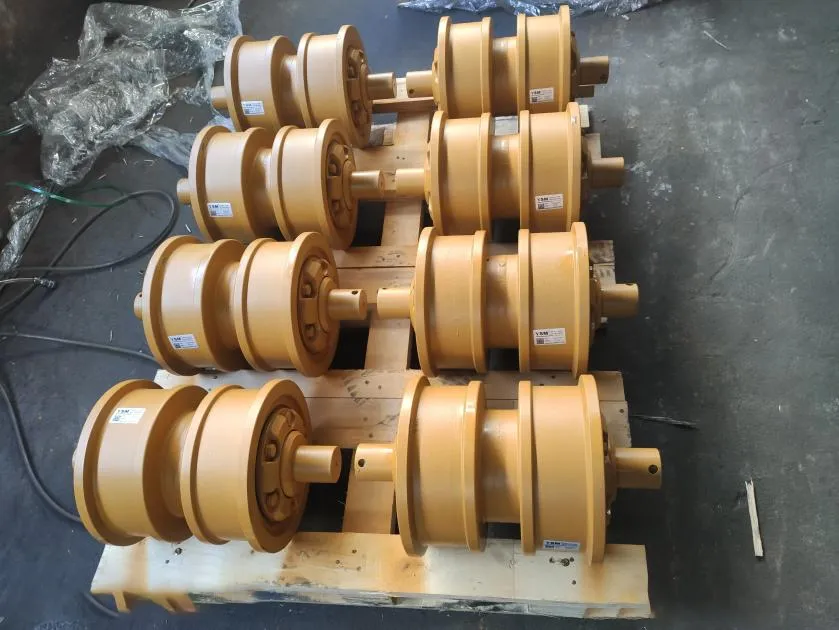
Inspect each position for leakage, shell or flange damage, loose mounting hardware, abnormal contact, flat wear areas, and rotation. Compare matching positions on both sides. The official specification lists seven lower rollers per side for the current D85EX-18 configuration shown, but the actual machine and serial data remain controlling.
Front idler, guides, and adjuster
Check the idler tread, flanges, leakage, guide surfaces, lateral movement, mounting condition, and relative position in the frame. Repeated tension loss or derailment may involve the adjuster, seals, guides, chain, packing, alignment, or another component. Do not repeatedly add grease without finding the cause.
Sprocket segments and engagement
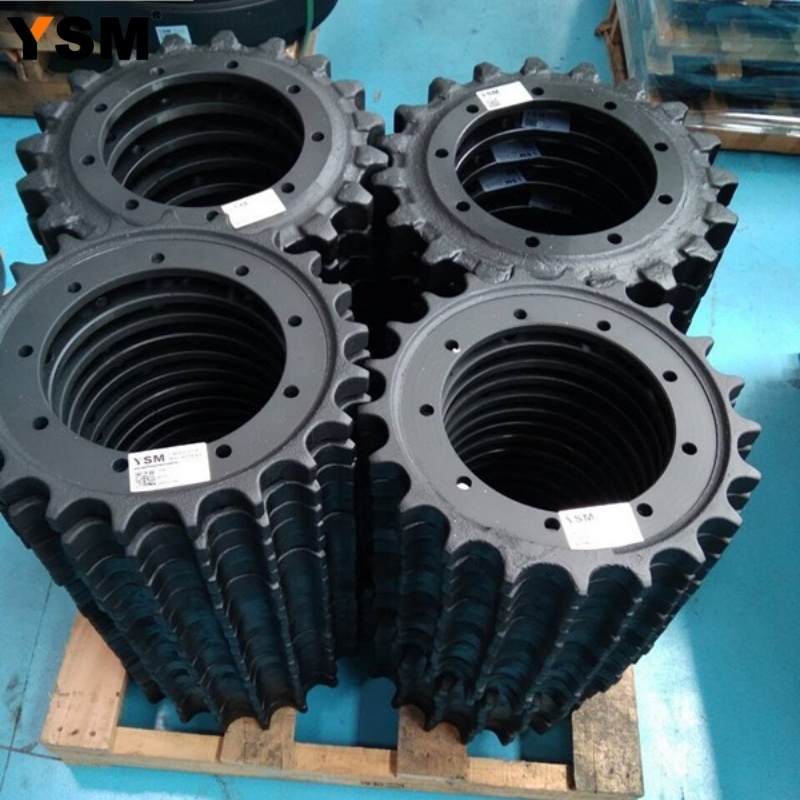
Inspect tooth profile, side wear, segment fasteners, cracks, and bushing contact as the chain enters and leaves the sprocket. Rough engagement may result from pitch wear, tooth wear, incorrect tension, seized joints, packing, or mismatched parts. A new sprocket segment is not a substitute for measuring the chain.
Shoes, grousers, and hardware
Check for bent or cracked shoes, grouser wear, loose or missing bolts, elongated holes, and polished movement marks. Confirm shoe width, bolt pattern, and application. Wider shoes can increase flotation but also change turning resistance and side loads on firm ground.
Equalizer bar, pivot area, guards, and frames
Observe accessible areas for cracks, leakage, damaged mounts, unusual clearance, frame position, and loose guard hardware. Uneven undercarriage wear can be related to suspension or frame condition, but diagnosis may require lifting and specialist procedures. Do not use the blade as an improvised lifting method for a routine inspection.
4. Inspect chain and rotating-bushing behavior correctly
Visual inspection should note whether joints articulate consistently and whether bushing surfaces engage the sprocket evenly. For a PLUS system, rotating-bushing performance should be assessed using Komatsu's applicable inspection method and wear tooling. A bushing that appears stationary in one observation is not automatically failed; load, contamination, wear, and observation conditions matter.
Measurements must use the correct reference points for the installed system. Record the tool, position, side, date, hours, and ground condition. Do not compare a PLUS wear value with a conventional-chain limit or use a dimension from another model. When the system identity is uncertain, stop the parts-selection process and verify it first.
5. Common wear patterns and possible contributors
| Observed condition | Possible contributors | Next check |
|---|---|---|
| One track group wears faster | Slope work, repeated turn direction, packing, alignment, suspension condition, or unequal components | Compare both sides, frames, guides, equalizer and pivot areas, and operating history |
| Rough sprocket engagement | Chain pitch wear, tooth wear, tension, stiff joints, packing, or a mixed system | Confirm system identity, clean, measure chain and sprocket, and inspect engagement safely |
| Heavy flange or rail-side wear | Side loading, guide wear, alignment, turning habits, or frame position | Inspect inner and outer rail surfaces, idler guidance, rollers, guards, and work pattern |
| Localized bushing damage | Impact, lubrication or seal loss, packing, poor engagement, or mismatched parts | Inspect adjacent joints, sprocket teeth, tension, seals, and system identification |
| Track tension changes repeatedly | Packing, adjuster leakage, seal damage, wear, or inconsistent measurement | Repeat the approved procedure under documented conditions and inspect the adjuster safely |
These patterns direct further checks. They do not prove a single root cause without measurements and qualified diagnosis.
6. Manage D85EX-18 track tension safely
Komatsu's product information notes grease adjustment, but the correct measurement points, machine position, and target value come from the exact operation and maintenance manual. Ground condition matters. Rock, clay, waste, frozen soil, and tightly packed material can change how the track sits and how a reading should be interpreted.
An over-tight track raises loading across chains, bushings, rollers, idlers, sprockets, adjusters, and final-drive components. An excessively loose track can impact, mis-track, or derail. Never copy a generic sag value, stand in line with the adjustment valve, or release grease pressure using an improvised method.
7. Avoid common D85EX-18 repair-planning mistakes
- Do not call every D85EX-18 track group a PLUS system.
- Do not assume D85EX, D85PX, EXi, PXi, or waste-handler components are identical.
- Do not mix conventional and PLUS components without verified technical compatibility.
- Do not replace sprocket segments without measuring chain and bushing condition.
- Do not apply a conventional pin-and-bushing turn rule to a PLUS system.
- Do not treat one hot, noisy, or leaking part as a complete diagnosis.
- Do not order from a stock photo or visual resemblance alone.
Stop operation and request qualified inspection when
- a link, shoe, roller shell, idler, frame, or suspension mounting is cracked;
- the track climbs the sprocket, is near derailment, or repeatedly derails;
- oil loss, smoke, or abnormal heat appears at a roller, idler, or final drive;
- critical fasteners are broken, missing, or repeatedly loose;
- the equalizer, pivot, recoil, or adjustment area appears damaged; or
- the machine suddenly pulls, vibrates, impacts, or changes ride behavior.
8. Information needed for D85EX-18 undercarriage parts
- brand, complete model and suffix, regional designation, and application package;
- complete serial number or PIN from the machine plate;
- confirmed conventional or PLUS system identification, with evidence;
- part name, requested quantity, and readable part or casting numbers;
- clear overall, side, mounting, marking, bushing, and sprocket photos;
- dimensions taken from agreed reference points;
- shoe type and width, link count, bolt pattern, and relevant configuration details;
- destination country and working conditions; and
- history of conversions, partial rebuilds, or mixed components.
Compatibility must be confirmed for the actual installed system. Similar dimensions or appearance do not prove interchangeability.
Frequently Asked Questions
Does every D85EX-18 use the PLUS undercarriage?
No. Komatsu describes PLUS as an option. Verify the installed system from the machine, serial information, component identification, and service records.
Does PLUS need a pin-and-bushing turn?
Komatsu describes its rotating-bushing PLUS design as not requiring the conventional turn. Do not extend that statement to an unidentified or different track system.
Can conventional and PLUS parts be mixed?
Do not assume they can. Confirm the complete system, serial range, part numbers, dimensions, and approved compatibility before ordering or installation.
What track-sag value should be used?
Use the exact operation and maintenance manual for the installed system, serial number, measuring procedure, and ground condition. This article intentionally gives no universal value.
Technical references
Check D85EX-18 Undercarriage Replacement Options
Send system-identification evidence, machine details, photos, and measurements for a model-specific review. We can check suitable supply options for requested undercarriage items such as:
- track rollers and carrier rollers;
- front idlers and sprocket segments;
- track chains, track shoes, and related fasteners.
Corporate Email: sales@china-ysm.com
WhatsApp: +86-18606961587
Compatibility and availability must be confirmed from the complete model, serial number, installed undercarriage system, part number, clear photos, requested dimensions, quantity, destination country, and working conditions before ordering.