
Track-chain wear explained
Track Bushing Wear vs Chain Pitch Wear: What Is the Difference?
Track bushing wear vs chain pitch wear is a distinction worth making before a crawler repair. The bushing outside contacts the sprocket; the pin and bushing inside form the moving joint. An outside-diameter reading and a pitch reading describe different conditions. Neither should be used as a substitute for the other.
1. Start with the two wear surfaces
On a conventional steel crawler chain, a bushing spans between the link sides around a pin. Its outside surface meets the drive sprocket. The internal bearing surfaces move relative to one another as the chain articulates.
External contact can change the bushing profile. Internal wear between the pin and bushing can increase the effective joint spacing when the chain is measured under the prescribed conditions. The phrase "stretched chain" often describes this accumulated joint wear, not proof that the link plates have simply stretched like elastic.
Identify the chain construction first. Dry, sealed, sealed-and-lubricated, and rotating-bushing systems do not share every service rule. This guide explains observations, not disassembly or rebuilding instructions.
2. Track bushing wear vs chain pitch wear
| Question | External bushing condition | Internal joint / pitch condition |
|---|---|---|
| What is being assessed? | The outer contact surface and remaining profile | The measured spacing across the specified joints |
| What may be visible? | Flats, grooves, cracks, or uneven contact | Sometimes little that is conclusive in a photograph |
| What does not prove it? | A pitch reading alone | A bushing OD reading alone |
| What reference is needed? | Correct measurement location and component limits | Correct span, setup, reference dimension, and limits |
The two findings may occur together, but they need not progress at the same rate. Keep separate fields in the inspection report instead of writing only "chain worn." That simple distinction makes a repair discussion much more useful.
3. Record external wear without judging only the shine
Once the machine is safely parked and isolated, arrange cleaning and access according to the manual. Photograph the identified section before and after cleaning where practical. Dirt can obscure a crack or make a worn profile difficult to interpret.
A polished contact band shows that surfaces have met; it does not by itself establish an excessive wear condition. Record flats, cracks, localized damage, and the direction or position of the affected surface. Use the prescribed measuring tool and location rather than selecting the most convenient accessible edge.
A useful external-wear entry includes the side, joint reference, measurement method, actual reading, unit, and applicable reference. If access prevents a reliable reading, mark the item "not measured" instead of estimating a number from the image.
Cracked or severely damaged bushings call for qualified assessment. Do not grind, weld, or rotate a component as an informal way of improving its appearance.
4. Measure pitch as its own inspection task
Pitch assessment needs a defined setup. Ask the inspector to identify the exact chain, the required measurement span, the endpoints, and the condition specified by the relevant service information. Retain that method with the reading so a later inspection can be compared fairly.
Do not present a measurement across several joints as a one-joint dimension, and do not compare unlike spans. A report that says only "length increased" without units, locations, or a baseline is difficult to act on.
Where repeatability is uncertain, request a recheck before drawing a replacement conclusion. Do not improvise machine movement, loading, lifting, or track tensioning to obtain a measurement. Those operations belong to an approved procedure and qualified personnel.
Also keep track sag separate from pitch. Sag is not a direct wear gauge. A loose-looking track requires a broader assessment of adjustment, packing, component condition, and the installed system; its appearance cannot identify the cause on its own.
5. Read the chain findings alongside the sprocket
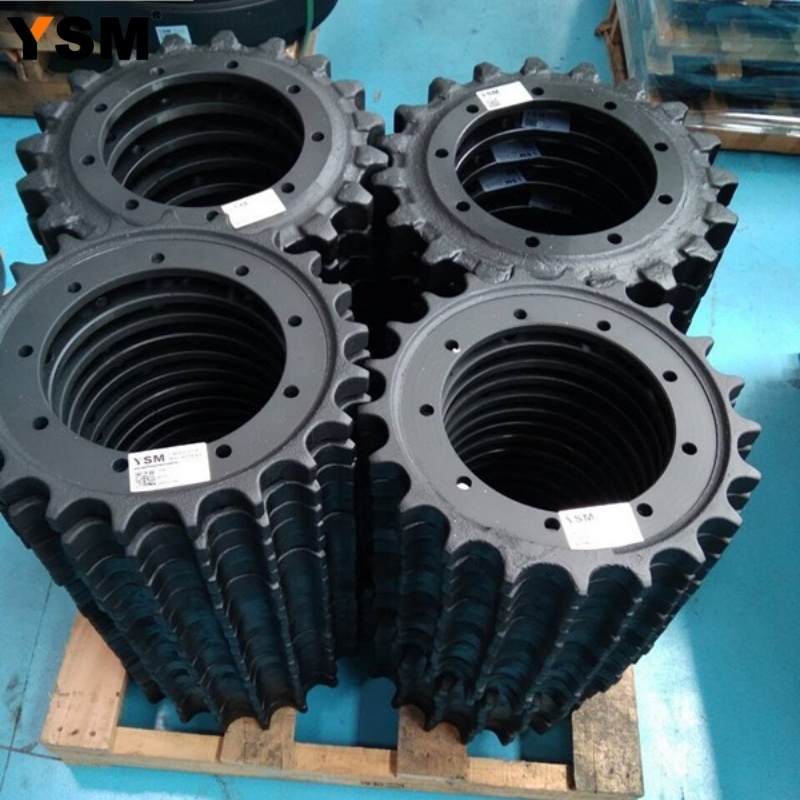
Komatsu describes how internal pin-and-bushing wear changes link pitch while sprocket contact also wears. The relationship matters because the parts work together. A chain-only purchase decision can miss a relevant engagement problem elsewhere in the system.
Ask for matching sprocket photographs and inspection findings, including side and location. Add notes on unusual contact, tooth damage, packing, and recent component replacement. Treat noise, jumping, or vibration as symptoms requiring investigation, not automatic proof that either the chain or sprocket is solely responsible.
ITM likewise treats undercarriage condition as a system-level issue. For a repair review, keep link rails, shoes, rollers, idlers, guards, and fasteners visible in the record rather than cropping every photograph around the bushing alone.
6. Avoid three shortcuts in the repair decision
- "The outside looks good, so the joints must be good." External appearance does not replace pitch assessment.
- "The chain is loose, so remove a link." Do not use a dimensional change as a substitute for diagnosing wear or adjustment.
- "Turn the bushings on every worn chain." Rebuilding eligibility depends on chain design, condition, wear limits, and service requirements.
A turning or rebuilding proposal should state which system is installed, what was measured, what related parts were assessed, and why the proposed work is suitable. Rotating-bushing systems and different joint designs must not inherit a conventional-chain recommendation automatically.
Do not convert a visual condition into a promised number of remaining operating hours. Ask the service provider to explain the applicable limits and the uncertainty behind any projection.
7. Send a clear inspection-to-parts handoff
Build the inquiry around evidence rather than a broad request for "one excavator chain." Include the machine brand, full model, PIN or serial number, installed chain identification, part number if available, and both crawler sides.
- Separate external bushing readings from pitch readings.
- Attach the measurement method, units, reference document, and inspection date.
- Include the sprocket condition and other significant crawler findings.
- State shoe and assembly requirements, quantity, destination, and working conditions.
- Distinguish a request for assessment from an already approved replacement specification.
In short, measure what each question actually requires. External bushing condition, internal joint wear, and the surrounding crawler deserve connected but separate records before a service or supply decision.
Frequently Asked Questions
Does external bushing wear directly measure chain pitch?
No. It describes the outer surface. Pitch needs its own correctly specified measurement and reference.
Can sealed-and-lubricated track still have external wear?
Yes. Internal lubrication does not remove the external contact between bushings and sprocket. Inspect the installed system as directed.
Does a photograph prove the chain has elongated?
Not reliably. A photograph can document appearance, but a pitch conclusion needs a suitable measured inspection.
Should every worn chain receive a pin-and-bushing turn?
No. Eligibility depends on design, measured condition, service limits, and related component condition. Obtain a qualified recommendation.
Technical references
Discuss Track Chain and Sprocket Requirements
We are a China-based manufacturer and wholesale supplier focused on excavator and dozer undercarriage parts. After the inspection defines the requirement, our team can review suitable supply options for:
- track chains and complete track assemblies;
- sprockets, track shoes, bolts, and nuts;
- related rollers and idlers when the inspection supports replacement;
Corporate Email: sales@china-ysm.com
WhatsApp: +86-18606961587
Compatibility and availability must be confirmed from the complete model, serial number, part number, clear photos, and requested dimensions before ordering. Include quantity, destination country, and working conditions.