
Model-specific wear inspection
Volvo EC350E Excavator Undercarriage Wear Inspection Guide
The Volvo EC350E undercarriage supports a heavy production excavator across quarry, earthmoving, and mass-excavation work. A useful inspection does more than label parts as good or bad: it records the same components, positions, and operating conditions over time. That trend can reveal uneven loading, packing, leakage, alignment concerns, or a changing wear rate before a repair plan is prepared.
1. Confirm the exact EC350E configuration
Volvo's official EC350E literature describes a robust X-shaped lower frame, greased and sealed track chains, multiple track-shoe choices, eight bottom rollers per side, and two top rollers per side. It also distinguishes long and narrow undercarriage configurations in some markets. These details show why the family name alone is not enough for parts identification.
Record the full model designation, regional version, complete serial number or PIN, track-shoe type and width, and any readable part or casting number. Photograph the identification plate, complete machine, both track frames, mounting areas, and markings. Note any past conversion or mixed-component repair. A replacement part must match the actual installed assembly, not only a catalog illustration.
This is independent educational content and is not affiliated with or endorsed by Volvo Construction Equipment. The brand and model name are used only to identify the machine being discussed.
2. Build a repeatable undercarriage wear baseline
Park on stable, level ground, lower the attachment, apply the parking controls, shut down the engine, and isolate energy according to the machine manual. Keep personnel outside the travel path. Track adjustment, lifting, stored grease pressure, and heavy component removal require the approved procedure and qualified service support.
Clean enough material from the undercarriage to expose rail surfaces, roller and idler flanges, sprocket engagement, shoe hardware, guards, and the adjuster area. Record the jobsite material before cleaning because packed clay, wet sand, crushed rock, frozen soil, or demolition debris can influence tension and wear.
Use the same identifiers every time. Number the lower rollers from front to rear, label the left and right track groups, and photograph from consistent angles. Record the date, hour-meter reading, work application, ground condition, operator shift if relevant, measurement tool, reference points, values, and photo numbers. Do not compare measurements taken by different methods as if they were one trend.
| Record field | Why it matters | Example entry |
|---|---|---|
| Machine identity | Separates model, suffix, serial break, and installed configuration | Complete plate details and shoe configuration |
| Component position | Shows localized wear instead of hiding it in an average | Left lower roller 3, right carrier roller 2 |
| Operating condition | Provides context for abrasion, impact, packing, and side loading | Quarry floor, crushed rock, frequent right turns |
| Method and tool | Makes future values comparable | Approved reference points and calibrated tool |
| Photos | Preserves visual evidence of leaks, shape, and contact | Same side view and close-up at every inspection |
3. EC350E undercarriage component inspection
Track chains, links, pins, and bushings
Look for seal damage, dry or stiff joints, cracks, side wear, abnormal rail profile, localized heat, and inconsistent articulation. Measure link and bushing condition only at the approved locations. A noisy or hot joint is an inspection signal, not proof of one cause; contamination, tension, packing, alignment, and mating-component wear also need review.
Lower track rollers
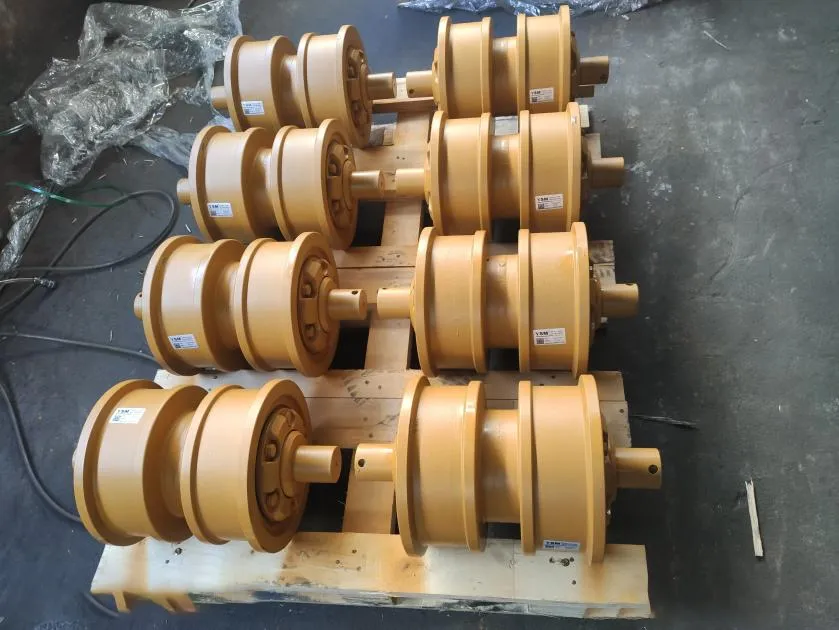
Inspect all eight positions on each side rather than checking only the easy-to-reach rollers. Look for oil leakage, flat spots, damaged flanges, uneven diameter, loose mounting bolts, heavy side contact, and a roller that does not rotate normally. Compare matching positions on the left and right frames. Surface residue should be cleaned and traced before it is called a confirmed seal failure.
Carrier rollers
Check the two upper positions on each side for leakage, shell wear, flange contact, rotation, loose hardware, and changes in the upper chain path. A carrier roller that stops turning can develop a flat wear area, but packed debris, chain condition, and tension may contribute. Diagnose the system rather than replacing a roller solely from one symptom.
Front idlers and guides
Inspect the idler tread and flanges, side movement, leakage, guide surfaces, mounting condition, and position within the frame. Unequal left-right position may be associated with tension, wear, packing, or adjustment history. Excessive movement or repeated derailment requires qualified inspection of the idler, guides, chain, adjuster, and alignment.
Sprockets and final-drive area
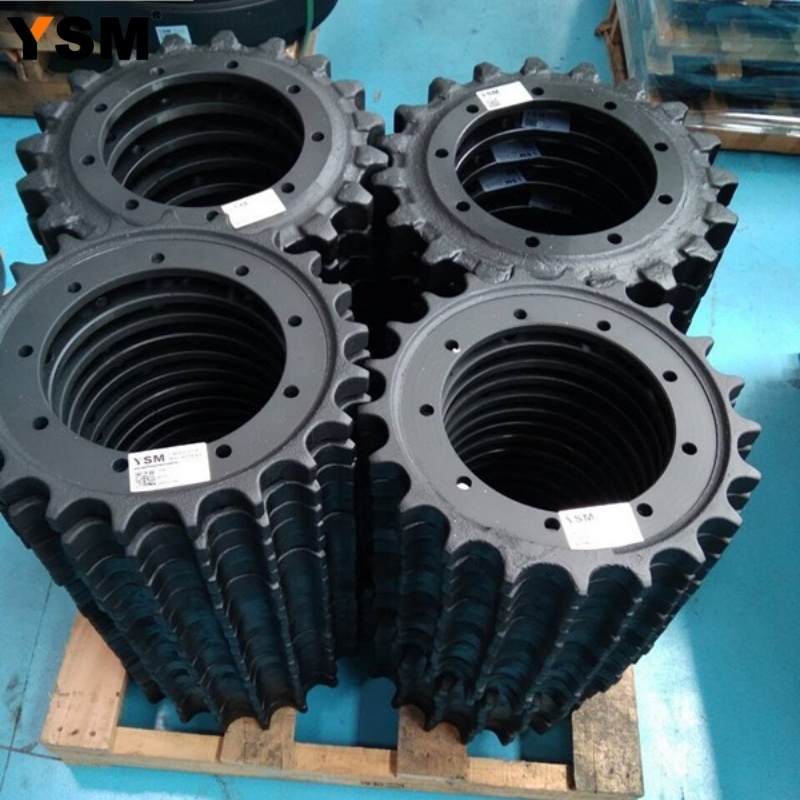
Check tooth shape, side wear, cracks, fasteners, chain seating, and evidence of impact as the bushings engage. Pointed teeth can appear with worn chain pitch, but tooth shape alone does not define the entire repair. Trace any oil in the final-drive area to its actual source before deciding which assembly is involved.
Track shoes and hardware
Inspect for bent or cracked plates, grouser wear, missing or loose bolts, elongated holes, and polished movement marks around the joints. The official brochure lists several shoe types and widths, so dimensions and patterns must be confirmed on the machine. A wider shoe changes ground pressure and leverage; it is not automatically suitable for every surface.
Track frame, guards, and adjuster area
Look for cracks, impact damage, loose or missing guard hardware, distorted guides, blocked drain paths, and fresh grease where it should not be present. Never loosen an adjuster or work near the recoil spring without the exact manual procedure. Stored pressure and heavy parts can cause severe injury.
4. Read wear patterns as clues, not final diagnoses
| Observed pattern | Possible contributors | Next check |
|---|---|---|
| One side wears faster overall | Slope work, repeated turning direction, packing, alignment, travel pattern, or unequal component condition | Compare work history, both frames, guides, rail sides, rollers, idlers, and sprockets |
| One roller position wears faster | Roller fault, frame or mounting issue, localized packing, impact, or load distribution | Inspect adjacent components, mounting faces, leakage, rotation, and frame condition |
| Heavy inner or outer flange contact | Side loading, guide wear, alignment, chain wear, or turning pattern | Compare rail-side wear, idler guidance, guards, operating direction, and frame geometry |
| Rough chain-to-sprocket engagement | Pitch wear, tooth wear, tension, seized joints, packing, or mixed components | Clean, measure the chain and sprocket, and observe safe low-speed engagement |
| Tension changes repeatedly | Packing, adjuster leakage, seal damage, wear, or inconsistent measuring conditions | Repeat the approved procedure under recorded conditions and inspect the adjuster safely |
A visual pattern narrows the inspection path. It does not prove that one component is the root cause. Service history, measurements, machine behavior, and the correct manual remain necessary.
5. Check EC350E track tension with the exact manual
Track sag depends on the machine configuration, installed track, measurement method, and ground condition. Clean the measurement area and position the machine exactly as the applicable operation and maintenance manual directs. Record how and where the value was taken. This article intentionally provides no universal sag dimension.
An over-tight track can increase load across chains, rollers, idlers, sprockets, adjusters, and travel components. An excessively loose track can slap, mis-track, climb, or derail. If the track cannot hold its setting, investigate packing and the adjustment system rather than repeatedly adding grease without diagnosis.
6. Connect wear trends to operating conditions
- Record long travel, reverse travel, sharp turning, slope direction, and abrasive ground.
- Remove packing before it restricts rollers, idlers, chain articulation, or guards.
- Alternate work direction and machine orientation when the safe work plan allows it.
- Reduce unnecessary pivot turns and track spinning under high load.
- Review shoe width against flotation needs, side loading, and the actual surface.
- Recheck the undercarriage when the machine moves to a materially different jobsite condition.
These actions support wear management but do not guarantee a fixed component life. Application severity, impact, abrasion, moisture, travel distance, maintenance quality, and component design all influence the result.
7. Plan the repair around mating components
When the record shows accelerated or uneven wear, measure the complete wear system before selecting parts. A new chain operating against a heavily worn sprocket, or one new roller within a distorted or mismatched system, may not distribute load correctly. Review chains, rollers, carrier rollers, idlers, sprockets, shoes, fasteners, guides, adjusters, and frame condition together.
Stop operation and request qualified inspection when
- a link, shoe, roller shell, idler, guard mounting, or structural area is cracked;
- the track is climbing the sprocket, close to derailment, or repeatedly derailing;
- a roller, idler, or final-drive area leaks heavily or becomes abnormally hot;
- critical hardware is missing, broken, or repeatedly loosening;
- new vibration, impact noise, severe pulling, or sudden ride change appears; or
- the adjuster or recoil assembly appears damaged.
8. Information needed for EC350E undercarriage parts
- brand, complete model, suffix, regional designation, and undercarriage configuration;
- complete serial number or PIN from the identification plate;
- part name, requested quantity, and any readable part or casting number;
- clear overall, side, mounting, marking, and wear-surface photos;
- dimensions measured from agreed reference points;
- shoe type and width, link count, bolt pattern, and other relevant configuration data;
- destination country and working conditions; and
- previous modifications, conversions, or mixed-component repairs.
Similar appearance is not proof of compatibility. Confirm fitment against the exact machine and installed assembly before ordering.
Frequently Asked Questions
How often should EC350E undercarriage measurements be taken?
Use the machine manual, site maintenance plan, component condition, and application severity. A single universal interval is not appropriate. Increase attention when conditions or wear rate change.
Why are trend records better than one measurement?
One measurement describes the current state. Consistent measurements over time show rate and direction, helping separate normal progression from a localized or accelerating problem.
Can EC350E and EC350EL parts be selected by appearance?
No. Confirm the complete designation, serial number, installed configuration, part number, photos, and dimensions. Regional and undercarriage variants can affect fitment.
Should a leaking roller be replaced immediately?
Clean and confirm the source, then evaluate lubrication loss, heat, movement, and measured condition with qualified support. Leakage is an important warning sign, but the repair decision depends on verified condition.
Technical references
Check EC350E Undercarriage Replacement Options
After inspection, send the identification data, photos, and measurements for a model-specific review. We can check suitable supply options for requested undercarriage items such as:
- track rollers and carrier rollers;
- front idlers and sprockets;
- track chains, track shoes, and related fasteners.
Corporate Email: sales@china-ysm.com
WhatsApp: +86-18606961587
Compatibility and availability must be confirmed from the complete model, serial number, part number, clear photos, requested dimensions, quantity, destination country, and working conditions before ordering.