
Excavator Travel Troubleshooting
Why Does an Excavator Pull to One Side? 9 Checks Before Replacing a Travel Motor
An excavator that will not travel straight may have unequal ground resistance, an undercarriage problem, a brake or final-drive fault, or unequal hydraulic delivery to the two travel motors. The direction of the pull is useful evidence, but it is not enough to identify the failed component.
Quick answer
Test the symptom on firm, level ground only if the machine can be operated safely. Start with packed material, track tension and visible undercarriage resistance. Then compare final-drive condition and determine whether the problem changes with travel direction, speed mode, oil temperature or upper-structure position. Pressure, flow, case-drain, brake-release and swivel-joint tests require the machine-specific service procedure and qualified diagnostic equipment. Do not order a travel motor simply because one track is slower.
Before diagnosis, record how the excavator pulls to one side
A useful diagnosis begins with repeatable observations. Note the ground condition, travel speed, hydraulic-oil temperature, attachment position and whether the upper structure is facing the same direction each time. If the machine is safe to test, compare forward and reverse on the same level path. Never use a public road, steep slope or crowded work area as a test lane.
| Observed pattern | Inspection priorities | What it does not prove |
|---|---|---|
| The same physical track is slower in forward and reverse | Mechanical resistance, brake release, final drive, travel motor and that side's hydraulic supply | It does not automatically prove that the travel motor is worn |
| The pull changes between forward and reverse | Control linkage or sensors, control valve, relief/check functions, hose routing and motor direction-specific behavior | Direction change alone cannot identify a valve or motor fault |
| The problem appears only in high travel speed | Travel-speed control, two-speed shift signal, motor displacement control and hydraulic supply | It does not necessarily mean the undercarriage is healthy |
| The pull becomes worse after warming up | Hydraulic oil condition, internal leakage, brake release, motor or valve clearances | Heat-related change is a clue, not a complete diagnosis |
| The machine travels straight on concrete but not in mud | Ground resistance, packed material, shoe width, tension and traction difference | Straight travel on one surface does not rule out developing wear |
| Noise, heat or vibration comes from one side | Rollers, idler, sprocket-chain engagement, final drive and brake | Do not locate the fault by sound or touch alone |
A tracked machine may not follow a perfect line on loose or uneven ground. Diagnosis should focus on a consistent, excessive difference under controlled and safe conditions.
Nine checks before replacing an excavator travel motor
1. Confirm the test surface and operating inputs
Soft soil, a side slope, debris under one track or unequal traction can make a healthy machine wander. Check that the travel pedals or levers return correctly and are being operated evenly. Record the selected travel-speed mode and confirm the symptom with the upper structure in a consistent orientation. If the machine has electronic travel control, check displayed warnings and diagnostic codes before disconnecting anything.
2. Clean both undercarriages
Packed clay, stone, frozen material or demolition debris can add resistance on one side. Clean around the track frame, rollers, idler and sprocket, then compare both sides. Material buildup may also change track tension as it is compressed into the chain path.
3. Compare track tension using the exact manual procedure
A track that is too tight can create unnecessary drag and accelerate wear; excessive slack can disturb engagement and guidance. Compare the two sides only after positioning and measuring the machine as specified by the OEM. Do not apply one universal sag dimension to different excavator models, steel tracks or rubber tracks.
4. Check for a seized or heavily worn roller or idler
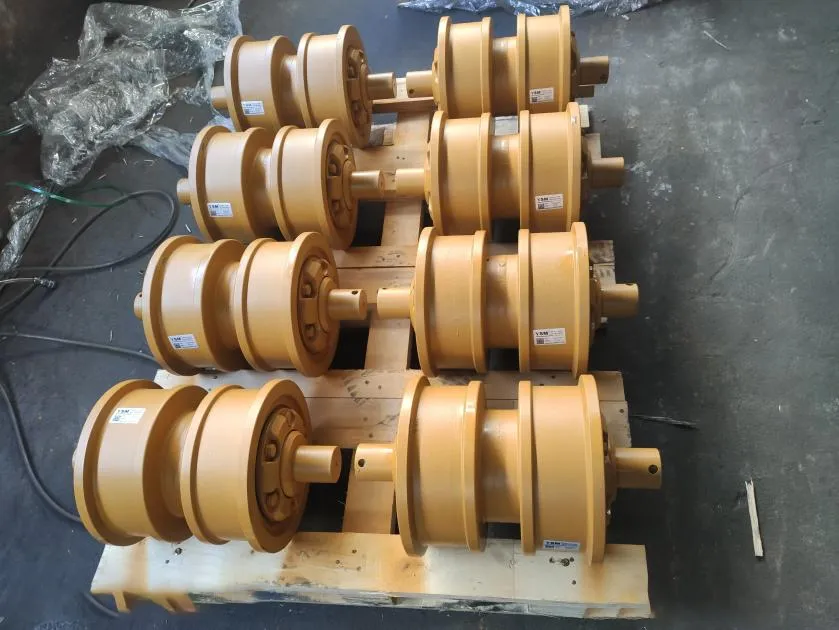
A seized track roller, damaged flange, oil loss or abnormal idler clearance can increase rolling resistance and alter guidance. Look for flat wear, leakage, fresh metal contact, uneven rail marks or a component that does not rotate normally. Temperature difference after operation can be useful to a technician, but do not touch hot components or rely on temperature alone.
5. Inspect the chain, shoes and sprocket as a wear system
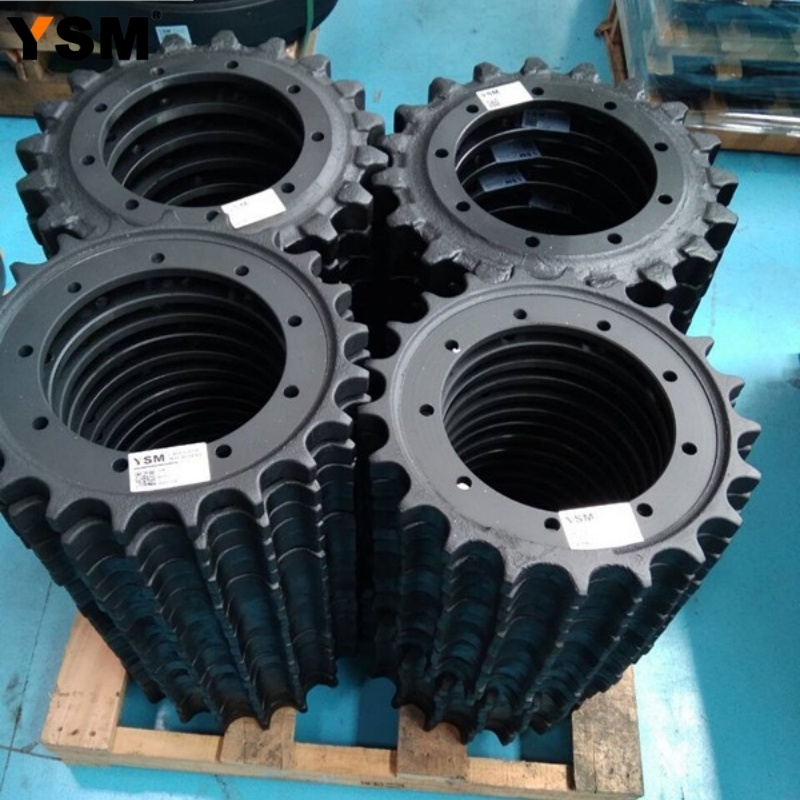
Unequal chain pitch growth, dry joints, damaged links, bent shoes, missing hardware or poor sprocket-to-bushing engagement can make one side consume more power. Compare left and right wear patterns and obtain measurements. A new sprocket fitted against a severely worn chain may not restore normal engagement.
6. Inspect final-drive condition
Check for external leakage, loose mounting hardware, unusual noise and the final-drive oil level or condition according to the machine manual. Metal debris, burnt oil, repeated overheating or grinding noise requires professional investigation. Do not remove a hot or pressurized plug, and do not assume that every final-drive oil leak comes from the same seal.
7. Confirm travel-speed and brake-release operation
Many excavators use two-speed travel motors and spring-applied, hydraulically released brakes. If one side does not shift or release correctly, the machine may travel at unequal speed or show high resistance. These checks depend on the exact circuit and should use the service manual, pressure specifications and test ports for the machine.
8. Test hydraulic delivery and the centre swivel joint
The travel control valve, pump control, relief functions, hoses and centre swivel joint can cause unequal flow or pressure. A damaged swivel-joint seal may allow internal leakage between circuits, while a restricted or leaking line can reduce delivery to one motor. A technician should compare travel cycle time, pressure, flow and case drain under standardized conditions instead of guessing from the pull direction.
9. Evaluate the travel motor only after external causes are separated
Internal motor wear can reduce torque or speed, especially under load or when the oil is hot. However, a worn motor, dragging brake, damaged gearbox and hydraulic supply fault can produce overlapping symptoms. Test results, oil condition and inspection evidence should support the repair decision before a motor or complete final drive is replaced.
How to separate undercarriage drag from a hydraulic travel fault
The safest owner-level checks are visual: clean both sides, compare tension, inspect rollers and idlers, look for damaged shoes or chain links, and record leaks, noise and when the symptom appears. If those checks do not identify the cause, the next step is not random parts replacement—it is a controlled service test.
| Evidence leaning toward mechanical resistance | Evidence leaning toward hydraulic or drive diagnosis |
|---|---|
| One track is packed with material or adjusted much tighter | Mechanical checks are comparable, but measured travel speed remains unequal |
| A roller is seized, leaking or shows a flat wear path | Performance changes strongly with oil temperature or speed mode |
| Chain, idler or sprocket contact is visibly abnormal | Pressure, flow, brake-release or case-drain readings differ from specification |
| Loose, missing or damaged track hardware is visible | Hydraulic noise, external leakage or diagnostic codes accompany weak travel |
These are routing clues only. A machine may have both mechanical wear and hydraulic weakness at the same time.
Common mistakes that cause unnecessary parts replacement
- Ordering a travel motor from the symptom alone: track tension, rollers, idlers, brakes, valves, the swivel joint and the final-drive gearbox can create similar behavior.
- Testing on soft or sloping ground: unequal traction can hide or exaggerate the fault.
- Ignoring forward-versus-reverse behavior: repeatable direction data helps the technician choose the correct circuit tests.
- Assuming both tracks have equal tension: measure them with the correct procedure.
- Replacing one wear part without measuring its mating components: chains, sprockets, rollers and idlers should be assessed as a system.
- Carrying out an improvised stall test: incorrect blocking or loading can damage the machine and create a serious safety risk.
Maintenance practices that support straight travel
- Keep both undercarriages clean and inspect them under comparable conditions.
- Maintain track tension using the exact OEM method and ground-condition guidance.
- Record left- and right-side wear measurements instead of relying only on appearance.
- Check final-drive oil and hydraulic-system items at the intervals specified for the machine.
- Reduce unnecessary long-distance travel, sharp pivot turns and heavy side loading.
- Investigate new noise, heat, leakage or speed difference before the symptom becomes severe.
Information needed before selecting undercarriage replacement parts
If diagnosis identifies excessive undercarriage resistance or wear, do not select parts from a short model name alone. Serial ranges, track configurations and shoe options can differ. Prepare:
- equipment brand and complete model designation;
- serial number or a clear identification-plate photo;
- part name and part number, if available;
- clear photos of both complete undercarriages and the affected components;
- chain pitch, roller/idler dimensions or other requested measurements;
- steel-track or rubber-track configuration and shoe width;
- quantity, operating conditions and destination country.
Compatibility and availability must be confirmed from the complete model, serial number, part number, clear photos and requested dimensions before ordering. Hydraulic and travel-motor diagnosis should be confirmed separately by a qualified service technician.
Frequently Asked Questions
Does an excavator pull toward the slower track?
On a firm level surface, a tracked machine generally turns toward the side travelling a shorter distance. However, upper-structure orientation, control direction, ground resistance and operator input can confuse a simple left-or-right description. Measure or compare the physical track speeds instead of identifying a failed part from steering direction alone.
Can incorrect track tension make an excavator travel unevenly?
Yes. A track adjusted too tightly may create extra resistance, while excessive slack can affect engagement and guidance. Use the machine-specific positioning and measurement procedure because the correct value is not universal.
Does one slow track always mean a bad travel motor?
No. Possible causes include packed material, track tension, a seized roller, idler or chain wear, brake drag, final-drive damage, speed-control faults, restricted hydraulic delivery, internal swivel-joint leakage and travel-motor wear.
Why does the excavator pull more after the hydraulic oil warms up?
A temperature-related change may be associated with internal hydraulic leakage or component clearances, but it requires controlled pressure, flow and case-drain testing. It should not be treated as proof that the travel motor has failed.
Should both sides of an excavator undercarriage be replaced together?
Not automatically. Both sides should be measured, and mating components on the affected side should be evaluated together. The replacement plan depends on wear balance, service limits, operating plans and the exact undercarriage design.
Technical references
- Caterpillar: Hydraulics Technical Analysis Guide
- Caterpillar: What to Know About Excavator Undercarriage Maintenance
- Hitachi Construction Machinery UK: Undercarriage 101
- Volvo Construction Equipment: Excavator Tips to Minimize Wear and Tear
- Volvo Construction Equipment: Undercarriage Wear and Maintenance
These sources support general inspection principles. Diagnostic limits, test conditions and specifications must come from the service information for the exact machine and serial range.
Consult Our Excavator Undercarriage Parts Team
If professional diagnosis shows that unequal travel is related to worn running gear, we can help check suitable track rollers, carrier rollers, front idlers, sprockets or segments, track chains, track shoes, track assemblies and related fasteners.
Corporate Email: sales@china-ysm.com
WhatsApp: +86-18606961587
Please send the machine brand, complete model, serial number or plate photo, part number, clear part photos, requested dimensions, quantity and destination country. Compatibility and availability must be confirmed before ordering.