
Excavator Undercarriage Maintenance
Excavator Track Tension: Signs of a Track That Is Too Tight or Too Loose
Correct excavator track tension is a balance, not a visual preference. A steel track needs the model-specific amount of sag so the chain can engage the sprocket, follow the rollers and idler, absorb jobsite material and move without unnecessary load. This guide explains what operators can observe, what each symptom may mean and how to prepare a safe, repeatable inspection.
Quick answer
A track that is too tight may show less sag than the machine specification, run with higher friction or heat and place extra load on the chain joints, rollers, idler, sprocket, adjuster and travel system. A track that is too loose may slap, index poorly on the sprocket or become more likely to derail. However, appearance alone is not enough. Clean the undercarriage, place the machine in the condition required by its operation and maintenance manual, measure at the specified location and compare the result with the exact model's limit.
How does excavator track tension work?
The track chain forms a loop around the drive sprocket, front idler, bottom rollers and, where fitted, carrier rollers. The adjuster moves the front idler to change the effective length of that path. The recoil mechanism also allows controlled movement when the track encounters impact or trapped material.
Sag is the visible result of this geometry, but it is not a universal number. Measurement location changes between undercarriage designs. Machines with one or more carrier rollers may use a different reference point from machines without them. Steel tracks, rubber tracks, compact excavators, large excavators and dozers can all have different procedures and limits.
Jobsite material matters too. Mud, clay, ice and stones can pack between the chain and frame. As the track rotates through packed material, effective tension can rise. A setting that looks acceptable in a clean yard may become too tight after the undercarriage fills during work.
Signs an excavator track may be too tight
One sign is less sag than the specified range when measured under the correct conditions. The upper chain run may appear unusually straight, but that observation is only a prompt to measure. Other possible signs include new travel resistance, abnormal squealing, elevated temperature around joints or rolling components, rapid wear and repeated tension increase as material packs into the frame.
Excess tension keeps the chain under higher load throughout its path. This can accelerate wear at pins and bushings, link rails, roller and idler treads, sprocket contact surfaces and the adjuster assembly. It may also increase the load required from the travel system. A hot or noisy component can have other causes, including a dry joint, seized roller, alignment problem or insufficient lubrication, so it should not be diagnosed from tension alone.
What to check when the track looks too tight
- remove packed material before comparing the measurement;
- confirm the machine is positioned exactly as the manual specifies;
- compare both tracks using the same method and condition;
- inspect adjuster travel and look for grease leakage;
- check whether a roller or carrier roller is seized;
- inspect link joints, idler slides and sprocket engagement;
- review whether tension was recently adjusted in a different ground condition.
Signs an excavator track may be too loose
Excessive measured sag is the clearest starting point. During slow travel, the chain may slap the frame or guards, move inconsistently over the carrier roller or engage the sprocket less smoothly. In turns, uneven ground or side loading, a loose track has less control around the idler and rollers and may be more likely to derail.
Loose tension can be an adjustment issue, but it can also indicate chain pitch wear, a leaking adjuster, damaged recoil components, worn idler slides or a mismatch among the chain, sprocket and rollers. If grease is added frequently but the sag returns, do not continue treating the symptom without finding the cause.
What to check when the track looks too loose
- measure sag rather than judging only from a hanging upper run;
- inspect the track adjuster for fresh grease or damaged seals;
- record front-idler position and available adjuster travel;
- measure track-chain pitch using the OEM procedure;
- inspect sprocket teeth and bushing engagement;
- look for bent guards, damaged shoes, loose hardware and worn roller flanges;
- review recent derailments, rock impacts and repeated pivot turns.
Excavator track too tight versus too loose
| Observation | Possible too-tight condition | Possible too-loose condition | Next confirmation |
|---|---|---|---|
| Measured sag | Below the model-specific range | Above the model-specific range | Repeat under the manual's stated machine condition |
| Travel behavior | Higher resistance, friction, noise or heat | Slapping, unstable guidance or poor engagement | Inspect rollers, idler, chain joints and sprocket |
| Typical risk | Accelerated wear and high component load | Impact, indexing problems and derailment | Stop if abnormal noise, damage or unsafe movement appears |
| Jobsite influence | Packed mud, clay, ice or debris may tighten the path | Material falling out may reveal an already worn or loose system | Clean and record the ground condition |
| If adjustment will not hold | Check obstruction, seized parts or incorrect procedure | Check adjuster leakage, chain wear and component damage | Arrange qualified diagnosis before repeated adjustment |
This comparison is a screening guide, not a substitute for inspection. For example, a seized roller can make travel feel tight even when measured sag is correct, and an elongated chain can remain loose even after the adjuster approaches the end of its travel.
How to check excavator track sag correctly
- Identify the exact machine. Use the brand, full model, suffix and serial number or PIN to locate the correct manual.
- Read the complete procedure. Confirm the required direction of travel, stopping method, attachment position, track orientation, measuring point and permitted range.
- Choose safe level ground. Keep people outside the machine's movement area and use the specified isolation procedure.
- Clean the undercarriage. Remove packed material that changes the chain path. Follow the manual's guidance for the intended working condition.
- Condition the track. Move the machine only as directed, stop gradually and do not disturb the track before measuring.
- Use the stated reference. A straightedge, string, tape or lifted-track method may be specified. Do not transfer the method from another machine.
- Measure both sides. Record the date, ground condition, machine hours, location and value.
- Adjust only by the approved method. Follow all stored-pressure warnings and remeasure after the procedure.
There is no safe universal “two-finger” or millimetre rule for all excavators. Even machines of similar operating weight can use different undercarriage geometry. A number without the exact model, track type, measuring location and machine position can create the wrong setting.
Is it a tension problem, chain wear or an adjuster fault?
| Finding | Possible causes to investigate | Useful evidence |
|---|---|---|
| Sag changes after cleaning | Material packing was changing effective tension | Before-and-after measurement and site material photos |
| Sag returns soon after adjustment | Adjuster leakage, damaged valve or internal seal problem | Grease traces, idler-position marks and time log |
| Adjuster is near end of travel | Chain pitch wear, wrong parts or cumulative component wear | Pitch measurement, part numbers and link count |
| Correct sag but heat or drag remains | Seized roller, dry joint, misalignment or travel-system problem | Temperature comparison, rotation check and wear pattern |
| One side repeatedly derails | Loose tension, worn flanges, bent guards, alignment, operating pattern or ground condition | Left-right measurements and full undercarriage inspection |
Track sag and chain wear are related but different measurements. Sag describes the current adjustment condition. Track-chain pitch and component dimensions show accumulated wear. Both are needed when the idler has moved forward substantially or adjustment no longer stays stable.
Common track-tension mistakes
- Adjusting by eye: upper-run appearance changes with machine position, carrier rollers and ground condition.
- Using another model's number: measurement location and acceptable range may differ.
- Overtightening after a derailment: the original cause may be worn flanges, guards, chain pitch, alignment or operating technique.
- Measuring before cleaning: packed material can create a false or changing result.
- Ignoring working material: the required manual procedure may account for mud or other packing conditions.
- Repeatedly adding grease: this can hide an adjuster leak or an elongated chain until the unit reaches its limit.
- Releasing pressure casually: adjuster grease can be hazardous; only use the manual's controlled procedure.
- Replacing one visible part: a new chain on a severely worn sprocket or damaged roller path may not operate correctly.
Practical inspection and maintenance routine
At the beginning and end of a shift, walk around both tracks. Remove material as required; inspect track shoes, bolts and nuts; look for dry joints, grease leaks, damaged guards, cracked links, bent shoes and abnormal sprocket contact. Check that rollers and idlers are not leaking or visibly seized. Listen during slow straight travel in a safe area.
Check tension at the interval in the machine manual and whenever the machine changes to a very different underfoot condition. Increase inspection frequency after derailment, heavy rock impact, frozen mud, repeated slope work or repairs to the track system. Record changes rather than waiting for a track to come off.
Stop and request qualified inspection if a track repeatedly derails, a link or shoe is cracked, fasteners are missing, the adjuster leaks heavily, an idler or roller is seized, the chain runs against damaged guards, or new impact, grinding or vibration occurs.
Undercarriage parts and fitment information
If inspection confirms worn or damaged components, evaluate the system as a matched wear group. Track chains, sprockets, rollers, idlers, carrier rollers, track shoes and fasteners interact. A single replacement cannot correct a bent frame, incorrect tension or severe mismatch elsewhere.
For a fitment check, prepare:
- machine brand, complete model, suffix and serial number or PIN;
- nameplate photo and current operating hours;
- part name, position and part number where available;
- clear full-side and close-up photographs of both undercarriages;
- track pitch, link count, shoe width and requested dimensions;
- recorded sag, chain-wear measurements and adjuster position;
- quantity and destination country.
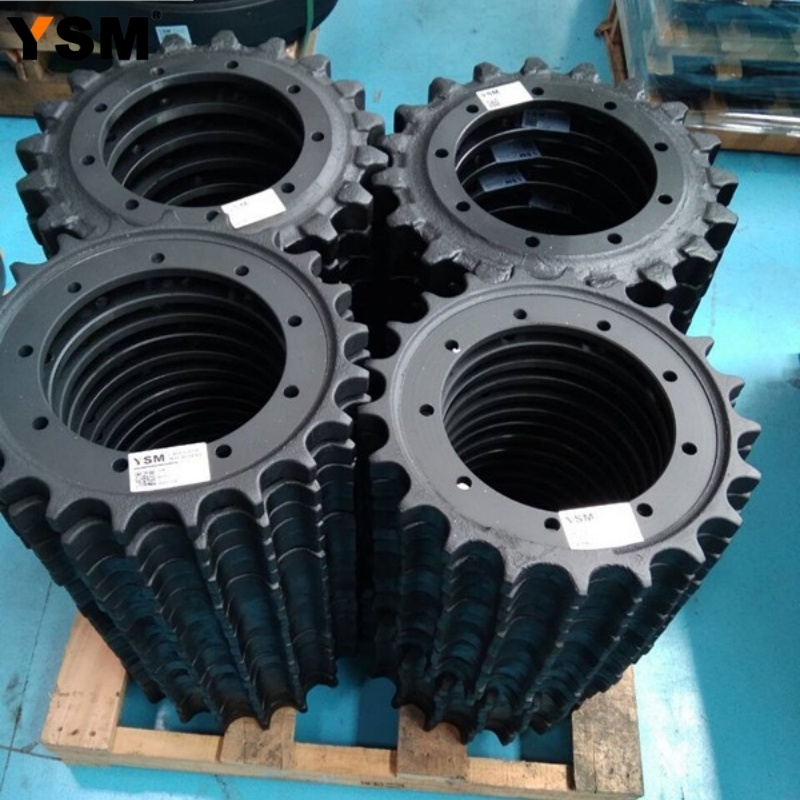
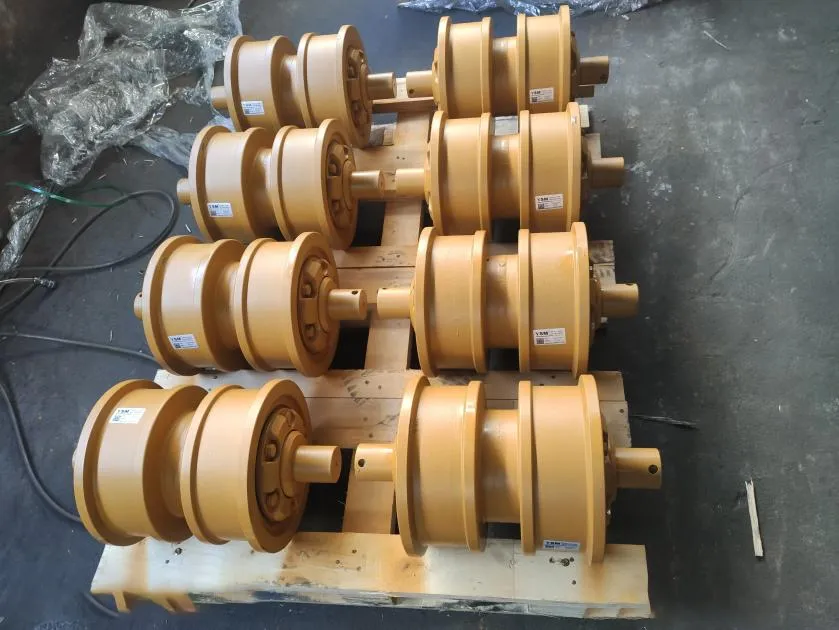
We can review matching track rollers, carrier rollers, front idlers, sprockets or segments, track chains, track shoes, track groups and related fasteners for suitable excavator and bulldozer applications. Final fitment must be confirmed from the complete machine and part information before ordering.
Frequently asked questions
How much sag should an excavator track have?
Use the exact operation and maintenance manual. The required value and measuring method depend on the machine, track type and undercarriage design. A value copied from another excavator is not a reliable specification.
Can a track be slightly loose to work in mud?
Some OEM guidance accounts for material packing, but any change must remain within the exact machine's approved specification and procedure. Do not invent an extra allowance. Clean the undercarriage and follow the manual for the actual working condition.
Why does my excavator track keep getting loose?
Possible causes include an adjuster leak, chain pitch wear, damaged recoil or idler components, incorrect measurement conditions or incompatible parts. Record how quickly the sag changes and inspect the complete system.
Will tightening the track stop it from coming off?
Not necessarily. Derailment can also involve worn roller or idler flanges, bent guards, chain and sprocket mismatch, side loading, debris or operating technique. Overtightening can add wear without correcting the cause.
Should both excavator tracks have exactly the same measured sag?
Both should be checked against the same model-specific procedure. A meaningful difference deserves cleaning, repeat measurement and inspection, but final judgment comes from the permitted range and the condition of each side.