
Excavator Upper Roller Maintenance Guide
Excavator Carrier Roller Wear: Function, Failure Signs and Inspection
An excavator carrier roller—also called a top roller or upper roller—supports and guides the upper return run of the track chain. It does not carry the machine's ground load like a bottom track roller. Oil leakage, a flat spot, abnormal heat, noise, flange damage or a chain that no longer runs smoothly over the roller should trigger inspection of the roller and the complete track path.
Quick answer: how do you check a carrier roller?
Clean the upper track frame, look for fresh oil or oily dirt around the carrier roller, inspect the tread and flange for uneven wear, and check mounting hardware and chain contact. If the approved procedure allows the chain load to be removed safely, a technician can check roller rotation and play. Measure the tread or specified wear point with the correct tool and compare it with the OEM new and service-limit data. Also inspect track sag, chain rails, idler, sprocket and frame alignment.
What does an excavator carrier roller do?
The track chain forms a continuous loop around the front idler and rear drive sprocket. Along the upper return run, one or more carrier rollers hold the chain above the track frame and guide it toward the sprocket and idler. This reduces uncontrolled contact with the frame and helps the chain follow its intended path.
The roller contacts the chain rails through its tread. A flange or guiding profile helps control side movement according to the design. The mounting bracket transfers the upper-chain load into the track frame, while internal bushings or bearings and seals allow the shell to rotate and retain lubricant.
The carrier roller supports the chain but does not set track tension. The track adjuster moves the front idler to establish model-specific sag. A high or low upper chain run can therefore involve carrier-roller condition, track sag, chain pitch, material packing or the number and position of rollers.
Carrier roller vs. bottom track roller
| Feature | Carrier roller / top roller | Bottom track roller |
|---|---|---|
| Location | Above the track frame | Below the track frame |
| Main role | Supports and guides the upper chain return | Carries machine weight through the lower chain rails |
| Typical quantity | Usually fewer; exact number varies by model | Several rollers along the lower frame |
| Loading | Upper-chain support, impact and side guidance | High ground load, shock and continuous rolling contact |
| Ordering risk | May be confused with a smaller bottom roller | Position and flange type can vary along the frame |
When requesting a quotation, state “carrier roller” or “top roller,” send a full-side undercarriage photo and identify the mounting position. The word “roller” alone is not enough for reliable fitment.
Carrier roller construction and common types
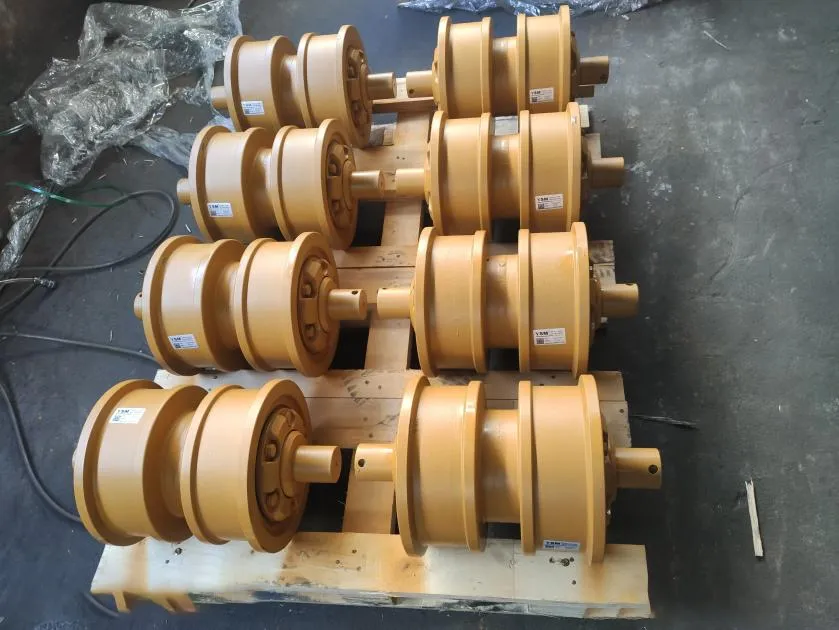
A typical carrier roller assembly includes a forged or cast shell, tread, one or more guide flanges, shaft, bushing or bearing surfaces, seals, internal lubricant and a mounting bracket. The exact arrangement varies.
Single-flange and double-flange profiles
Some carrier rollers use a single central guide flange, while others use a different flange or tread arrangement. The correct profile must match the chain rails and machine design. A roller with the same outside diameter but the wrong flange spacing can guide the chain incorrectly.
Integrated and separate brackets
Some assemblies include a complete bracket; others use a roller body or shaft that fits an existing mount. Bolt spacing, bracket height, shaft orientation and chain-centre position all matter.
Grease- or oil-lubricated internal designs
Sealing and lubricant systems differ. Do not assume every carrier roller can be refilled, rebuilt or disassembled in the same way. Use the parts catalog and service procedure for the exact unit.
Common signs of excavator carrier roller wear
| Observed sign | What to inspect next | Other possible causes |
|---|---|---|
| Fresh oil or oily dirt below the roller | Seal area, shell, bracket and whether the roller still rotates normally | Oil carried from another component or old service residue |
| Flat spot or strongly reduced tread diameter | Rotation, internal seizure, chain rail surface and adjacent upper run | Material jammed between roller and chain |
| Squealing, grinding or rhythmic impact | Lubrication, bearing or bushing condition, flat areas and loose mounting | Dry chain joint, shoe hardware or another roller |
| Unusual heat at one carrier roller | Internal friction, track tension, packed material and alignment | Heat conducted from nearby joints or operating conditions |
| Flange chipped, thin or heavily polished on one side | Chain side movement, frame alignment, idler, guards and slope operation | Impact from stones or unsuitable clearances |
| Upper chain run moves sideways or contacts the frame | Carrier roller profile, mounting height, chain rails, sag and alignment | Pitch-worn chain, bent frame or incorrect component |
| Loose bracket or cracked mount | Bolts, threads, frame surface, impact and chain contact | Incorrect hardware or installation procedure |
A light film near a seal is not automatically proof of functional leakage. Clean the area and check for fresh lubricant. Combine leakage evidence with rotation, temperature, noise and measured wear.
Do not diagnose from upper-track sag alone
The shape of the upper chain run depends on track adjustment, chain pitch, carrier-roller position, machine design and material packing. A visibly low chain does not prove that the carrier roller has failed, and a new roller cannot correct excessive chain pitch wear.
Step-by-step carrier roller inspection
- Identify the exact machine. Record model, serial number, operating hours and undercarriage option.
- Park and isolate safely. Use level ground and follow the manual.
- Clean the upper track frame. Remove material around the roller, bracket and chain without damaging seals.
- Take overview photos. Photograph the complete upper chain run on both sides.
- Check for fresh leakage. Clean oily dirt and locate the source after a controlled recheck.
- Inspect tread and flange. Look for flat areas, ridges, scoring, cracks, thinning and one-sided polish.
- Inspect the mount. Check bolts, bracket, welds, seating surface and chain-centre alignment.
- Check rotation only by the approved method. The chain load must be removed and the machine supported safely before manual rotation or play checks.
- Measure the specified wear point. Use the correct caliper, gauge or ultrasonic tool and compare with model-specific data.
- Inspect related components. Check chain rails, sag, idler, sprocket, bottom rollers, guards and frame.
What dimensions may be measured?
Depending on the design, service information may specify tread diameter, flange diameter, flange thickness, roller width or another reference. Use the exact drawing and measuring direction. A similar-looking carrier roller may have a different wear limit or flange geometry.
Record both sides and each roller position. If one roller differs sharply from the other side, investigate seizure, misalignment, packing and chain contact rather than relying on an average.
Why do carrier rollers wear prematurely?
Incorrect track sag
Excessively tight tracks increase loads and friction. Excessive slack can increase impact and unstable chain contact. The correct sag and measuring method are model-specific and may vary with undercarriage arrangement and working material.
Material packing
Mud, clay, stones or frozen debris can block roller rotation or lift the chain away from its normal path. Repeated dragging can create a flat spot and rail damage.
Misalignment and side loading
A bent bracket, frame damage, worn idler or repeated cross-slope work can push the chain into one flange. The roller wear mark may be a symptom of the alignment problem, not its original cause.
Seal or lubricant failure
Once lubricant escapes or contamination enters, internal friction can increase. Heat and rough rotation may develop before the shell visibly fails.
Chain and rail wear
Pitch extension, scalloped rails or strong side wear change how the chain contacts the carrier roller. Replacing the roller without measuring the chain may leave the same loading pattern.
Impact and loose mounting
Rocks, debris or loose bolts can damage flanges and brackets. Incorrect fasteners or mounting height can place the roller outside the intended chain centreline.
Check the complete upper chain path
Start at the front idler and follow the chain toward the sprocket. Look for a smooth, centred path over each carrier roller. Compare the inner and outer rail contact marks and check whether the chain touches the frame, guards or bracket.
Continue the inspection around the sprocket and lower run. Carrier-roller wear can be linked with:
- front idler flange or alignment wear;
- track-adjuster leakage or restricted travel;
- chain pitch extension or dry joints;
- sprocket and bushing mismatch;
- bottom roller flange wear;
- bent track guards or damaged frame;
- incorrect shoe width and high side loading.
A system inspection prevents a new carrier roller from being used as a temporary correction for a worn or misaligned chain path.
Carrier roller maintenance and operating habits
- inspect the upper rollers during every undercarriage walk-around;
- remove packed material before it hardens or freezes;
- maintain track sag according to the exact manual;
- avoid repeated sharp pivot turns and unnecessary high-speed travel;
- minimize cross-slope work where the safe site plan allows;
- check fresh leakage, noise and heat after demanding work;
- record tread measurements and flange condition over time;
- compare the upper chain path on the left and right tracks.
Do not aim damaging high-pressure water directly at seal areas. Do not add lubricant or weld a worn roller unless the design and approved repair procedure specifically allow it.
When should a carrier roller be repaired or replaced?
Replacement should be considered when the applicable wear limit is reached, the roller is seized, a flat spot affects chain travel, the shell or flange is cracked, internal play is excessive, mounting damage cannot be corrected safely, or lubricant loss has caused internal failure.
Some designs may be rebuildable under controlled workshop procedures; others are complete replacement assemblies. The decision depends on the shell, shaft, internal components, dimensions, tooling and service information. Continued use of a seized roller can damage the chain rail even if the track still moves.
Before installation, inspect the bracket surface, bolt threads, chain rails, adjacent components and alignment. Follow the specified hardware and tightening procedure. Recheck the upper chain path and track sag after service.
Information needed before ordering a carrier roller
- machine brand, complete model and suffix;
- serial number or PIN and a clear nameplate photo;
- carrier-roller part number or casting markings;
- full-side undercarriage photo showing the roller position;
- photos of the removed roller, bracket and mounting face;
- overall tread diameter and width;
- flange count, diameter, thickness and spacing;
- bolt-hole spacing, bracket height and mounting dimensions;
- track-chain pitch, shoe width and related configuration;
- quantity, operating conditions and destination country.
Do not select a carrier roller from excavator tonnage, outside diameter or appearance alone. Compatibility and availability must be confirmed from the complete model, serial number, part number, clear photos and requested dimensions before ordering.
Related undercarriage parts that can be checked
For suitable excavator and bulldozer applications, our team can check carrier rollers together with track rollers, front idlers, sprockets or segments, track chains, track shoes, complete track groups and related track fasteners. The quotation scope should follow the complete inspection rather than assume every visible part requires replacement.
Frequently Asked Questions
Is a carrier roller the same as a track roller?
No. A carrier roller supports the upper return run above the track frame. A bottom track roller sits below the frame and carries machine weight through the lower chain rails.
Does a carrier roller control track tension?
No. The track adjuster positions the front idler to establish the specified sag. Carrier rollers support and guide the upper chain run, so their condition affects its path but does not replace correct adjustment.
Can a leaking carrier roller continue working?
Clean and confirm the source. Fresh lubricant loss can allow contamination and internal damage. Rotation, heat, noise and measured wear should be checked promptly rather than assuming the leak is harmless.
What causes a flat spot on a carrier roller?
A flat spot often develops when a roller stops rotating and the chain drags over one area. Internal seizure, material packing or severe damage may be involved. Inspect the chain rail as well as the roller.
Why does the upper chain run touch the track frame?
Possible causes include incorrect sag, pitch-worn chain, worn or missing carrier roller, incorrect mounting height, frame damage or material packing. One visual symptom cannot confirm the cause.
Can I identify a carrier roller using only the machine model?
The complete model and serial number are the starting point, but part number, installation photo and dimensions may still be required because serial ranges and undercarriage options can differ.
Technical references
- Hitachi Construction Machinery: Undercarriage 101
- Caterpillar: Undercarriage Roller and Carrier Roller Inspection Points
- Caterpillar: D4 Undercarriage Maintenance
- Caterpillar: Undercarriage for Excavators
- Volvo Construction Equipment: Undercarriage Inspections
These sources support general roller function, cleaning and inspection principles. Use the parts catalog, operation manual, wear chart and service instructions for the exact machine for dimensions, measuring points, support procedures and service limits.
Consult Our Carrier Roller and Undercarriage Parts Team
We can help check suitable carrier rollers, track rollers, front idlers, sprockets or segments, track chains, track shoes, complete track groups and related track fasteners for many mainstream excavator and bulldozer applications.
Corporate Email: sales@china-ysm.com
WhatsApp: +86-18606961587
Please send the machine brand, complete model, serial number or nameplate photo, part number, installation and removed-part photos, flange and mounting dimensions, track pitch, quantity and destination country. Compatibility and availability must be confirmed before ordering.