
Model guide | Medium dozer undercarriage
Cat D6 Dozer Undercarriage Maintenance and Parts Guide
The undercarriage converts a D6 dozer's power into traction while carrying repeated impact, abrasion and side load. Cleaning, consistent inspection, correct track adjustment and application-aware operation can make wear easier to predict. They also provide the evidence needed to plan rollers, idlers, sprocket segments, track chains, shoes and related repairs as one system.
Identify the Exact Cat D6 Build and Application
D6 is a model family name used across different generations and configurations. The current Caterpillar product range also distinguishes machines such as D6, D6 XE and D6 GC. Standard, low-ground-pressure, VPAT and other arrangements may use different frames, shoe widths or undercarriage options. A familiar model name is not enough for parts selection.
Start with the product identification number, serial prefix, complete model designation and a clear plate photograph. Record operating hours, blade and rear attachment, installed undercarriage arrangement, shoe type and shoe width. Photograph the whole left and right track groups before cleaning, then capture readable numbers, master connections and mounting details.
Caterpillar's current D6 information describes multiple configurations and undercarriage choices intended for different applications. Treat these as evidence that configuration matters, not as proof that a particular option is installed. A physical survey and serial-specific documentation remain necessary.
This guide treats Cat D6 undercarriage maintenance as a current search-active candidate because current manufacturer pages, maintenance articles and replacement-parts results remain visible in search. That does not establish exact search volume, fleet population or a popularity ranking.
Daily D6 Dozer Undercarriage Maintenance Routine
A dozer can collect abrasive or tightly packed material around its tracks during a single shift. Daily cleaning and inspection are therefore operating tasks, not just workshop tasks. A fixed route makes changes easier to recognize.
- Observe before cleaning. Photograph material packing, displaced shoes, leaks and contact marks while their location is still clear.
- Clean safely. Remove mud, rock, clay, frozen material, wire and debris with an approved tool and method. Never reach into a loaded pinch point.
- Inspect track hardware. Look for missing or damaged shoe bolts, shiny movement marks, cracked shoes and damaged grousers.
- Check rollers and idlers. Look for leakage, chipped flanges, unusual side polishing, flat spots and components that do not appear to rotate normally.
- Inspect sprocket engagement. Observe tooth profile, bushing contact and packed material around the elevated drive area.
- Compare both sides. Record whether wear or leakage is concentrated on the left, right, front or rear.
- Listen during controlled movement. Repeated clicks, knocks or squeals can guide further inspection but do not prove the failed part.
Attach the date, machine hours, operator, work area and ground condition to each inspection record. The same observations are far more useful when they form a trend.
Track Chains, Pins and Bushings
Each track chain articulates around the idler, rollers and sprocket. Wear at pins and bushings changes joint geometry and pitch. External bushing wear also reflects engagement with sprocket teeth. This is why a chain cannot be evaluated separately from the sprocket and other guidance components.
Inspection points
- cracked, distorted or damaged links;
- dry, leaking, hot or noisy joints;
- external bushing wear and unusual tooth-contact marks;
- pin movement, abnormal end play or shifted joints;
- link-rail wear at the specified measurement locations;
- uneven left-to-right or front-to-rear wear patterns.
Dirt can hide a leak, so clean and compare adjacent joints. Temperature screening may help identify a joint or roller that behaves differently, but tool emissivity, operating time and surface contamination affect the reading. Confirm any hot or cold spot with the proper mechanical inspection.
Do not estimate chain life from grouser height or sprocket shape alone. Use calibrated tools, the approved Caterpillar measurement procedure and the wear limits for the installed undercarriage. Measurements from several positions help distinguish local damage from a system-wide pattern.
Track Rollers and Carrier Rollers
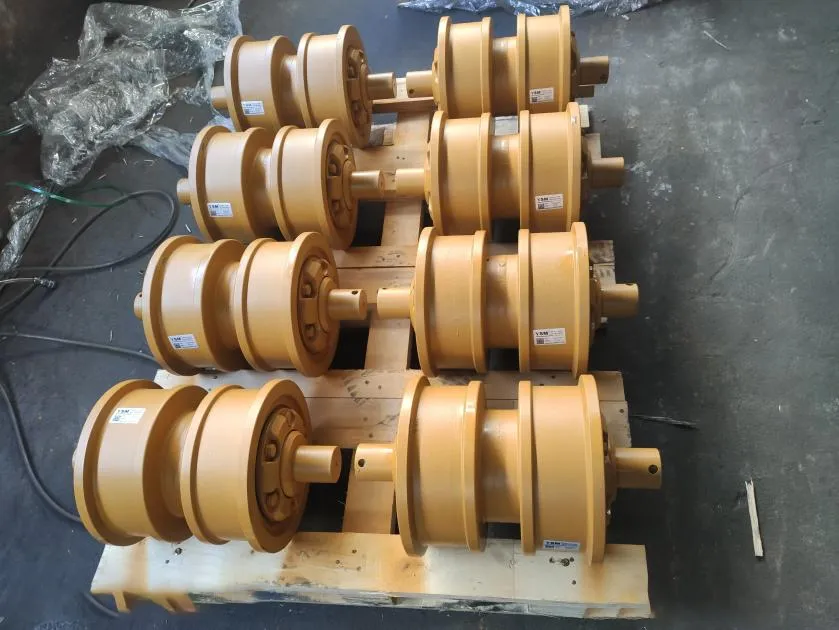
Track rollers carry the machine and guide the link rails. Carrier rollers support the upper chain where fitted. Inspect seals, tread surfaces, flanges and mounting areas. Fresh oil, a flat spot, a cracked flange or a roller that has stopped rotating can increase load on neighboring parts.
Map flange polishing across the track frame. A repeated shiny band on one side may reflect slope work, frequent turning, frame guidance, idler position or chain condition. Replacing the most visibly worn roller without understanding the complete pattern can leave the cause unchanged.
Measure at the designated reference points. Dirt, raised burrs and tool angle can change the result. If access requires lifting the machine or entering a hazardous area, use the service procedure, rated supports and trained personnel.
Elevated Sprocket and Segment Inspection
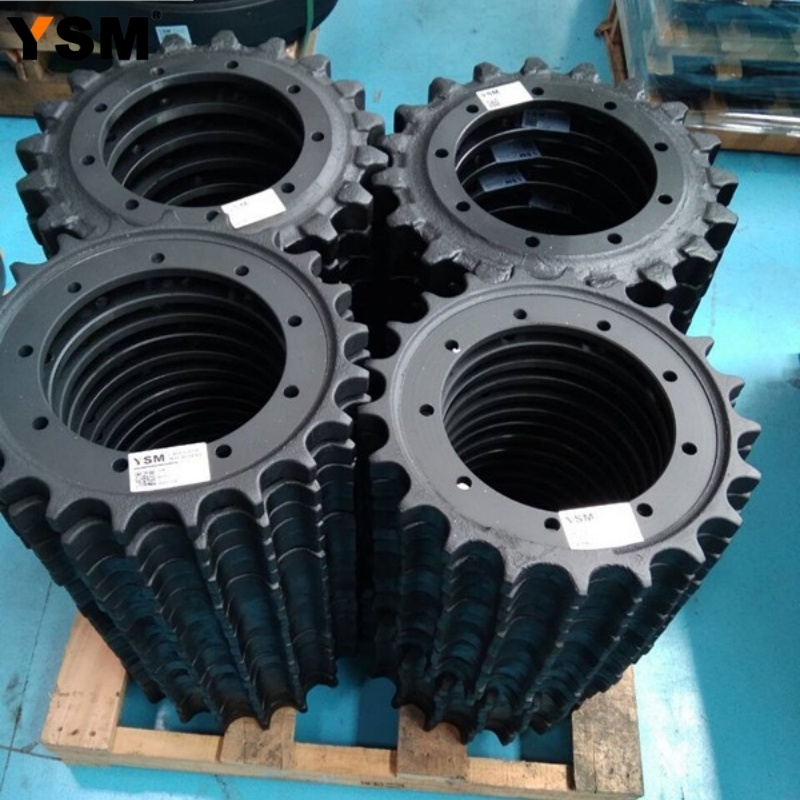
The elevated drive arrangement helps separate final-drive components from some ground shock, but its sprocket segments still wear where they engage the bushings. Inspect tooth faces and roots, side polishing, cracks, packed material and segment hardware.
Hooked, sharp or asymmetric teeth can accompany pitch and bushing wear. Compare the profile around the sprocket because wear may not appear identical at every position. Check chain measurements before deciding whether segments alone should be changed.
New segments working against a severely worn chain, or a new chain engaging severely worn segments, can produce poor contact and accelerated wear. The correct replacement combination depends on measured condition, reuse criteria and the planned service period.
Oil around the elevated-drive area requires source tracing. Clean first and identify where fresh oil begins. Do not attribute every oily sprocket to a segment problem or open a drive assembly without the correct procedure.
Front Idler, Recoil System and Track Tension
The front idler guides the chain and moves with the recoil and adjustment system. Inspect tread and flange wear, leakage, chipping, abnormal side contact, guide condition and material packed around the yoke or track frame. Compare both sides from the same viewing position.
Idler position can reflect chain wear and adjustment reserve, but position alone does not diagnose a failed idler. Relate it to chain measurements, tension history and the correct wear chart.
Track tension affects the whole undercarriage. A track that is too tight can increase loads through pins, bushings, rollers and idlers. A track that is too loose can guide poorly and increase impact or derailment risk. Packing can tighten a track during work, especially in sticky or freezing material.
Never apply a generic sag value. Caterpillar procedures define how to prepare, position and measure the track for a specific machine and configuration. Use the current manual and approved grease-release method. The recoil system stores dangerous energy and must not be opened, heated or cut during routine maintenance.
Track Shoes, Shoe Width and Ground Conditions
Track shoes transfer machine weight and drawbar force to the ground. Inspect plates, grousers, bolt holes and link seating areas for wear, cracks, bending and movement. Loose or missing hardware can allow the shoe to move against the link and damage both surfaces.
Wider shoes can reduce ground pressure and improve flotation in soft conditions. The tradeoff is more shoe width outside the chain support. On firm, rocky or uneven ground, the outer wing may carry greater bending and twisting loads. The correct shoe balances flotation, stability, impact resistance and approved machine configuration.
Do not identify a replacement by width alone. Record the shoe profile, grouser type, bolt-hole pattern, center spacing, plate details and chain interface. Low-ground-pressure and standard arrangements should not be assumed interchangeable.
If shoes crack or bend repeatedly, review ground conditions, impact location, remaining plate and grouser section, hardware clamp, link seating and operator technique. Appearance alone cannot prove a material defect.
Track Frame, Guards and Equalizer-Bar Area
The track frame locates rollers and guides the moving chain. Inspect for cracks, damaged guards, loose or missing hardware, trapped material and fresh contact marks. A polished area can show where chain, idler or debris has been touching, but the complete geometry must be checked before assigning a cause.
Guards can protect components in demanding material while also creating areas that need deliberate cleaning. After removing debris, inspect hidden surfaces and confirm that guards are secure and not bent into the chain path.
The equalizer bar and related mounting areas allow the track frames to respond to terrain. External inspection can identify leakage, looseness, damaged mounting areas or abnormal movement clues. Pin, bearing or structural diagnosis requires the correct service procedure and measurements. Do not work beneath the machine without approved support.
Operating Practices That Influence D6 Undercarriage Wear
Undercarriage wear is shaped by the work cycle. Abrasive material removes metal, impact damages surfaces, packing changes tension and side loading changes contact patterns. Operator technique cannot stop normal wear, but it can reduce avoidable load.
- use gradual turns where production and site safety allow;
- limit unnecessary pivot turns and track spin;
- reduce long high-speed reverse travel when a better work pattern is practical;
- avoid repeatedly operating with the same side downhill when the plan permits variation;
- approach rock ledges and debris to reduce severe side impact;
- clean before packed material hardens or freezes around the tracks;
- review shoe width when the machine moves between soft ground and hard rock;
- record changes in haul distance, slope, material and attachment use.
Production needs and site rules remain important. The goal is to identify repetitive actions that add wear without adding useful work.
Wear Measurement and Repair Planning
A formal undercarriage inspection creates a baseline for maintenance budgeting. Clean each reference point, use calibrated tools and record the actual measurement rather than only a percentage estimate. Include chain, bushings, rollers, idlers, sprocket segments, shoes and adjustment position.
| Observed pattern | Possible contributors | Next check |
|---|---|---|
| One side wears faster | Slope work, turn direction, packing, travel pattern or geometry | Compare operating history and full left-to-right measurements |
| Repeated roller-flange polishing | Side loading, chain guidance, idler position or alignment | Map contact from front idler through all rollers |
| Sprocket teeth hook or sharpen | Pitch change and bushing engagement wear | Measure chain and inspect bushing contact |
| Shoe bolts loosen | Loss of clamp, damaged seating faces, holes or hardware | Inspect shoe, both link pads and approved installation method |
| Track becomes tight during work | Material packing or incorrect adjustment condition | Clean and repeat the model-specific tension procedure |
| One joint or roller runs differently | Lubrication loss, seal problem, impact or internal damage | Confirm with qualified inspection and compare neighboring parts |
Use trends to estimate when components will approach their applicable limits. Remaining service depends on wear rate, future job conditions and risk tolerance; it cannot be promised from a single measurement. Coordinate mating components so a partial repair does not create poor engagement elsewhere.
Cat D6 Undercarriage Parts Fitment Checklist
Provide enough information to separate similar D6 names and configurations before a supplier checks parts:
- equipment brand, complete model, series and every visible suffix;
- product identification number, serial prefix and a clear plate photo;
- part name, required quantity and readable part number where available;
- overall, side, mounting and damaged-area photographs;
- requested dimensions with clearly identified measuring points;
- standard, LGP, VPAT or other known machine configuration;
- shoe width, grouser style, bolt pattern and master connection;
- link count or track-chain identification when requested;
- left or right position where the component is side-specific;
- destination country, soil, rock, impact, slope and travel conditions.
Current D6, D6 XE, D6 GC and older D6 series should not be assumed to share every roller, idler, segment, chain or shoe. Compatibility and availability must be confirmed before ordering.
Frequently Asked Questions
How often should a Cat D6 undercarriage be cleaned?
Inspect and remove harmful packing as operating conditions require, commonly as part of the daily routine. Sticky clay, rock, wire, frozen material or a change in track tension may require additional cleaning during the shift.
Is every Cat D6 undercarriage the same?
No. Generation, serial range, drive configuration and standard or low-ground-pressure arrangement can affect parts. Verify the complete machine and installed track group.
What causes one dozer track to wear faster?
Slope direction, repetitive turns, travel pattern, packing, side loading and geometry can contribute. Compare documented operations and complete wear measurements before diagnosing the cause.
Should new sprocket segments be fitted to a worn chain?
Chain and segments must be evaluated as a mating system. Poorly matched wear profiles can accelerate wear. Follow measurement limits and the repair plan for the exact machine.
Can a universal track-sag value be used?
No. Use the correct Caterpillar procedure, machine preparation, measuring points and value for the exact D6 configuration and condition.
Technical References
- Caterpillar: D6 Dozer Product Page - current model configurations and described undercarriage options.
- Caterpillar: Dozer Undercarriage Maintenance - cleaning, inspection, tension and operating-practice guidance.
- Caterpillar: Planned Maintenance for Cat Dozers at 2,000 Hours - structured maintenance and undercarriage inspection context.
- Caterpillar: Undercarriage for Dozers - undercarriage system, measurement and application context.
This independent educational guide is not affiliated with or endorsed by Caterpillar. Cat, Caterpillar and the model names are trademarks of their respective owner. Always follow the operation and maintenance manual, service instructions, wear chart and site safety procedures for the exact machine.
Ask About Cat D6 Undercarriage Parts
We can check suitable supply options for track rollers, carrier rollers, front idlers, sprocket segments, track chains, track shoes, track assemblies and related undercarriage hardware after reviewing the exact machine and application.
Corporate Email: sales@china-ysm.com
WhatsApp: +86-18606961587
For a fitment check, send the equipment brand, complete model and suffix, serial number or PIN, part name, part number, clear photos, requested dimensions, quantity, destination country and working conditions. Compatibility and availability must be confirmed before ordering.