
Excavator Undercarriage Troubleshooting
Excavator Undercarriage Noise: What Squealing, Clicking, Grinding and Banging May Mean
A new sound from an excavator undercarriage deserves inspection, but sound alone does not identify a failed part. Squealing can come from a dry joint or rolling component; rhythmic clicking may follow one damaged shoe, link or sprocket contact point; grinding may involve a seized roller or trapped material; and banging may be caused by a loose track or hardware. The safest approach is to record when the sound occurs, inspect the complete track system and confirm the cause with measurements.
Quick answer
Stop and inspect an unfamiliar undercarriage noise before it becomes louder or is accompanied by heat, vibration, leakage, tracking problems or visible damage. Clean the track frame, check track tension by the exact machine manual, inspect rollers and idlers for leakage or seizure, examine track-chain joints, shoe hardware and sprocket engagement, and compare both sides. Do not replace a roller, idler or chain from sound alone.
Record the sound before taking parts apart
Undercarriage sounds change with travel direction, speed, ground, temperature, turning and load. Before cleaning or adjustment, record a short video from a safe distance and note the operating condition. A repeatable description is more useful than saying that the machine “sounds bad.”
- Does the sound occur moving forward, in reverse or in both directions?
- Does its rhythm increase directly with track speed?
- Does it appear only while turning, climbing or crossing uneven ground?
- Is it stronger at the front idler, upper chain run, lower rollers or rear sprocket?
- Does it occur on one side or both sides?
- Does cleaning packed material change the sound?
- Is there new vibration, heat, leakage, track wander or loss of travel power?
Use a spotter only under a controlled site procedure. The spotter should stand where the operator can see them and should never walk beside, in front of or behind a moving excavator.
Excavator undercarriage noise patterns and inspection areas
| Sound pattern | Possible inspection areas | Supporting signs | Important limitation |
|---|---|---|---|
| High-pitched squeal or chirp | Dry chain joint, roller, carrier roller, idler, seal or packed material | Heat, leakage, dry joint, polished rubbing mark | Sound can travel through the track frame |
| Regular click or knock | Loose shoe hardware, damaged link, master joint, sprocket contact or trapped object | One event per chain or wheel revolution | The rhythm must be matched to component position |
| Grinding, scraping or rumbling | Seized roller, damaged flange, chain rubbing guard, stone or metal debris | Vibration, flat spot, metal particles, fresh rub marks | Stop promptly if metal-to-metal contact is suspected |
| Heavy bang, pop or clunk | Loose track, chain indexing, worn sprocket, damaged shoe, bent guard or excessive clearance | Track jump, unstable engagement or visible movement | Derailment risk requires controlled inspection |
| Upper-run slapping | Excessive track sag, failed carrier roller, adjuster fault or chain wear | Chain contacting frame or guard | Sag must be measured by the exact manual |
These relationships are screening clues, not diagnoses. One damaged component can create several sounds, and one sound can have several causes. The frame can transmit noise away from its origin.
What can cause squealing or chirping?
A dry sealed-and-lubricated track joint can squeal as the chain articulates around the sprocket or idler. Look for a joint that does not move like its neighbours, shows seal damage, appears dry or runs hotter. Shoe separation or changing joint clearance also deserves attention.
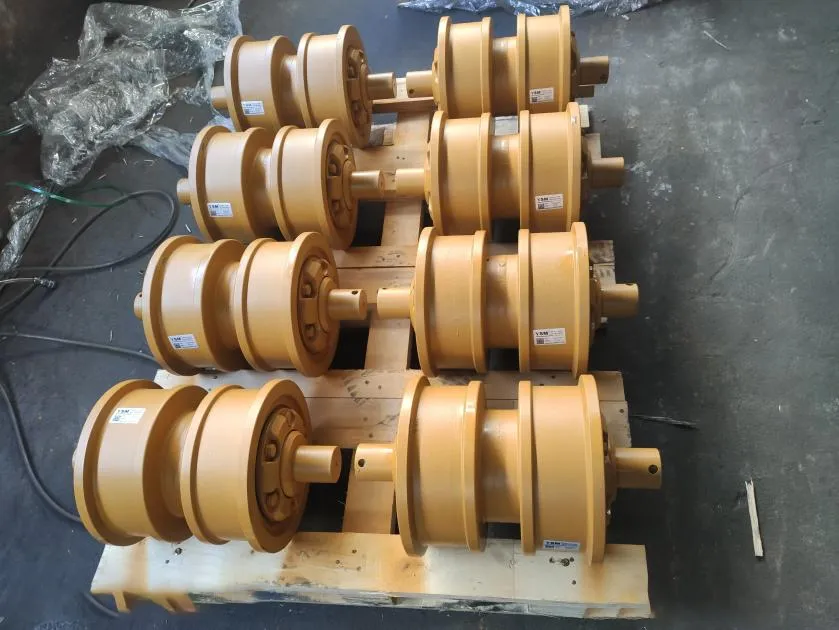
Rollers, carrier rollers and idlers contain internal bearings or bushings and lubricant. A failed seal or internal wear can create friction before the component visibly stops turning. Inspect for oil or grease loss, dirt stuck to a wet seal area, flat wear, discoloration, side play and temperature difference. Do not touch a hot component directly; use an approved temperature-measuring method.
Packed clay, stones or metal debris can also squeal as they rub between the chain, frame and guards. Cleaning is therefore an early diagnostic step. If the sound disappears after cleaning, still inspect the rubbing surfaces for damage and confirm that guards and clearances remain correct.
What can cause clicking or knocking?
A click that repeats at a fixed interval may follow one local defect around the track loop. Mark the track position only after the machine is safely shut down, then compare the apparent interval with shoe spacing, chain joints and sprocket rotation. Look for a cracked or bent shoe, loose bolt, damaged link, abnormal master joint and foreign material caught in the sprocket pocket.
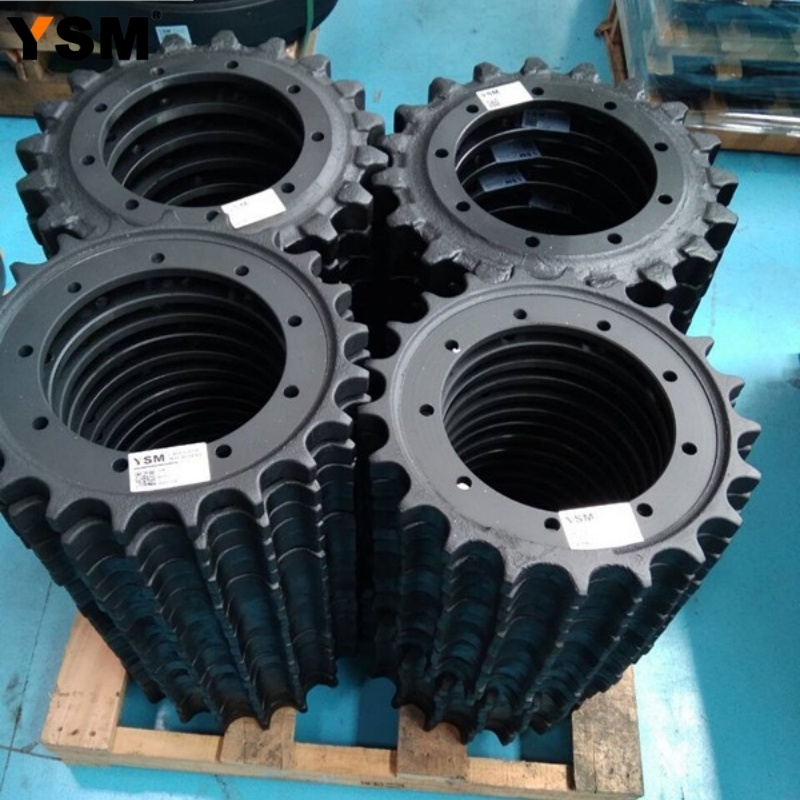
Worn chain pitch and sprocket teeth can change how bushings enter and leave the sprocket. The result may be impact or clicking, especially in one travel direction. Inspect chain and sprocket as a wear pair. Replacing only the visibly sharp sprocket or only the elongated chain can leave mismatched contact.
Loose track-shoe hardware can create a heavy regular knock and polished movement marks around bolt seats. Follow the OEM tightening procedure and fastener specification. Do not simply add torque to stretched, damaged or incorrect bolts.
What can cause grinding, scraping or rumbling?
Grinding deserves prompt attention because it may indicate continuous metal contact. A roller that no longer rotates can develop a flat spot while the link rail slides across it. A broken or worn flange can allow the chain to rub the frame or guard. An idler that does not rotate smoothly may produce wear on its tread and the chain rails.
Fresh shiny lines, metal dust, heat and a smell of hot lubricant help locate contact. Compare the same position on the opposite side, but remember that left and right duty can differ. A bent track guard, damaged frame or misaligned idler can create rubbing even when the roller itself remains serviceable.
Low rumbling can also come from the travel drive, final drive, slew system or work attachment rather than the undercarriage. If the noise occurs while the upper structure moves but the tracks remain stationary, do not assume a track component is responsible. Professional testing may be needed.
What can cause banging, popping or track slapping?
Excessive sag can allow the upper chain run to contact a guard or frame. A failed carrier roller may remove support and change the point of contact. A loose chain can also engage the sprocket inconsistently or derail during turning and uneven travel.
Track tension must be measured in the exact condition and at the location defined by the machine manual. There is no universal sag number. Mud, ice and debris may pack into the undercarriage and make a track tighter during operation, so record whether the sound appeared before or after cleaning.
A bang under load may also come from a cracked shoe, broken bolt, damaged link, bent guard or severe sprocket wear. Stop rather than repeatedly driving over the sound to identify it. Repeated impact can enlarge the original damage.
Safe diagnostic sequence for undercarriage noise
- Record the condition. Note when the sound started, recent work, impacts, derailments and adjustments.
- Perform a controlled listening check. Use a trained operator, safe separation and the lowest appropriate travel speed.
- Park and isolate. Lower the attachment, shut down and follow the manual before close inspection.
- Clean both track systems. Remove material without damaging seals.
- Inspect shoes and hardware. Look for movement, cracks, missing fasteners and fresh contact marks.
- Inspect chain joints and rails. Check dry joints, pitch, rail wear and side contact.
- Inspect rollers and idlers. Compare leakage, wear profile, flanges, rotation evidence and temperature.
- Inspect sprocket engagement. Look for abnormal tooth and bushing contact, cracks and loose segment hardware.
- Check track tension. Use the exact machine procedure and record both sides.
- Request professional testing. Lifting, track removal, stored-pressure work and internal final-drive diagnosis require suitable equipment and training.
Common undercarriage-noise diagnosis mistakes
- Replacing the nearest part: noise can travel through the frame.
- Assuming every squeal is a roller: dry joints, idlers and trapped debris can sound similar.
- Ignoring rhythm: track-speed-related repetition helps separate local contact from continuous friction.
- Testing beside a moving track: diagnosis never justifies entering a hazardous area.
- Overtightening the track: this can hide slapping while adding load and wear.
- Checking only one side: the opposite side provides a useful reference.
- Continuing after grinding or impact: a small fault can damage mating parts.
- Ordering from a photo alone: similar-looking rollers and idlers may have different shafts, mounting dimensions and applications.
When should the excavator stop operating?
Stop in a safe location if grinding or banging increases, a roller or idler appears seized, a track jumps or repeatedly derails, a shoe or link is cracked, hardware is missing, fresh lubricant loss is substantial, metal particles appear, the track contacts the frame, or new vibration and heat accompany the noise. Also stop if travel response changes or the machine pulls unexpectedly.
Do not remove the track, open the adjuster or dismantle heavy components without the correct service procedure, lifting equipment, supports and stored-energy controls.
Undercarriage parts and fitment information
When inspection confirms a worn part, evaluate its mating components. A seized roller may have damaged the link rail. An elongated chain may no longer match the sprocket. A leaking idler may also involve slide, adjuster or alignment problems.
Prepare the machine brand, complete model and suffix, serial number or PIN, part name and position, part number where available, full-side and close-up photos, sound video, track pitch, link count, shoe width, mounting dimensions, measurements, quantity and destination country.
We can review matching track rollers, carrier rollers, front idlers, sprockets or segments, track chains, track shoes, track groups and related fasteners for suitable excavator and bulldozer applications. Compatibility and availability must be confirmed from the complete machine and part information before ordering.
Frequently asked questions
Why does my excavator squeak when travelling?
Possible causes include a dry chain joint, leaking or worn roller, carrier roller or idler, packed debris or another rubbing point. Clean and inspect the complete system; do not identify the part from the sound alone.
Can a loose track make a banging sound?
Yes, excessive sag can allow slapping or unstable sprocket engagement, but damaged hardware, guards, shoes and rollers can produce similar sounds. Measure tension using the exact model manual.
How do I find which roller is noisy?
After safe shutdown, compare leakage, temperature, flat spots, contact marks and wear at every roller position. Removing a track or rotating components individually is professional service work requiring controlled support and stored-energy procedures.
Does a grinding sound mean the final drive is failing?
Not necessarily. A seized roller, rubbing guard, damaged idler or trapped material can grind. If the symptom persists after undercarriage checks, qualified testing can separate travel-drive and final-drive causes.
Should I replace the chain and sprocket together?
Measure both and compare them with the relevant wear limits. They operate as a contact pair, but the replacement decision depends on actual dimensions, wear profile and service plan.