
Used Excavator Buying Guide
Used Excavator Undercarriage Inspection: A Buyer's Checklist Before Purchase
A clean paint finish and low hour-meter reading do not prove that a used excavator has a healthy undercarriage. Ground conditions, travel distance, turning habits, track tension and maintenance can produce very different wear on machines with similar hours. Before bidding, paying a deposit or arranging export, identify the exact machine and document the track chains, shoes, rollers, idlers, sprockets, guards and adjusters with consistent measurements.
Quick answer
Inspect both sides on clean, level ground. Verify the serial number or PIN, compare the hour meter with records, photograph every component, measure track-chain pitch and wear points with the correct OEM method, inspect rollers and idlers for leakage and profile loss, check sprocket engagement, shoe condition and hardware, then perform a controlled travel test. Do not accept a seller's unsupported “percentage remaining” or estimate remaining life from hours alone.
Verify the excavator's identity and operating history
Begin with the machine nameplate. Record the manufacturer, full model, suffix, product identification number or serial number, year where documented and market specification. Compare the plate with sale documents, customs papers, service records and any electronic machine data available. A model family name without the serial range may be insufficient for parts identification.
Photograph the hour meter before starting the machine, but treat it as one data point. Ask for maintenance records, previous undercarriage measurements, major repairs, track-chain or sprocket replacement, working material, attachments and typical travel. Quarry rock, sand, mud, demolition debris and long-distance travel create different wear patterns.
Look for signs that condition has been disguised: fresh paint only on wear components, recently washed wet areas, uneven cleaning, new hardware on one section, missing labels or measurements that cannot be repeated. Fresh paint is not proof of a problem, but it should not replace inspection.
Prepare a repeatable used excavator inspection
Bring a flashlight, camera, straightedge, measuring tape, suitable calipers or depth gauges, chalk or removable markers, mirror and the correct OEM wear chart or inspection method. Generic measurements from another excavator cannot be converted into a reliable wear percentage.
- Ask that the machine remain cold before the inspection where a cold-start check is planned.
- Place it on dry, stable and level ground with enough room for a safe walkaround and travel test.
- Clean packed material from both undercarriages while preserving visible leak evidence.
- Take full left- and right-side photos from the same angle.
- Number roller positions from front to rear and label every measurement by side and position.
- Record shoe width, track pitch, link count and visible part numbers.
- Note ground, temperature and track position so another inspector can reproduce the check.
How to inspect used excavator track chains and joints
Track-chain condition cannot be judged only by the amount of visible sag. Sag is an adjustment measurement, while pitch and link dimensions show wear. Measure a defined number of links using the OEM procedure, then compare the result with the correct chart for the exact chain. Use consistent pin-center references and apply the required track tension or machine position before measuring.
Inspect each visible joint for dry seals, oil loss, rust around a formerly lubricated joint, cracking and unusual articulation. A joint that remains straight while neighbouring joints bend around the sprocket or idler may be stiff. Shoe separation, changing joint gaps or side movement may indicate wear or damage.
Examine link rails where they contact bottom rollers, carrier rollers and the idler. Measure rail height or other specified dimensions. Compare inner and outer rail wear, left and right tracks, and front-to-rear patterns. Strong one-sided contact can point to alignment, flange, guard, slope-work or shoe-width issues rather than uniform service wear.
How to inspect track shoes, grousers and fasteners
Record shoe type and width. Look for bent edges, cracked plates, broken grousers, elongated bolt holes, missing bolts and polished movement around seats. Measure grouser height only at the defined point and compare shoes from several positions. A new-looking replacement shoe among heavily worn neighbours can hide a local impact history.
Excessively wide shoes on firm uneven ground can increase overhang and bending load. Outer-edge cracking or bolt-hole damage should trigger a review of shoe width, application and chain condition. A narrow shoe on weak ground may show deep penetration and high slip, but the correct choice still depends on the approved machine configuration.
Do not assume new bolts correct damaged holes or seating faces. Check whether hardware type, length and specification are consistent. Evidence of welding on wear plates or grousers should be assessed for quality and suitability by a qualified inspector.
How to inspect track rollers and carrier rollers
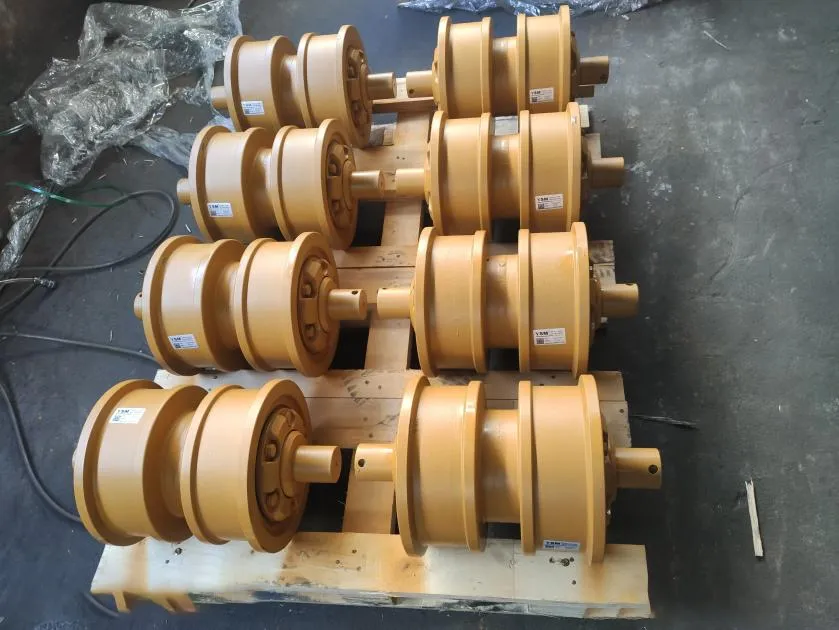
Bottom rollers carry machine weight and guide the chain rails. Inspect every position for oil leakage, wet dirt around seals, flat areas, chipped or thin flanges, abnormal side wear and impact damage. Measure the tread or wear surface using the correct point and method. An average can hide one severely worn or seized roller, so keep each position separate.
Carrier rollers support the upper chain run. Check tread profile, flange condition, leakage, alignment and evidence that the chain has been rubbing the frame. Packed material can restrict rotation and create flat wear. A sagging upper run is not proof that the carrier roller alone has failed; track tension and chain wear also matter.
After a controlled test and safe shutdown, compare temperatures with an approved non-contact method. One substantially hotter position can be an inspection signal, but temperature depends on travel direction, duration, load and ambient condition. It is not a stand-alone failure limit.
How to inspect the front idler, slides and track adjuster
Inspect the idler tread and flanges for ridging, uneven contact, cracks and leakage. Compare left and right flange wear. Look at the idler's position in the track frame, slide surfaces and signs of side contact or restricted movement. Fresh polished marks may reveal misalignment or a chain that is not running centrally.
Record the adjuster position and remaining visible travel where the OEM method allows. An idler near the end of its adjustment range may reflect chain pitch wear, incorrect parts or cumulative wear; it does not prove that one link can simply be removed. Inspect for grease leakage and damaged access covers.
Measure track sag exactly as the manual specifies. The required position and range vary with undercarriage design, carrier rollers, track type and working condition. Reject universal “finger-gap” or millimetre claims that are not tied to the exact model.
How to inspect sprockets or segments
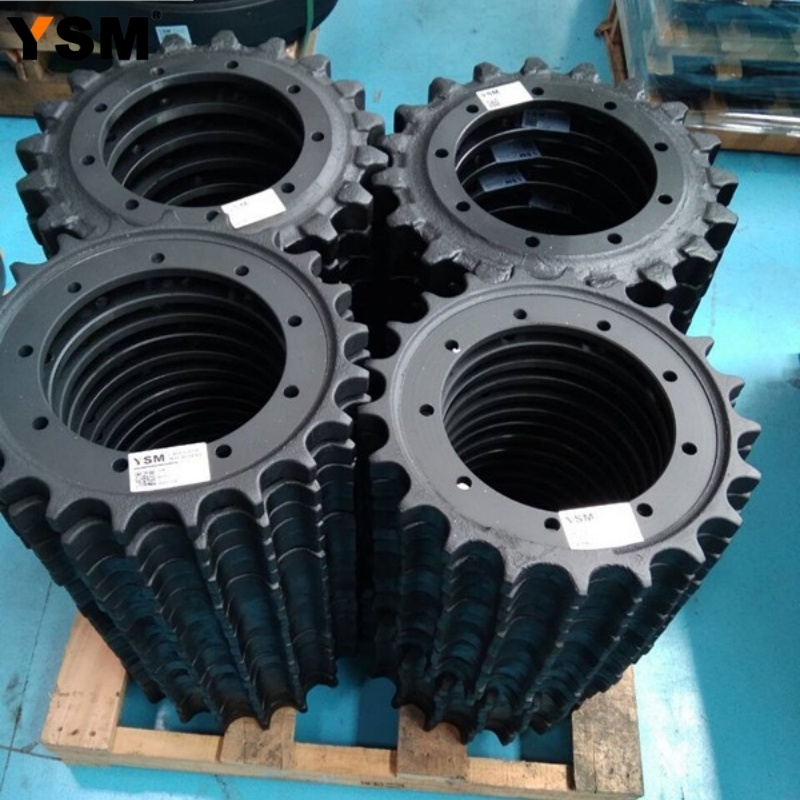
Inspect every accessible tooth, not only the most visible one. Look for asymmetric wear, thin or pointed profiles, broken tips, cracks, loose segment bolts and foreign material in the pockets. The common description “shark-fin teeth” is useful visually, but a replacement decision should use the appropriate profile or measurement standard.
Observe how bushings enter, seat in and leave the sprocket during a controlled test from a safe distance. Clicking, jumping or uneven engagement may involve chain pitch, tension, sprocket wear, alignment or trapped debris. Inspect the chain and sprocket together because they form a wear pair.
Check for final-drive leakage around the sprocket area, but do not confuse a travel-drive leak with roller, idler or adjuster lubricant. Trace the source after cleaning and follow the relevant service procedure.
Controlled travel checks before purchase
After the static inspection and only where the site permits, use a trained operator to travel slowly in a clear area. The inspector must remain outside the travel and swing zones. Observe both directions and gentle turns without aggressive pivoting.
| Observation | Possible inspection areas | Do not conclude yet |
|---|---|---|
| Machine pulls to one side | Track tension, rolling resistance, chain wear, travel motor or hydraulics | One undercarriage part is not automatically the cause |
| Rhythmic click or knock | Shoe hardware, local link damage, sprocket engagement or debris | Sound can travel through the frame |
| Grinding or strong vibration | Seized roller, damaged flange, rubbing guard or travel drive | Stop before repeated testing enlarges damage |
| Track wanders sideways | Idler and roller flanges, guards, alignment, tension and shoe loading | Ground slope may change the apparent pattern |
| Track jumps or slaps | Sag, adjuster, chain pitch, sprocket and carrier roller | Overtightening is not a complete repair |
Also inspect the complete excavator—engine, hydraulics, swing bearing, structure, attachment, cylinders, electrical system, controls and safety equipment. This article focuses on the undercarriage, not the whole purchase decision.
Turn inspection findings into a purchase report
Separate findings into four groups: serviceable now, monitor, repair soon and stop-use or replace. Attach photos and measurements to every significant item. Distinguish visible fact from interpretation—for example, “left front roller has fresh oil at the seal area” is a fact; “roller requires replacement” is a conclusion that should follow the service criteria.
Prepare a parts plan that includes mating components, labour, lifting, transport, customs and downtime, but do not invent costs. Obtain current quotations for the exact machine and destination. If the sale is remote, request continuous walkaround, cold-start and travel videos plus close-ups with a measuring reference. A polished promotional video is not a substitute for inspection access.
High-risk findings include cracked links or shoes, multiple seized or leaking rollers, severe frame or guard damage, repeated derailment, adjuster leakage, heavily mismatched chain and sprocket wear, missing identity data and measurements that the seller will not allow to be verified.
Replacement planning and fitment information
If the machine remains a suitable purchase, collect complete fitment data before ordering undercarriage parts. Similar models may use different track pitch, link count, shoe width, roller shaft or mounting dimensions and sprocket configuration.
- machine brand, full model, suffix and serial number or PIN;
- nameplate, hour-meter and full undercarriage photographs;
- part names, positions and part numbers where visible;
- track pitch, link count, shoe width and bolt pattern;
- roller, idler and sprocket measurements or drawings;
- inspection report and intended repair scope;
- quantity and destination country.
We can review suitable track rollers, carrier rollers, front idlers, sprockets or segments, track chains, track shoes, track groups and related fasteners for many mainstream excavator and bulldozer applications. Compatibility and availability must be confirmed from the complete model, serial number, part number, clear photos and requested dimensions before ordering.
Frequently asked questions
Can operating hours tell me how much undercarriage life remains?
No. Hours provide context, but wear depends on ground, travel, turning, maintenance, tension and component history. Use measurements and the correct OEM criteria.
What is the most important undercarriage measurement on a used excavator?
No single measurement is enough. Track pitch, link rails, rollers, idlers, sprockets, grousers and tension should be assessed together and by position.
Are pointed sprocket teeth always worn out?
A thin or hooked profile is an important warning sign, but compare it with the correct profile or service data and inspect chain engagement before deciding.
Should a seller provide an undercarriage wear percentage?
A percentage is useful only when it includes raw measurements, reference dimensions, method and component-by-component results. Ask how it was calculated.
Can I inspect a used excavator remotely?
Remote evidence can support screening, but a qualified independent inspection is safer before payment. Request the serial plate, continuous videos, detailed measurements and photos that can be verified.
Should all worn undercarriage parts be replaced at once?
Not automatically. Plan replacement around measurements, mating-component compatibility, safety, expected use and labour access. Avoid installing new parts into a severely mismatched wear system.