
Forestry applications | Excavator undercarriage
Forestry Excavator Undercarriage Maintenance for Stumps and Slash
Forestry land clearing exposes a crawler excavator to stumps, roots, slash, rocks, side slopes and soft ground in the same shift. These conditions can pack debris around rollers, bend guards, loosen shoe hardware and apply twisting loads to the track. A useful maintenance plan starts with route control, safe daily cleaning, repeatable inspection and machine-specific wear measurements.
Why Forestry Conditions Change Excavator Undercarriage Wear
Construction excavation often provides a relatively predictable travel surface. Forestry work does not. A cleared path may alternate between wet soil, buried rock, root mats, cut stumps and cross slopes. Each condition changes the forces entering the track shoes and chain.
A stump beneath one shoe creates a concentrated load rather than supporting the full track evenly. Traveling across a root or log can twist the chain and press shoe edges against guards. Woody debris may ride into the sprocket or collect on top of the track frame. Mud holds bark and chips around rollers, while steep travel can load the downhill side differently from the uphill side.
These observations are not a diagnosis by themselves. One bent shoe may result from an isolated impact. Repeated shoe-edge contact may point toward operating route, shoe width, guard position, track tension or frame alignment. Maintenance teams should record the evidence before deciding which part caused the pattern.
Pre-Start Inspection and Route Planning
Begin on level, stable ground with adequate light. Walk around the machine before starting and compare both tracks. Look for branches under the frame, wire around the final-drive area, loose guards, missing bolts, fresh leakage and a track that sits differently from the opposite side.
- Confirm every visible shoe and master-joint fastener is present.
- Check whether any shoe is bent upward, cracked or pulled away from the link.
- Inspect accessible guards for loose bolts, bent edges and contact with moving parts.
- Look for oil at lower rollers, carrier rollers and the front idler.
- Check the chain for stiff joints, separation, abnormal pitch or dry-joint clues.
- Confirm that branches, cables or straps are not wrapped around the sprocket or final-drive area.
Route planning is part of inspection. Identify stumps, rock outcrops, deep ruts and side slopes before travel. Plan a path that keeps the track as fully supported as practical. Do not rely on the undercarriage to crush every obstacle. If a stump or log must be moved, use the approved work tool and procedure rather than driving a track onto a concentrated point.
Safe Cleaning After Stump and Slash Work
Clean before bark, mud and woody fibers become tightly packed. Park on an approved level area, lower the bucket or forestry attachment, apply the parking controls, stop the engine and isolate energy. Photograph unusual packing or damage first so the evidence is not lost.
- Remove loose surface debris: use a long-handled tool from outside the track loop. Do not pull a branch that is visibly bent under tension toward your body.
- Clear the top of the frame: bark and chips can block carrier rollers or remain hidden behind support guards.
- Inspect the inner run: look from safe accessible angles for wood between links, rollers and guides. Do not crawl beneath the machine.
- Use controlled washing when allowed: remove packed soil without directing concentrated pressure at seals, pins, breathers or service-sensitive points.
- Reinspect after cleaning: check for bright impact marks, cracked welds, displaced guards, oil leakage and fresh metal exposed beneath debris.
Wire, fencing and cable require special caution. They can tighten around rotating parts and spring back when cut. Isolate the machine and use approved cutting tools, eye protection and a controlled removal plan. If the material enters behind a guard or final-drive cover, qualified service access may be necessary.
Forestry Excavator Undercarriage Component Checks
| Area | What to inspect | What the finding may mean |
|---|---|---|
| Track shoes and bolts | Cracks, bent corners, loose or missing hardware, polished shoe edges and uneven grouser wear | Impact, side loading, loose hardware, shoe choice or repeated obstacle contact |
| Links, pins and bushings | Stiff joints, seal-area contamination, pitch variation, rail wear and external bushing contact | Internal wear, contamination, tension, sprocket engagement or misalignment requires further checking |
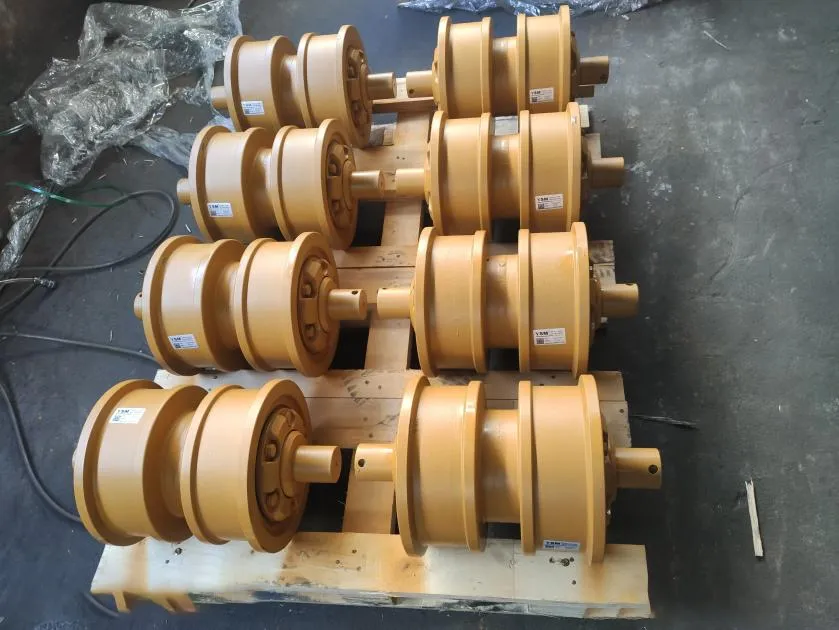
| Lower rollers | Oil leakage, seized rotation, flange contact, shell damage and woody packing | Seal failure, impact, abnormal guidance or debris blocking normal rotation |
| Carrier rollers | Debris on the frame, leakage and upper-chain sliding marks | A blocked roller may force the chain to slide instead of roll |
| Front idler | Guide wear, leakage, damaged supports and material restricting movement | Impact, alignment, contamination or recoil-system condition needs evaluation |
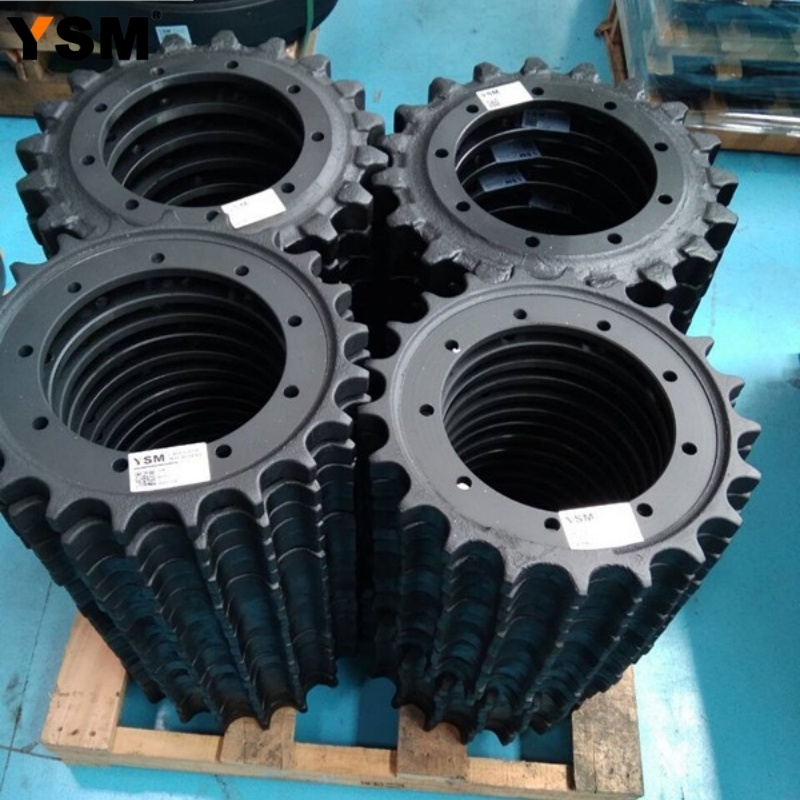
| Sprocket | Broken or loose hardware, tooth-profile change, packed roots and asymmetric engagement | Chain pitch, bushing wear, loading direction and sprocket condition interact |
| Track frame and guards | Bent plates, cracked welds, missing fasteners, packed wood and fresh contact marks | Obstacle impact or repeated chain contact; guard removal is not automatically the correct answer |
Inspect left and right sides in the same order and photograph the same locations. A clean sequence makes changes easier to detect. Leaks, noise, heat and unusual wear are inspection signals, not proof that one named component is the only cause.
Guards, Track Shoe Selection and Track Tension
Understand the guard configuration
Forestry machines may use full-length shoe-support guards, roller guards, final-drive protection or a high-and-wide undercarriage. A standard construction excavator may have a different arrangement. More guarding can reduce impact exposure but may also hide packed material. Inspect the actual configuration and keep its cleaning access points open.
A bent guard that touches the chain can create its own wear pattern. Do not straighten, remove or add guards without checking the manufacturer-approved configuration, mounting condition and machine application.
Do not choose shoes by width alone
Wide shoes can improve flotation in soft ground, but additional width also changes leverage on shoes and links when one edge lands on a stump or rock. Select the narrowest shoe that still provides the required flotation and stability for the site, subject to the OEM options for the exact machine.
Measure tension after cleaning
Roots, bark and mud can change apparent track sag. Clean the specified area and place the machine in the exact measurement condition described in the manual. Never apply a universal sag number. Releasing or adding adjuster grease involves stored pressure and requires the prescribed safe procedure.
Operating Habits on Slopes, Stumps and Uneven Ground
Minimize unnecessary travel and counter-rotation. Use gradual turns while moving when site conditions allow. Repeated pivot turns on roots or rock can push debris into the track and increase side loading. Approach obstacles squarely when crossing cannot be avoided, and keep the machine within its approved operating limits.
Travel up or down a slope rather than across it where the site plan, machine manual and safety assessment permit. Cross-slope travel can load the downhill rollers, guides and shoe edges differently. Never use this general advice to exceed the machine's rated slope or stability limits.
Avoid placing the excavator so the sprocket is repeatedly closest to digging or pushing forces when the manual recommends another orientation. Reduce high-speed reverse travel and long nonproductive moves. If the track begins climbing a sprocket, pulling to one side or producing severe chain slap, stop and inspect rather than applying more travel power.
Wear Measurement and Repair Planning
Record machine hours, site section, ground condition, slope direction, debris type, cleaning completed and any unusual impact. Keep overview and close-up photos of both sides. If a shoe, roller or guard is replaced, record the part, position, date and reason.
A qualified undercarriage inspection may measure link pitch, rail height, bushing diameter, roller and idler treads, grouser height and sprocket profile. Use the exact reference points, tools and limits for the installed undercarriage. Do not transfer a wear percentage from a different model or component design.
Plan repairs at system level. A new chain may engage poorly with severely worn sprockets. A new roller will not correct a bent frame or a guard rubbing the links. One damaged shoe may be repairable within an approved scope, while repeated shoe failures require investigation of route, width, hardware, tension and alignment.
Forestry Excavator Undercarriage Parts Fitment Checklist
For track rollers, carrier rollers, idlers, sprockets, chains, shoes, bolts, guards or related parts, provide:
- equipment brand, complete model and every suffix;
- serial number or PIN and a clear nameplate photograph;
- standard, forestry, high-and-wide or other undercarriage configuration;
- part name, quantity and any readable part number;
- overview, mounting and damaged-area photographs after cleaning;
- requested dimensions taken with the agreed method;
- shoe width, link count, track gauge and guard arrangement where relevant;
- working conditions and destination country.
Do not assume a forestry conversion uses the same components as the standard excavator. Larger-class rollers, alternative guards, different shoe widths or modified frames may be installed. Compatibility and availability must be confirmed before ordering.
Frequently Asked Questions
Can an ordinary construction excavator use forestry undercarriage parts?
Not automatically. Forestry machines may use different frames, rollers, guards, track pitch or shoe configurations. Confirm the serial number, installed arrangement and dimensions.
Should full-length track guards always be added?
No. Guard choice depends on machine design and application. Incorrect guarding may trap debris or contact the chain. Use an approved configuration.
Are wider shoes always better in forests?
No. They may improve flotation, but stump and rock contact can create greater bending leverage. Balance flotation and impact using approved shoe options.
Can a branch be pulled out while the machine idles?
No. Park, lower the attachment, stop and isolate the machine. Treat bent branches and wire as stored-energy hazards.
What causes repeated one-sided roller-flange wear?
Possible contributors include slope travel, guards, alignment, shoe choice, tension, frame condition and component wear. Measurements and operating records are needed before diagnosis.
Technical References
- Caterpillar: Your Six-Step Excavator Maintenance Checklist - daily cleaning and component inspection.
- Komatsu PC290LL-11 forestry machine - forestry-specific undercarriage and guarding context.
- Komatsu PC290LL-11 brochure - roller support, guard and debris-control configuration.
- Tigercat: Track Maintenance for Forestry Equipment - forestry terrain, operating and inspection considerations.
This general article does not replace the exact machine operation and maintenance manual, forestry safety plan or qualified inspection.
Ask About Excavator Undercarriage Parts for Forestry Work
We can check suitable supply options for track rollers, carrier rollers, front idlers, sprockets, track chains, track shoes, bolts and related undercarriage parts after reviewing the exact machine and forestry application.
Corporate Email: sales@china-ysm.com
WhatsApp: +86-18606961587
For a fitment check, send the equipment brand, complete model and suffix, serial number or PIN, part name, part number, clear photos, requested dimensions, quantity, destination country and working condition. Compatibility and availability must be confirmed before ordering.