
Excavator Track Chain Inspection Guide
How to Check Excavator Track Chain Wear: Pitch, Rails, Pins and Bushings
Excavator track chain wear cannot be judged from track sag or appearance alone. A useful inspection combines pitch measurement, link-rail measurements, bushing and joint checks, sprocket contact, shoe condition and left-to-right comparison. The results must then be compared with the wear data for the exact machine and chain specification.
Quick answer
Clean the undercarriage, identify the exact machine and track-chain specification, then record measurements at consistent locations on both sides. Measure chain pitch across several joints rather than relying on one link, inspect link-rail height and profile, check bushing wear around the sprocket contact area, and look for dry or seized joints. Do not use one universal percentage or millimetre limit: new dimensions, service limits and measuring points vary by model and undercarriage design.
Why excavator track chain wear needs measurement
A chain may still move the machine even when its internal and external wear is no longer balanced. Track sag can be adjusted by moving the front idler, so acceptable-looking sag does not prove that pins and bushings have little wear. New paint, mud or a recently adjusted tensioner can also hide useful visual clues.
Measurements provide a repeatable record. When the same points are checked at regular intervals, a maintenance team can compare the left and right tracks, identify unusual wear rates and plan work before a breakdown. A single measurement is useful, but a trend recorded with the same method is more informative.
The aim is not to create a replacement decision from one number. Pitch, rail, bushing, sprocket and shoe measurements answer different questions, and the condition of the whole undercarriage influences the final repair plan.
What parts of an excavator track chain wear?
| Track-chain area | Main contact or load | What wear may change |
|---|---|---|
| Pins and internal bushing surfaces | Articulation as the chain travels around sprocket and idler | Effective pitch, joint clearance and ability to retain lubricant |
| Bushing outside diameter | Repeated engagement with drive-sprocket teeth | Bushing profile, wall thickness and sprocket contact pattern |
| Upper link rails | Track rollers, carrier rollers and idler tread | Rail height, profile, side guidance and load distribution |
| Link sides and bosses | Roller flanges, idler flanges, guides and side loads | Side clearance, alignment and resistance to derailment |
| Shoe mounting faces and holes | Clamping force from shoe bolts and loads from the ground | Shoe movement, bolt seating and link damage |
| Seals and lubricated joints | Contaminants, impact, articulation and lubricant retention | Dry joints, heat, noise and accelerated pin-and-bushing wear |
Track-chain construction varies. Excavators may use dry, sealed, grease-lubricated or other chain designs depending on machine size and specification. Do not assume that a service method used on one dozer or excavator chain applies to another.
Tools and information to prepare
- machine brand, complete model, serial number or PIN and current operating hours;
- track-chain part number, pitch and link count if known;
- the applicable OEM wear chart, service manual or inspection software;
- a clean steel tape or suitable long-range measuring tool;
- calipers, depth gauge or dedicated undercarriage wear tools specified for the component;
- chalk or removable marker for identifying repeated measuring points;
- a record sheet for left and right measurements, photos, ground conditions and date;
- appropriate personal protective equipment and safe access equipment.
Check the measuring tool's condition and zero before use. A worn tape hook, damaged caliper jaw, dirt trapped between surfaces or inconsistent measurement point can create a misleading result. If a measurement is close to a service limit, repeat it and request a professional undercarriage inspection.
How to measure excavator track-chain pitch
Track pitch is the nominal distance from one pin centre to the next. As internal pin-and-bushing contact surfaces wear, the effective length across several joints can increase. This is often described as pitch extension or apparent chain elongation; the steel links themselves are not simply stretching like an elastic material.
General field method
- Clean and position the track. Remove packed material and follow the OEM procedure for placing the chain in the specified measuring condition.
- Select a straight chain run. Avoid measuring across the curved section around the sprocket or idler unless the service procedure specifically requires it.
- Place the joints in a consistent load direction. Slack within several joints can alter the reading. Use the machine-specific procedure rather than pulling the chain by an improvised method.
- Mark the start and finish references. Use the same feature at both ends, such as matching pin-centre references or the same edge orientation.
- Measure across several pitches. A multi-joint span reduces the effect of small placement errors. Caterpillar's general excavator guidance refers to running a tape across five links, but the correct span and endpoints must come from the applicable service method.
- Repeat the measurement. Check more than one section and record the left and right sides separately.
- Compare with the correct data. Use the new dimension and service limit for that exact chain part number and measuring span.
Common pitch-measurement mistakes
- measuring one joint and multiplying a reading that includes placement error;
- using the outside edge of one pin and the opposite edge of another;
- measuring a slack chain in a different condition each time;
- comparing a multi-link total with a single-pitch specification;
- assuming two chains with similar shoe width use the same pitch;
- using a generic percentage instead of the correct wear chart.
How to check track-link rail wear
The link rails form the running surface used by the track rollers. Rail wear is external and should be considered separately from internal pitch wear. A chain can have significant rail wear without the same percentage of pitch extension, or the reverse.
- Clean the rail top and the specified lower reference surface.
- Identify the exact measurement point shown in the wear chart; link geometry is not identical across chain designs.
- Measure link height or rail height with the recommended caliper, depth gauge or dedicated tool.
- Check several links away from obvious impact damage and compare both tracks.
- Record both the dimension and the rail profile. A flat, scalloped or uneven surface can provide context that one height number misses.
Also inspect the rail sides. Strong contact with roller or idler flanges may indicate side loading, misalignment, worn flanges, incorrect guards, slope operation or repeated turning in one direction. The wear mark identifies contact; it does not confirm the root cause by itself.
How to inspect pins, bushings and track joints
Bushing outside wear
The drive sprocket contacts the outside of the bushings. Clean several bushings and inspect the driving surface for flattening, uneven profile, cracking, heavy impact marks or abnormal contact. Where the service procedure calls for a diameter measurement, use the specified tool and orientation. A bushing can wear unevenly, so one convenient caliper position may not represent its minimum remaining section.
Dry or seized joints
Possible signs include squealing, a joint that does not articulate normally, lubricant loss, metal dust, shoe separation or one pin area running hotter than neighbouring joints. Treat heat as a warning, not a touch test: components may cause burns after operation. Thermal comparison and closer inspection should be performed with the appropriate procedure.
Pin ends, seals and master joint
Look for movement, seal damage, displaced components, cracked links and differences between adjacent pin ends. Identify the master-joint design and inspect it according to the manufacturer's instructions. Do not attempt to press, weld or improvise a repair on a loaded track chain.
Can pins and bushings be turned?
Pin-and-bushing turning is applicable to some undercarriage designs, particularly certain dozer track systems, but it is not a universal excavator repair. Chain design, previous service, bushing condition, rail wear and available press tooling all matter. A qualified specialist should confirm whether the specific chain is serviceable and whether turning remains technically and economically appropriate.
Check the sprocket, rollers, idler and shoes with the chain
An excavator undercarriage works and wears as a system. Before deciding that only the track chain needs attention, inspect the components that contact it.
| Related component | What to inspect | Relationship to chain wear |
|---|---|---|
| Drive sprocket | Tooth profile, cracks, loose hardware and bushing contact pattern | A worn chain and sprocket may no longer share load correctly |
| Bottom track rollers | Tread and flange wear, leakage, rotation, alignment and unusual heat | Roller condition affects rail loading and side guidance |
| Carrier rollers | Tread wear, leakage, rotation and material packing | The upper chain run can develop abnormal contact or sag |
| Front idler | Tread, flanges, alignment, leakage and adjuster travel | The idler guides the chain and influences the available adjustment range |
| Track shoes and hardware | Grouser height, bent plates, loose bolts, cracked holes and movement marks | Shoe loads and width influence link and joint loading |
| Track guards and frame | Rubbing, bending, cracks, missing bolts and alignment | Side interference can accelerate link-side and flange wear |
Track tension is part of this system check. Excessively tight or loose tracks can accelerate wear or increase derailment risk. Use only the model-specific sag measurement and adjustment procedure; no single sag dimension is correct for every excavator.
Measurement principle
Record dimensions, not just “good” or “bad.” Compare the same locations using the same tools and machine condition. Use the correct OEM new specification and service limit to calculate or interpret wear. When different measurements disagree, investigate the operating pattern and mating components instead of averaging the problem away.
How to plan track-chain repair or replacement
The repair scope depends on measured condition, application and future machine use. Typical planning questions include:
- Is internal pitch wear near the applicable limit?
- Do the link rails still have usable material and an acceptable profile?
- Are bushings, seals and joints serviceable, dry, cracked or previously repaired?
- Will the current sprocket engage correctly with a replacement chain?
- Are the existing shoes and bolt seats suitable for reuse?
- Are rollers and idlers wearing evenly enough to support the planned chain?
- Is wear concentrated on one side because of alignment, terrain or operating habits?
- Does planned machine utilisation justify a chain-only repair, shoes plus chains, or complete track groups?
Replacing only the most visible component can be a false economy when its mating surfaces are already beyond limits. The opposite is also true: a full undercarriage should not be prescribed automatically when measurements show that some components remain serviceable. Use evidence from the complete inspection.
Information needed before ordering a track chain or track group
- machine brand and complete model, including suffix;
- serial number or PIN and a clear nameplate photo;
- track-chain, link-assembly or complete track-group part number if available;
- measured pitch and the exact multi-link span used;
- total link count per side;
- track-shoe width, hole pattern and shoe part number if shoes will be reused;
- photos of the complete left and right undercarriages;
- close photos of rails, bushings, sprocket teeth, master joint and shoe mounting areas;
- requested supply scope, quantity, operating conditions and destination country.
Do not rely on excavator tonnage or one dimension alone. Machines with similar operating weights may use different pitches, link counts, master joints, shoe holes and sprocket specifications. Compatibility and availability must be confirmed before ordering.
Relevant undercarriage parts that can be checked together
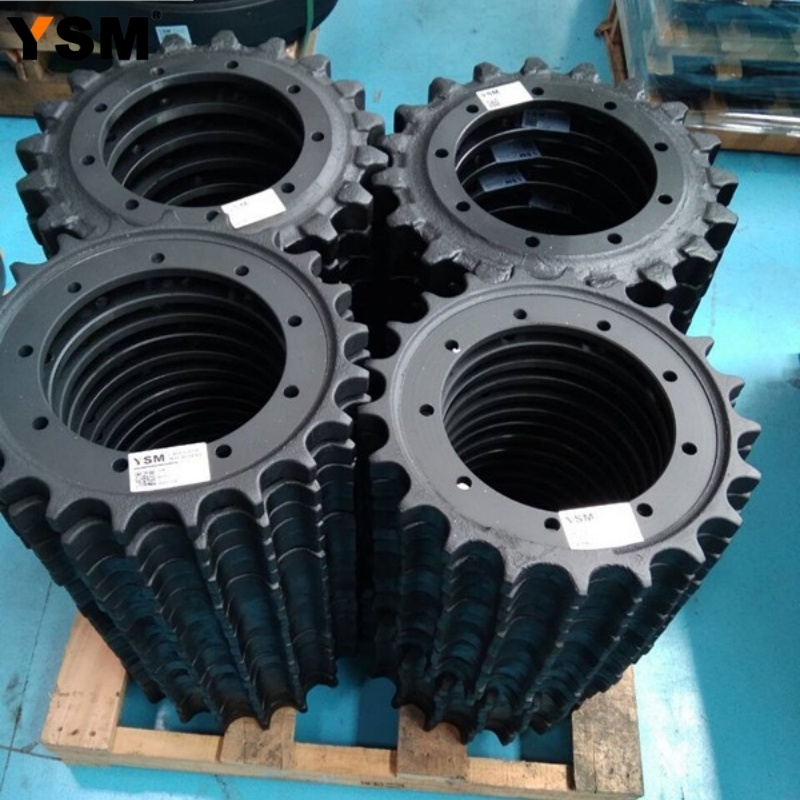
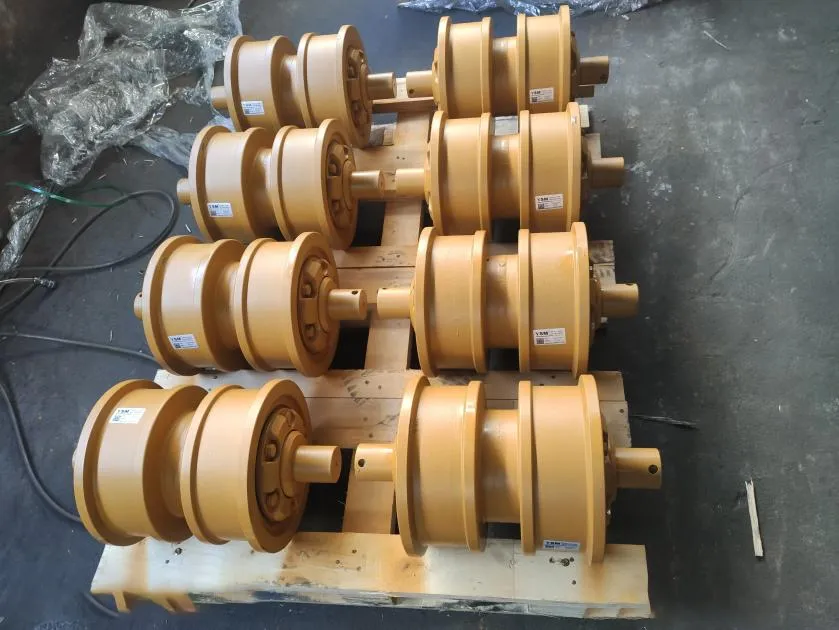
For suitable excavator and bulldozer applications, our team can check track chains and link assemblies, track shoes, complete track groups, drive sprockets or segments, track rollers, carrier rollers, front idlers and related track fasteners. The appropriate supply scope depends on the measurement record and mating-component condition.
Clear identification data helps avoid a chain that matches the nominal pitch but not the machine configuration. Final suitability requires the complete model, serial number, part number, photos, requested dimensions and quantity.
Frequently Asked Questions
Does extra track sag mean the chain is worn out?
Not necessarily. Sag is affected by adjustment, packed material, chain condition and measuring procedure. Pitch and component wear must be measured before confirming that the chain has reached its limit.
Why measure track pitch across several links?
A longer span reduces the influence of small placement errors and represents wear across several joints. The exact number of links and reference points should follow the service procedure for the machine.
Is track-chain elongation caused by the steel links stretching?
In normal wear discussion, apparent elongation mainly reflects material loss and clearance developing at pin-and-bushing interfaces. The total effective pitch across multiple joints increases.
Can I use track sag to identify the replacement chain pitch?
No. Chain pitch is a component dimension, while sag is an adjustment measurement. Confirm pitch from the part specification and a correctly measured multi-joint span.
Should a new track chain always use a new sprocket?
Not automatically, but the sprocket must be measured and its contact pattern assessed. A badly worn sprocket can engage poorly with a new chain, while a serviceable sprocket may not require replacement solely because the chain is being changed.
What is the difference between a track chain and a complete track group?
A track chain or link assembly normally refers to the connected links, pins and bushings. A complete track group generally includes the chain with track shoes and associated shoe hardware assembled, but supplier terminology should be confirmed in the quotation.
Technical references
- Caterpillar: What to Know About Excavator Undercarriage Maintenance
- Caterpillar: Undercarriage for Excavators
- Caterpillar: Get Expert Undercarriage Maintenance and Repair
- Hitachi Construction Machinery: Undercarriage 101
- Komatsu: Track Pad Wear Measurement and Undercarriage Monitoring
These sources support general inspection and wear-management principles. Use the operation manual, parts catalog, wear chart and service instructions for the exact machine and track-chain part number for measurement points and limits.
Consult Our Track Chain and Undercarriage Parts Team
We can help check suitable track chains, link assemblies, track shoes, complete track groups, sprockets or segments, track rollers, carrier rollers, front idlers and related track fasteners for many mainstream excavator and bulldozer applications.
Corporate Email: sales@china-ysm.com
WhatsApp: +86-18606961587
Please send the machine brand, complete model, serial number or nameplate photo, part number, clear undercarriage photos, measured pitch and span, link count, shoe width, requested dimensions, quantity and destination country. Compatibility and availability must be confirmed before ordering.