
Excavator Undercarriage Maintenance Guide
Excavator Front Idler Wear: Signs, Causes and Inspection Guide
The excavator front idler guides the track chain around the front of the track frame. Its tread and flanges work with the chain rails, while the track adjuster positions the idler to establish the model-specified track sag. Uneven wear, leakage, heat, noise or side movement should trigger a system inspection—not an automatic conclusion that the idler alone is faulty.
Quick answer: how can you recognize front idler wear?
Clean the undercarriage and inspect the idler tread, flanges, hub area, guides and alignment on both sides of the excavator. Warning signs include uneven tread or flange wear, oil around the hub, cracks, abnormal noise, unusual heat, wobble, heavy rubbing against one chain rail, or repeated tracking problems. Confirm the condition with measurements and the correct OEM service limits. Track sag alone cannot identify a worn idler because chain pitch, adjuster condition and packed material also affect the result.
What does an excavator front idler do?
The front idler is the large smooth wheel opposite the drive sprocket. The track chain bends around its tread as it changes direction between the upper and lower runs. The idler's flanges help guide the chain rails and keep the track aligned with the roller path.
The idler is normally mounted in a yoke, bracket or sliding arrangement connected to the recoil spring and track adjuster. Adding or releasing grease at the adjuster changes the idler's position and therefore the available track sag. The adjuster establishes position; the idler guides the moving chain. Treating the two assemblies as one indistinguishable part can lead to the wrong diagnosis or quotation.
On some machines, the idler and adjuster are more closely integrated, while others use separate serviceable assemblies. Frame design, mounting style and available travel vary by machine and serial range.
Front idler components and wear areas
| Area | Function | Typical inspection points |
|---|---|---|
| Tread or running surface | Supports and guides the track-chain rails around the front of the frame | Diameter or depth, ridging, flat areas, surface damage and left-right wear |
| Guiding flanges | Help control chain side movement | Flange height and thickness, sharp edges, cracks and one-sided rubbing |
| Shell or wheel body | Carries the tread and transmits load to the shaft | Cracks, impact damage, deformation and previous weld repairs |
| Shaft, bushings or bearings | Allow controlled rotation under load | Play, binding, noise, heat and abnormal movement |
| Seals and lubricant cavity | Retain lubricant and exclude contamination | Oil residue, wet dirt, damaged seal area and lubricant loss |
| Yoke, brackets and slides | Locate the idler and allow movement with the adjuster | Uneven clearance, cracks, bending, wear plates, debris and restricted movement |
| Recoil and adjuster connection | Positions the idler and absorbs some shock loading | Grease leakage, rod or cylinder damage, travel and alignment |
Names and construction differ between manufacturers. Some idlers are rebuildable under controlled workshop procedures; others are replaced as complete assemblies. Confirm the parts catalog and service information for the exact machine.
Common signs of excavator front idler wear
| Observed sign | What to inspect next | Other possible causes |
|---|---|---|
| Uneven tread or flange wear | Idler measurements, chain rail side wear, guides, frame alignment and roller flanges | Slope work, repeated turning, packed material or track misalignment |
| Oil or wet dirt around the idler hub | Clean the area, recheck the source, inspect seals and rotation | Oil carried from another component or old service residue |
| Grinding, squealing or clanking near the front track | Idler rotation, internal condition, chain joints, guards and trapped stones | Dry chain joint, rubbing guard, loose shoe or roller problem |
| One idler area is unusually hot | Internal friction, lubrication, binding, tension and material packing | Nearby dry joint or brake and travel-system heat |
| Visible wobble or side movement | Shaft, bushing or bearing clearance, yoke, guide surfaces and frame damage | Chain side wear or loose/damaged guiding components |
| Track repeatedly moves toward one flange | Idler and roller alignment, chain rails, frame, guards and shoe condition | Operating continuously across slopes or one-direction turning |
| Track sag changes repeatedly | Adjuster leakage, idler travel, chain pitch, packed material and measurement method | Temperature and ground-condition changes or incorrect adjustment |
| Cracked or broken flange | Stop and inspect the idler, chain, frame and cause of impact or misalignment | Severe side loading, debris impact or operation after earlier wear |
These are inspection signals, not single-cause diagnoses. Record whether the symptom appears on one track or both, during forward or reverse travel, on slopes, during turns, or only after material packs into the frame.
Important diagnostic distinction
A worn idler can affect guidance, but repeated derailment or poor tracking can also result from incorrect sag, pitch-worn chains, damaged roller flanges, bent guards, frame misalignment, loose shoes or operating conditions. Inspect the complete chain path before ordering one component.
Step-by-step front idler inspection
- Record machine information. Note the complete model, serial number, hours, shoe width, operating surface and recent symptoms.
- Park and isolate safely. Use the machine's approved inspection position and allow hot components to cool.
- Clean the front undercarriage. Remove mud, stones and compacted material without damaging or directly attacking seal areas.
- Photograph both sides. Take full-side views and close photographs of each idler, flange, slide and adjuster area.
- Inspect the wheel body. Look for cracks, impact marks, deformation, sharp edges or previous repair.
- Inspect tread and flanges. Compare the inner and outer wear pattern and note chain contact marks.
- Check for leakage. Clean suspicious residue and confirm whether fresh oil returns and where it begins.
- Compare alignment. View the idler, chain rails, bottom rollers and sprocket along the track path.
- Measure specified dimensions. Use the OEM wear tool or measurement points and compare with the correct new and service-limit data.
- Inspect the system. Check track sag, chain pitch, roller and sprocket wear, guards, shoes and adjuster travel.
What should be measured?
Depending on design, the service data may specify idler tread diameter, tread depth, flange height, flange thickness or another reference dimension. Use the exact tool position shown in the wear chart. Measuring the easiest visible edge may produce a repeatable number that has no valid service limit.
Measure both tracks and record the date and machine condition. Do not apply a percentage or millimetre limit from a similar-looking idler. Wheel diameter, rail geometry and allowed wear vary by model.
Is it an idler problem or a track-adjuster problem?
The idler and adjuster move together, so symptoms can overlap. The following distinctions help organize the inspection:
| Finding | More closely associated area | Required confirmation |
|---|---|---|
| Oil at the rotating idler hub | Idler seal, shaft or internal lubrication | Clean and locate the fresh leak source |
| Grease appearing at the adjuster cylinder, valve or damaged rod area | Track adjuster | Inspect using the model-specific pressure-safety procedure |
| Idler does not slide freely after debris is removed | Slides, yoke, frame or adjuster alignment | Check for bending, wear and restricted travel |
| Idler rotates roughly or has abnormal play | Idler shaft, bushing, bearing or internal surfaces | Professional unloaded inspection may be required |
| Adjuster is far forward but chain remains loose | Chain pitch wear, wrong link count or limited adjuster travel | Measure chain pitch and compare the configuration with the parts catalog |
Never remove a track link simply to hide excessive chain pitch wear. A tighter-looking track does not restore the original pin-and-bushing geometry or correct mating wear.
Why do excavator front idlers wear unevenly?
Incorrect track tension
Excessive tension increases loads and friction across the undercarriage. Too much slack can allow stronger impact and side movement. Track sag changes with model, carrier-roller arrangement, material packing and measuring method, so use the exact manual value.
Packed mud, clay, sand or stones
Material trapped around the idler and track frame can restrict movement, alter effective tension and create abrasive contact. Freezing packed material can prevent normal rotation or movement. Clean more frequently when the site causes rapid buildup.
Side loading and operating pattern
Repeated pivot turns, turning in the same direction, travelling across slopes and forcing the track against obstacles can concentrate contact on one flange. Compare operating history with the wear side before blaming a manufacturing defect.
Worn chain, rollers or guides
Pitch-worn chains and damaged roller or idler flanges change how the chain follows the track frame. One new idler cannot correct an entire worn or misaligned chain path.
Shoe selection and ground condition
Wide shoes may add leverage on firm or rocky ground, while abrasive soil accelerates contact wear. Shoe choice should follow the approved machine configuration and application rather than a wider-is-always-better rule.
Impact, misalignment or damaged frame
A bent idler yoke, worn slide, cracked frame or damaged guard can hold the idler off its intended centreline. Repair the locating problem before installing a replacement wheel.
Front idler maintenance practices
- include both front idlers in the daily undercarriage walk-around;
- clean packed material before it hardens or freezes;
- check track sag using the exact OEM procedure and condition;
- look for fresh leakage after cleaning, not only old oily dust;
- compare left and right tread and flange patterns;
- avoid unnecessary high-speed travel, repeated pivot turns and striking obstacles;
- record measurements over time instead of waiting for visible failure;
- inspect chain pitch, rollers, guards and sprocket at the same time.
Do not directly aim damaging high-pressure water at seals. Cleaning method, inspection access and service intervals should follow the machine manual and site conditions.
When should an excavator front idler be repaired or replaced?
Replacement should be considered when the applicable service limit is reached, the wheel or flange is cracked, leakage cannot be corrected economically, internal play or binding is excessive, or the idler cannot guide the chain correctly after related alignment and tension problems are resolved.
Some idlers can be rebuilt with approved shafts, bushings, bearings, seals or other internal parts. Suitability depends on shell condition, dimensions, design, workshop tooling and service information. Welding a worn running surface or improvising internal parts without an approved process can change geometry, hardness and alignment.
Before fitting a new idler, inspect the chain rails, adjuster, yoke, slides, rollers and guards. A replacement idler installed into a bent, seized or severely worn system may develop the same abnormal pattern.
Information needed before ordering a front idler
- machine brand, complete model and suffix;
- serial number or PIN and a clear nameplate photo;
- idler part number, casting number or previous supplier reference;
- photos of the complete undercarriage and both sides of the idler;
- overall wheel diameter and width using the supplier's diagram;
- tread width, flange profile and key requested dimensions;
- shaft, yoke, bracket or mounting dimensions where applicable;
- track-chain pitch, shoe width and related undercarriage configuration;
- quantity, operating conditions and destination country.
Do not select an idler from excavator tonnage or visual similarity alone. Different models and serial ranges may use similar-looking wheels with different shaft, flange, bracket or adjuster geometry. Compatibility and availability must be confirmed before ordering.
Related undercarriage parts that may need inspection
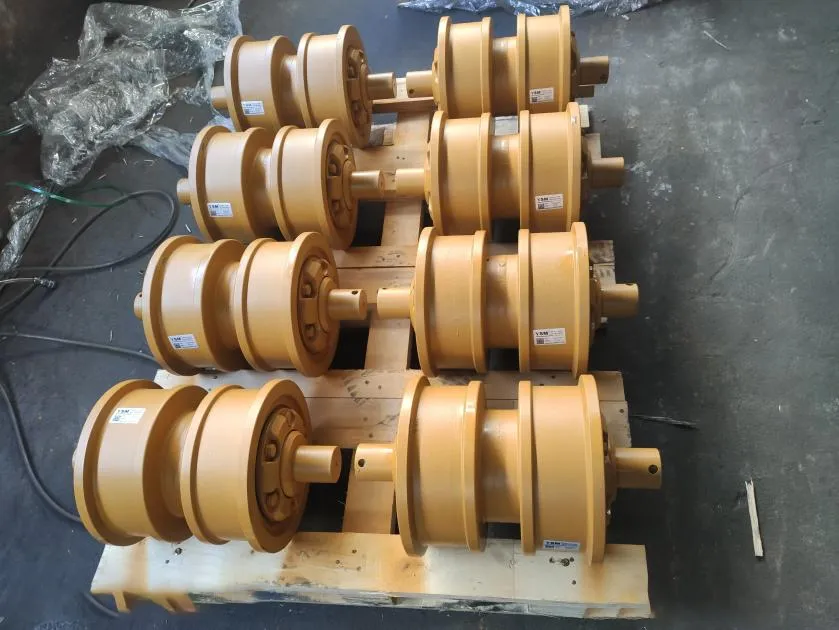
For suitable excavator and bulldozer applications, our team can check front idlers together with track rollers, carrier rollers, track chains, track shoes, complete track groups, sprockets or segments and related track fasteners. This does not mean every component requires replacement; the supply scope should follow measured condition and fitment data.
If the issue involves repeated track loss, uneven chain wear or limited adjuster travel, send photos and measurements of the complete left and right undercarriages rather than only a close-up of the idler.
Frequently Asked Questions
Is the front idler the same as the drive sprocket?
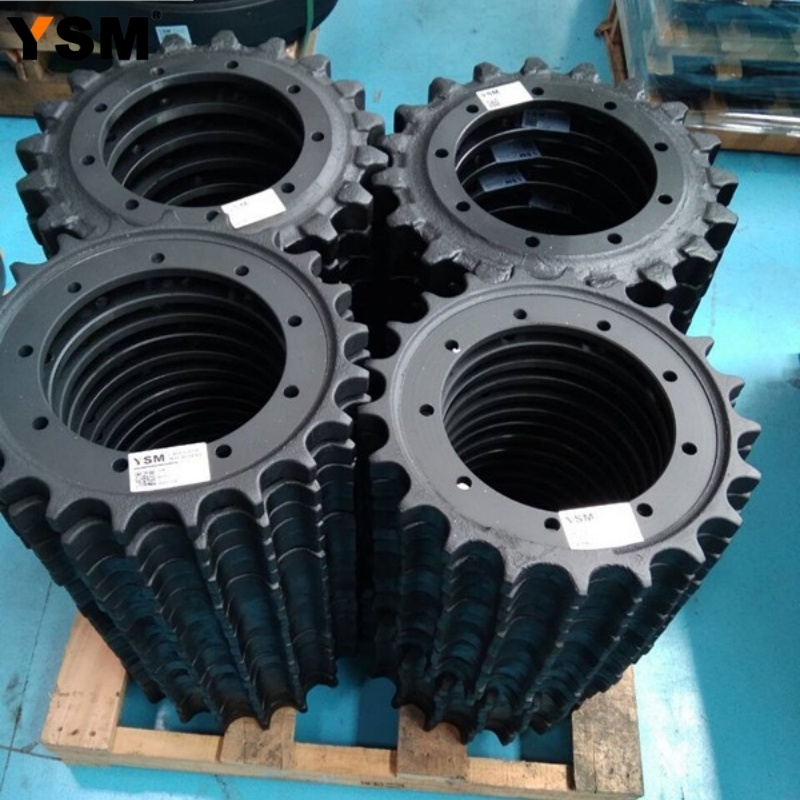
No. The front idler is normally a smooth guide wheel. The drive sprocket has teeth that engage the track-chain bushings and receives torque from the final drive.
Does the front idler set track tension?
The adjuster positions the front idler to create the specified track sag. The idler provides guidance and moves with the adjuster, but a tension problem may originate from the adjuster, chain wear, packed material or measuring method.
Can an oil leak around the idler be ignored?
Clean the area and identify the source. Fresh oil from the hub can indicate a seal or internal lubrication problem, but residue may also have travelled from another component. Continued operation without confirmation can allow internal damage to progress.
Why is one idler flange wearing faster?
Possible reasons include side loading, slope work, repeated turns, frame or roller misalignment, worn chain rails, damaged guides or packed material. The wear side is evidence of contact, not a complete diagnosis.
Can a worn idler cause the track to come off?
Severe wear, side play or flange damage can contribute to poor guidance, but derailment can also involve sag, chain pitch, rollers, guards, frame alignment, shoes, terrain and operating technique. Inspect the complete system.
What measurements are needed to identify a replacement idler?
Start with the complete model, serial number and part number. Suppliers may also request wheel diameter, overall width, tread and flange dimensions, shaft or bracket measurements, track pitch and clear photos.
Technical references
- Caterpillar: What to Know About Excavator Undercarriage Maintenance
- Caterpillar: How to Maintain Cat Rubber Tracks
- Hitachi Construction Machinery: Undercarriage 101
- Hitachi Construction Machinery: Idlers
- Volvo Construction Equipment: Undercarriage Inspections
These sources support general undercarriage, idler and inspection principles. Use the operation manual, parts catalog, wear chart and service instructions for the exact machine for safety procedures, measuring points and service limits.
Consult Our Front Idler and Undercarriage Parts Team
We can help check suitable front idlers, track rollers, carrier rollers, track chains, track shoes, complete track groups, sprockets or segments and related track fasteners for many mainstream excavator and bulldozer applications.
Corporate Email: sales@china-ysm.com
WhatsApp: +86-18606961587
Please send the machine brand, complete model, serial number or nameplate photo, part number, clear idler and undercarriage photos, requested dimensions, track pitch, shoe width, quantity and destination country. Compatibility and availability must be confirmed before ordering.