
Excavator Bottom Roller Selection Guide
Single-Flange vs Double-Flange Track Rollers: What Is the Difference?
Single-flange and double-flange track rollers are both load-carrying components in a crawler undercarriage. Their raised guide flanges help control the path of the track links, but the two designs are not freely interchangeable. The correct flange type, roller position, mounting dimensions and link clearance are determined by the machine's undercarriage design.
Quick answer
A single-flange track roller has one raised guide flange; a double-flange track roller has two. Both support the machine through the link rails while helping the chain remain aligned. Do not choose the flange type by appearance, terrain or model name alone. Confirm the exact roller position, parts diagram, full machine model and serial range, part number, bracket dimensions, tread and flange dimensions, and the installed track-link geometry.
What does an excavator track roller do?
Track rollers, also called bottom rollers or lower rollers, carry the machine's weight along the lower track frame. The link rails run across the roller treads as the machine travels. The roller shell rotates around a fixed shaft, while seals retain lubricant and help exclude abrasive material.
The roller's tread supports the link rails. Its raised flange or flanges provide lateral guidance when the chain begins to move sideways. This guidance function is important, but a flange is not intended to correct a bent frame, badly worn track link, failed track guard or incorrect track tension.
The roller works as part of a system that includes the track chain, shoes, idler, sprocket, carrier rollers, recoil and tensioning components, track guards and frame. A dimensional mismatch anywhere in that system can alter the contact pattern.
Single-flange and double-flange track rollers compared
| Feature | Single-flange track roller | Double-flange track roller |
|---|---|---|
| Guide profile | One raised circumferential flange | Two raised circumferential flanges |
| Link guidance | Provides a guide surface on one side of the running path | Provides guide surfaces on both sides of the running path |
| Installation | Used only in the positions specified for that undercarriage | Used only in the positions specified for that undercarriage |
| Visual identification | Count one functional raised guide flange, not small machining shoulders | Count two functional guide flanges surrounding the link-running channel |
| Ordering risk | Similar-looking rollers can differ in bracket, shaft, tread, flange and seal dimensions | |
Single-flange track roller
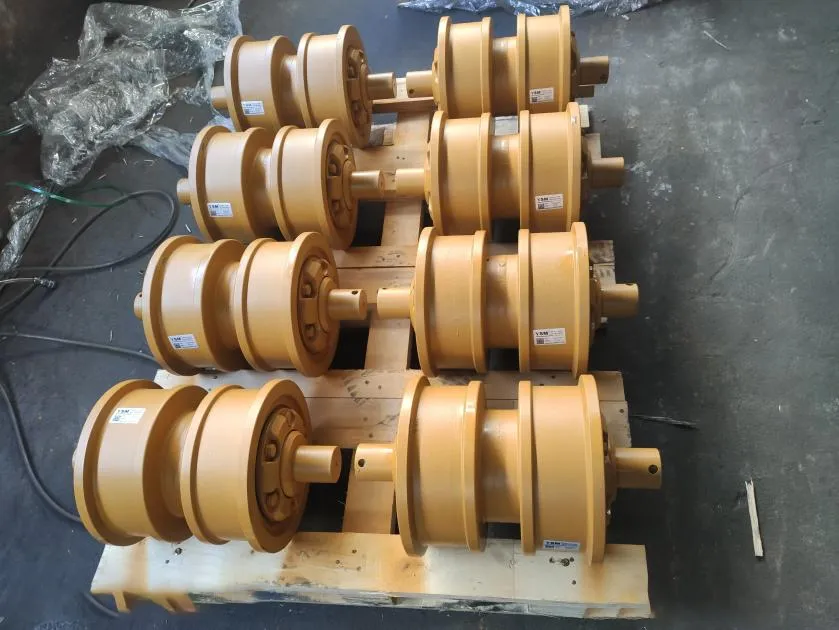
A single-flange roller uses one prominent raised guide surface. The opposite side leaves a more open profile for the link assembly and surrounding undercarriage geometry. Exact flange height, tread width and offset vary with the machine family.
Do not classify every small shoulder as a flange. A functional guide flange is the raised profile intended to control lateral link movement. Product drawings and end-view photographs are more reliable than a dark side photograph.
Double-flange track roller
A double-flange roller has a guide surface on both sides of the link-running channel. The distance between the flanges must suit the track-link arrangement and allow operating clearance. A channel that is too narrow can create side contact and heat; one that is too wide may provide insufficient guidance.
The presence of two flanges does not automatically make a roller “heavy duty,” nor does one flange automatically indicate a lighter machine. Load capacity depends on the complete roller design, material, heat treatment, shaft, bearing surfaces, seals and application.
Why track-roller placement is model-specific
Many crawler undercarriages use a planned combination of single- and double-flange rollers. However, there is no reliable universal sequence that applies to every excavator or bulldozer. The order can change with machine size, frame design, number of rollers, track guards and application configuration.
Komatsu's current track-roller information explains that installation order depends on machine size and identifies a placement practice for its designs. That is useful evidence that flange arrangement is engineered, not a dealer's preference. It should not be converted into a rule for every brand or model.
Before removal, record each roller's position from the front idler or rear sprocket, photograph both sides and compare the arrangement with the correct parts book. Marking the old position helps prevent an accidental swap during service. If the existing arrangement conflicts with the serial-specific diagram, investigate previous repairs before copying it.
Factory configuration can also change. Caterpillar's parts pages warn that modifications to the manufacturer's configuration can affect fitment. A base model match therefore remains only a starting point.
Can terrain determine whether to use single or double flanges?
Terrain affects wear, packing and side loads, but it does not authorize changing the designed flange sequence. Slopes, rock, demolition debris, mud and repeated turning can increase lateral contact. The correct response is to inspect tension, alignment, guards, roller rotation and component wear against service specifications.
Replacing a specified single-flange roller with a double-flange unit to “improve guidance” may reduce clearance or create unintended contact. Replacing a specified double-flange unit with a single-flange unit may reduce guidance. Any configuration change requires engineering or OEM approval based on the exact machine.
Track-roller wear patterns and what they may indicate
| Observation | Possible contributors | Next check |
|---|---|---|
| Heavy wear on one flange face | Side loading, misalignment, worn link rails, bent guard or frame, repeated one-direction turning | Compare both sides and inspect the complete track path |
| Both double flanges polished or grooved | Insufficient clearance, chain wander, packing or mismatched link geometry | Measure flange spacing, link width and alignment |
| Uneven or ridged tread | Abnormal link contact, contamination, seized roller or mixed wear levels | Check rotation, link rails, idler and adjacent rollers |
| Oil leakage or wet seal area | Seal damage, impact, excessive side load or internal failure | Follow the service procedure; do not refill or reseal by guesswork |
| Roller will not rotate, runs hot or develops a flat spot | Internal seizure, lubricant loss, packed debris or structural damage | Stop and arrange qualified inspection |
| Track repeatedly climbs a flange | Incorrect tension, damaged chain, guide failure, misalignment or wrong roller | Do not diagnose the roller alone; inspect the entire undercarriage |
These observations are diagnostic clues, not proof of one failed part. Clean the undercarriage, document both sides and compare measurements with the correct wear chart. Wear limits depend on the roller and machine; do not apply an internet percentage or fixed millimetre limit universally.
How to identify and measure a replacement track roller
Begin with the machine identification plate and the removed roller's evidence. Record the brand, complete model including suffix, serial number or PIN, roller position, left or right frame, and any visible part number. A readable casting mark may help, but it may not be the complete sales part number.
Then supply a clear measurement set. Use the reference points shown in the applicable drawing where possible:
- Single-flange or double-flange profile, shown from the end and side.
- Overall roller width and mounting width.
- Roller tread diameter and tread width.
- Outer flange diameter, flange thickness and flange-to-flange spacing where applicable.
- Shaft length and diameter at specified reference points.
- Bracket shape, bolt-hole diameter, centre spacing and mounting-face dimensions.
- Track-link rail width, spread and visible clearance around the installed roller.
- Quantity, destination country and whether matching hardware is required.
Take photographs with the measuring tool visible and the endpoints unobstructed. Include a full roller, both brackets, end profile, seal area, mounting face and the roller installed in its frame position. Label units as millimetres or inches.
For a complete cross-check, provide the track-chain and shoe information plus sprocket and idler photographs. The correct roller must fit both the frame and the running track system.
Check the complete undercarriage before replacing one roller
A failed roller can be the result of its own seal or internal wear, but surrounding conditions may accelerate failure. Inspect every roller for rotation, leakage, tread wear and loose fasteners. Check link rails for unequal height or side wear, the idler for ridging and alignment, the sprocket for abnormal engagement, and guards for impact damage.
Track tension must be checked by the machine-specific procedure under the stated ground and packing conditions. A track that is too tight increases loads throughout the undercarriage. A loose track can increase instability and derailment risk. Neither condition should be corrected using a generic sag number.
When several components are near their wear limits, replacing one new roller into a heavily worn system may create a different contact pattern. A qualified undercarriage inspection can help plan whether to replace an individual part or a matched group.
Common single- and double-flange roller ordering mistakes
- Ordering by excavator model only: serial range and undercarriage options may differ.
- Assuming the flange sequence: copied internet diagrams may belong to another machine.
- Counting shoulders as flanges: use an end profile and product drawing.
- Checking bolt holes only: frame mounting can match while tread or flange geometry does not.
- Mixing roller positions: record the exact location before removal.
- Ignoring worn measurements: a used roller's reduced diameter is not the new nominal dimension.
- Changing flange type for terrain: operating conditions do not override the designed arrangement.
- Assuming universal interchange: similar appearance is not proof of fitment.
When should the machine stop operating?
Stop and arrange qualified inspection if a roller is loose, cracked, seized, displaced or leaking significantly; if the track climbs a flange or repeatedly derails; if mounting bolts or brackets are damaged; or if abnormal heat, grinding or metal debris appears. Continuing to travel can damage the chain, shoes, guards, idler, sprocket and frame.
Do not place hands near a moving track to locate noise or heat. Observe from a safe position during a controlled test, then park, isolate and allow components to cool before close inspection.
Frequently asked questions
Can a single-flange roller replace a double-flange roller?
Only when the serial-specific parts information or qualified engineering approval confirms the substitution for that exact position. Matching bolt holes alone is not sufficient.
Are double-flange rollers always installed in the middle?
No universal placement rule should be applied across all machines. The sequence depends on undercarriage design and machine size. Use the correct parts diagram and record the original position.
Is a double-flange roller stronger?
Flange count describes the guidance profile, not complete load capacity or service life. Material, heat treatment, shaft, sealing, tread design and application also matter.
Why is only one roller flange wearing quickly?
Possible contributors include side loading, chain or frame misalignment, worn links, damaged guards, packing and an incorrect roller. Inspect the full system before deciding the cause.
What information is needed for a fitment check?
Provide the brand, complete model and suffix, serial number or PIN, part number, roller position, flange type, clear photos, requested dimensions, quantity and destination country. Previous undercarriage changes should also be disclosed.
Technical references
- Komatsu: Track Roller — functions, flange types and model-dependent installation order.
- Linser Industrie Service: Track Roller — current industry description of single- and double-flange designs.
- Cat Parts Store: 596-6878 Single Flange Track Roller — a current product example and configuration-fit warning.
- Cat Parts Store: 483-4039 Double Flange Track Roller — a current double-flange example.
- Caterpillar: What to Know About Excavator Undercarriage Maintenance — system inspection and maintenance context.
References support general principles only. The operation, maintenance and parts information for the exact machine controls the final inspection, limits and fitment decision.
Consult Our Undercarriage Parts Team
For model-specific track-roller checks, matching undercarriage parts or factory-direct wholesale enquiries:
Corporate Email: sales@china-ysm.com
WhatsApp: +86-18606961587
We supply single- and double-flange track rollers and can also check matching carrier rollers, idlers, sprockets, track chains, track shoes and fasteners. Please send the machine brand, complete model and suffix, serial number or PIN, part number, roller-position photos, requested dimensions, quantity and destination country. Final fitment is confirmed from the supplied information.