
Excavator Operating-Condition Maintenance
Excavator Undercarriage Maintenance in Sand and Abrasive Soil
Fine sand does not need to produce a dramatic impact to damage an excavator undercarriage. It enters clearances, mixes with moisture or lubricant residue and repeatedly passes between chains, rollers, idlers, sprockets and shoes. The practical response is not simply “wash more often.” Operators need condition-based cleaning, correct track tension, reduced unnecessary travel and measurements that reveal abrasive wear before components become mismatched.
Quick answer
On sandy jobsites, inspect and clean the undercarriage more frequently than on a clean firm surface, following the machine manual and site conditions. Remove packed material from track frames, sprocket pockets, roller areas and upper chain runs; check track tension using the exact model procedure; watch for dry joints, seal leakage, thin flanges, rail wear and polished contact; and minimize high-speed travel, track spinning, reverse travel and sharp pivot turns. Record measurements instead of guessing remaining life from appearance.
Why does sand accelerate excavator undercarriage wear?
Sand is made of small hard particles that can move through narrow spaces. When the track chain articulates around the sprocket and idler, particles can become trapped between contact surfaces. Repeated sliding creates abrasion even when no single impact is severe. Dry sand tends to flow and re-enter the system; damp sand may pack and hold particles against components.
The effect changes with particle size, mineral hardness, moisture, travel speed, load and undercarriage design. Beach sand, quarry fines, desert sand and crushed-rock dust are not identical. Salt or industrial contaminants can add corrosion concerns. The machine manual and site safety information should guide the cleaning method and inspection interval.
Abrasive wear often develops across several components at the same time. A chain rail, roller tread and idler can gradually wear into a shared pattern. Replacing one item without measuring the others may leave poor contact and rapid wear on the new part.
How sand affects excavator undercarriage components
| Component | Sand-related concern | Inspection focus |
|---|---|---|
| Track chains, pins and bushings | Abrasive particles at joints and sprocket contact | Dry joints, seal condition, pitch, bushing wear and side contact |
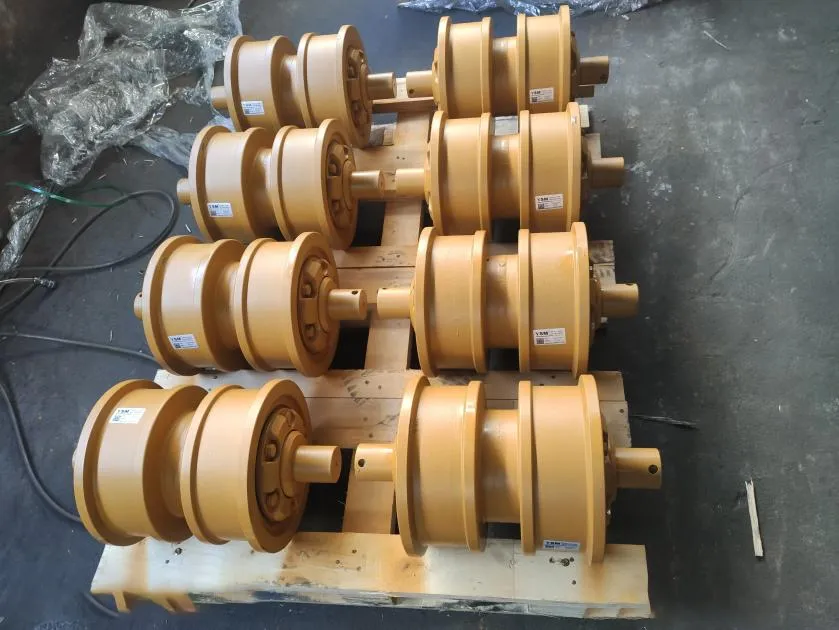
| Bottom track rollers | Sand between link rails and roller treads; seal contamination | Tread diameter, flange profile, leakage, flat spots and heat |
| Carrier rollers | Upper-run dust, packed material and restricted rotation | Flange wear, leakage, polished contact and frame rubbing |
| Front idlers | Abrasive rail contact and material around slides | Tread, flanges, leakage, alignment and adjuster movement |
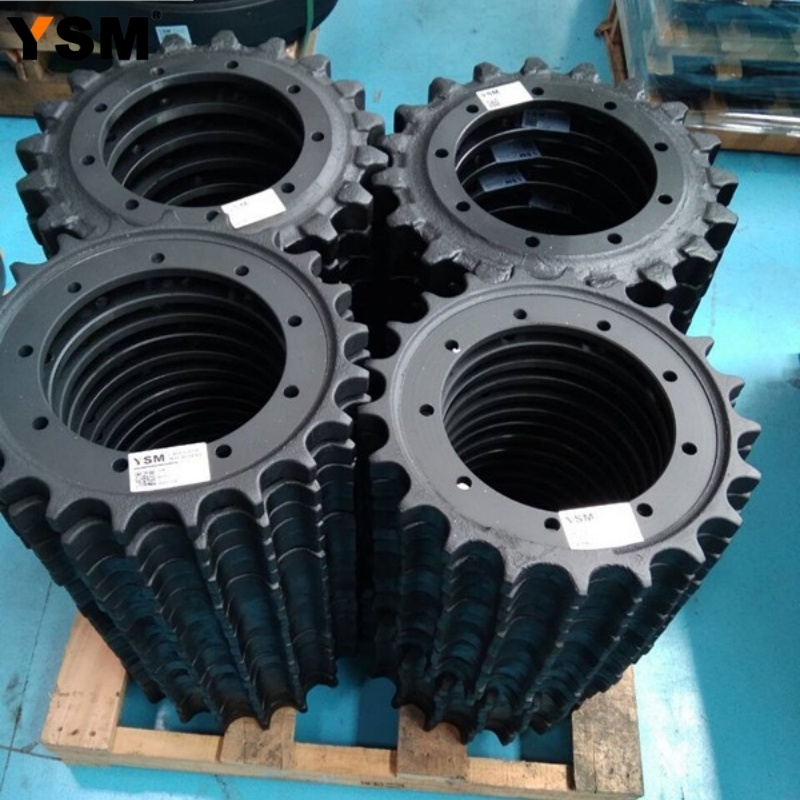
| Sprockets or segments | Sand carried into the tooth and bushing interface | Tooth profile, pocket packing, cracks and bushing engagement |
| Track shoes and grousers | Repeated slip, edge loading and abrasive ground contact | Grouser height, plate cracks, bent edges and loose hardware |
| Guards and track frame | Material retention and chain rubbing | Drain paths, packed zones, polished marks, bending and missing bolts |
| Track adjuster and recoil unit | Packing changes effective track tension | Grease leakage, idler travel, restricted slides and repeated adjustment |
Pre-shift inspection for sandy jobsites
- Identify yesterday's packing zones. Check behind sprockets, around rollers, on frame shelves and along the upper chain run.
- Look for fresh leakage. Dry sand sticks to oil or grease around roller, idler and adjuster seals.
- Inspect chain joints. Look for dry, stiff or separated joints and damaged seals.
- Check shoes and hardware. Find missing bolts, cracked plates, bent edges and loose seating marks.
- Inspect sprocket pockets. Remove trapped material and check tooth contact.
- Inspect rollers and idlers. Compare flange profiles, contact paths and evidence of non-rotation.
- Check track tension. Use the exact machine procedure and the intended working condition.
- Record both sides. Take consistent photographs and note any left-right difference.
A clean surface makes leaks and cracks easier to see, but do not remove all evidence before recording it. Photograph wet dirt, unusual packing and fresh metal contact first, then clean for closer inspection.
Operating habits that influence abrasive wear
Every metre of travel moves the chain over rollers, idlers and sprockets. Plan the work area to reduce unnecessary travel and repeated reversing. Where safe and consistent with the operation manual, use gradual turns instead of frequent stationary counter-rotation.
Avoid track spinning after traction is lost. Spinning increases relative movement between grousers and sand, drives material into the undercarriage and can polish away grouser height. Reassess the access route, ground support or machine configuration rather than repeatedly forcing the track.
Use an appropriate travel speed for the surface. High speed increases the rate at which abrasive particles circulate and can add impact when hidden stones are mixed with sand. Avoid travelling with one track on firm ground and the other in deep loose sand when a safer route is available; unequal resistance can add turning and side load.
Do not assume working only in a straight line removes all wear. Long-distance straight travel can still produce significant rail, bushing and sprocket wear. The goal is to eliminate travel that does not contribute to the job.
How to clean an excavator undercarriage after sand work
Follow the machine manufacturer's cleaning guidance. Begin with dry removal where appropriate: use suitable non-metallic tools, brushes or low-risk air methods allowed by the site to remove loose material from frame shelves, sprocket pockets, guards and accessible roller areas. Control airborne dust and protect nearby workers and equipment.
Water can help remove damp or compacted material, but pressure, nozzle distance and direction matter. Do not direct damaging high-pressure jets into seals, breathers, electrical connectors or joint areas. On saline or contaminated sites, follow the corrosion-control and wastewater requirements for that location.
Clean both sides consistently. Leaving a bank of packed material behind a guard can change track tension during the next shift. Inspect drainage and cleanout openings, but do not modify guards or drill holes without manufacturer approval.
After cleaning, inspect for leaks, shiny rub marks, metal particles and damaged seals that were hidden. If water was used, follow the manual's post-cleaning lubrication and operating instructions. Cleaning does not replace measurement.
Track tension in sand and packed material
Sand can change tension in two ways. Loose dry particles may leave the track path quickly, while damp compacted material can build between components and tighten the chain as it moves. Excess tension increases load on joints, rollers, idlers, sprockets and the travel system. Excessive looseness increases impact and derailment risk.
Measure track sag only in the machine condition, direction and location specified by the operation and maintenance manual. Machines with different carrier-roller layouts can use different references. There is no universal millimetre or “finger gap” value.
If the track repeatedly requires adjustment, inspect chain pitch, adjuster leakage, idler travel and packing conditions. Adding grease repeatedly can hide an elongated chain or leaking adjuster until adjustment travel is exhausted.
Measure abrasive wear instead of relying on appearance
A professional wear survey can include track-chain pitch, link-rail height, bushing outside wear, roller and idler tread dimensions, flange condition, sprocket profile and grouser height. Use the correct OEM wear chart, tools and measurement direction for the exact component.
Label each roller by side and front-to-rear position. Record inner and outer rail contact separately. An average value can hide one seized roller or localized alignment problem. Compare current readings with the previous survey to estimate the rate of change; do not apply a universal life-per-hour figure.
Keep the photographs, tool identification and raw readings with the machine record so a later inspection can reproduce the same measurement locations.
Shorter inspection intervals may be appropriate when the wear rate changes, but the interval must be set from the machine manual, site data, utilization and professional advice. A calendar alone cannot represent the severity of sand exposure.
Track-shoe width, flotation and sandy ground
A wider shoe increases contact area and can improve flotation on weak ground, but width also increases overhang beyond the chain rails. On firmer uneven surfaces, excessive overhang can add bending load to shoes, bolts, links and joints. Select the narrowest manufacturer-approved shoe that provides the flotation required for the actual site.
Grouser profile affects traction and turning resistance. General-purpose excavators commonly use triple-grouser shoes, while other profiles may be approved for special duty. Do not change width or profile based only on a similar machine photograph. Confirm the model, serial range, chain, bolt pattern, transport width and site requirements.
When should the machine stop for inspection?
Stop in a safe location if a roller or idler appears seized, a track repeatedly derails, a shoe or link is cracked, hardware is missing, fresh oil or grease loss is substantial, the chain contacts the frame, or new grinding, vibration, heat or travel resistance appears. Also stop if packed material cannot be removed safely or track tension cannot be maintained within the specified range.
Track removal, adjuster service, lifting and heavy-component replacement require trained personnel, approved supports and stored-energy controls.
Undercarriage parts and fitment information
When measurements confirm replacement needs, inspect mating components before ordering. A new chain may not engage correctly with a severely worn sprocket, and a new roller cannot correct a bent guard or misaligned frame.
Prepare the machine brand, full model and suffix, serial number or PIN, part names and numbers, full-side and close-up photographs, track pitch, link count, shoe width, bolt pattern, inspection dimensions, operating material, quantity and destination country.
We can review matching track rollers, carrier rollers, front idlers, sprockets or segments, track chains, track shoes, track groups and related fasteners for suitable excavator and bulldozer applications. Compatibility and availability must be confirmed from the complete model, serial number, part number, clear photos and requested dimensions before ordering.
Frequently asked questions
How often should an excavator undercarriage be cleaned in sand?
Use the machine manual and the actual rate of material buildup. Inspect at least as required by the daily routine and clean whenever packing can affect movement, inspection or tension. Severe sites may need checks during a shift.
Does dry sand wear the undercarriage even when it does not pack?
Yes. Flowing particles can repeatedly enter contact areas and create abrasion. The absence of a large mud pack does not mean the system is clean or unworn.
Should tracks be set looser for sand?
Do not invent a setting. Some manuals account for working material, but the result must remain within the exact machine's approved procedure and range.
Can I pressure-wash rollers and idlers?
Use only the pressure, distance and direction allowed by the manufacturer. Avoid directing damaging jets at seals and joints. Site environmental rules also apply.
Are wide shoes always better in soft sand?
No. Width can improve flotation, but excessive overhang can increase bending and side loads. Use an approved width matched to ground bearing capacity and machine configuration.