
Model guide | 22-ton crawler excavator
Hyundai HX220A L Undercarriage Inspection and Parts Guide
The HX220A L undercarriage carries a machine in the 22-ton class through nine lower rollers per side in the current European product description. That long support layout still works as one wear system: track chains, rollers, carrier rollers, front idlers, sprockets, shoes, guards and tension must be inspected together before replacement parts are selected.
Confirm the Exact HX220A L Configuration
Hyundai presents the HX220A L as an A-Series crawler excavator with an operating weight listed at 22,100 kg in the European market. The same product page highlights nine bottom rollers. Those facts help identify the general layout, but they do not replace serial-specific parts information.
Record the complete model exactly as shown on the identification plate, including spaces, letters and suffixes. Some parts pages compress the name to HX220AL, while older machines or regional models may use names such as HX220L or HX220NL. Similar spelling is not proof of shared rollers, idlers, chains or sprockets.
Photograph the machine plate, both complete track groups, shoe type, guard arrangement, master connection and every readable part or casting number. Note whether attachments, counterweight or undercarriage components have been changed. A used machine may no longer have its original track group.
This model is an active search candidate because a current manufacturer product page, manufacturer parts information and current undercarriage listings remain visible in search. That evidence does not establish monthly search volume, sales rank or fleet population.
Daily HX220A L Undercarriage Walk-Around
Use the same inspection route every shift. A consistent record makes it easier to see whether a wet seal, loose shoe or contact mark is new.
- Observe before cleaning. Photograph mud packing, trapped rock, wire, wet areas and fresh impact marks before their location is disturbed.
- Clean safely. Remove harmful debris with an approved method. Keep hands and tools out of loaded pinch points.
- Compare track position. Look for an unusual difference in sag, idler position, shoe alignment or overall ride height.
- Check shoe hardware. Note missing bolts, damaged heads, shiny movement marks, bent plates and cracks near mounting holes.
- Inspect every visible roller. Look for leakage, flat spots, broken flanges, packed debris and abnormal side contact.
- Check chain and sprocket engagement. Observe dry joints, external bushing wear, tooth profile and material packed around the drive end.
- Listen during controlled travel. A repeated click, knock or squeal is an inspection signal, not a confirmed diagnosis.
Add the date, machine hours, operator, work area, travel distance and ground condition to photographs. Repeated left-to-right differences are more meaningful when connected to the actual work cycle.
How to Inspect the HX220A L Nine-Roller Layout
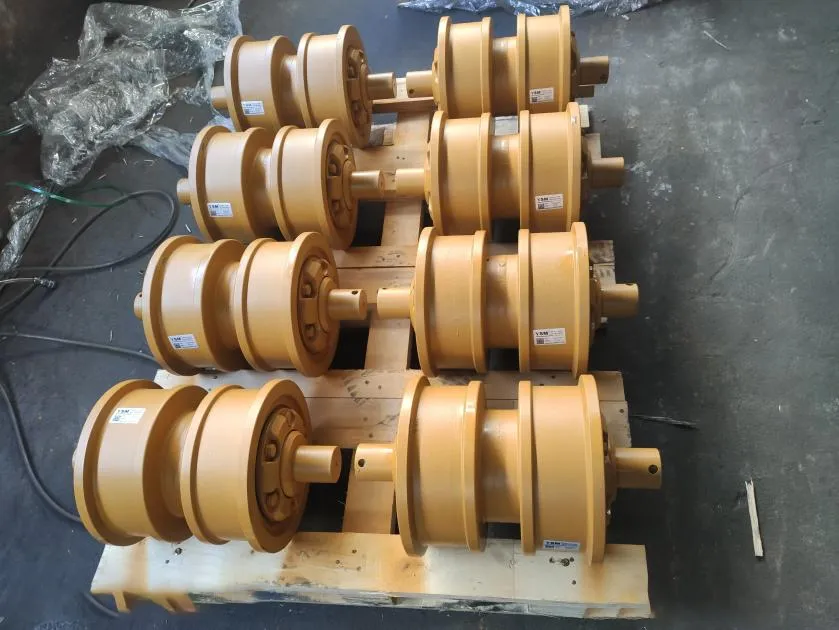
Nine lower rollers distribute support along the track frame. Inspect each position rather than looking only at the easiest front or rear roller. Number the roller locations from front to rear on both sides so that inspection notes remain unambiguous.
Seal and tread condition
Look for fresh oil at the seal area, dirt attached to a wet film, tread wear, dents, flat spots and a roller that does not appear to turn. Service residue can resemble an active leak, so clean and trace where fresh oil begins.
Flange contact
Map polished or worn flange surfaces. Repeated contact on one side of several rollers may reflect slope work, frequent turning, idler guidance, link wear or lower-frame geometry. One shiny flange does not prove misalignment.
Front-to-rear loading pattern
Compare front, center and rear positions. A single seized roller can shift load to neighboring components, while a repeated pattern may point to operation or system geometry. Measure rollers at the specified reference points with calibrated tools.
Carrier rollers
Inspect every upper roller actually fitted to the machine. Check for leakage, restricted rotation, flange wear and packed material. Do not decide the quantity from an AI illustration or a generic catalog photograph; confirm the physical machine and parts information.
Track Chains, Pins and Bushings
The track chain transfers drive force and carries the link rails over the rollers. Pins and bushings articulate around the idler, rollers and sprocket. Internal joint wear changes pitch, while external bushing and rail wear affect sprocket and roller contact.
Inspect for cracked links, leaking or dry joints, shifted pins, abnormal end play, bushing wear, rail-height loss and shoe movement. Clean suspicious joints and compare adjacent positions. A hot joint, squeal or stiff articulation can indicate lubrication loss or damage, but temperature and sound alone do not identify the cause.
Chain measurements should follow the correct Hyundai method and wear limits. Do not estimate remaining service from one link or from shoe grouser height. Record several positions and compare both sides.
Front Idler, Recoil System and Track Adjuster
The front idler guides the chain and moves with the recoil and adjustment system. Inspect tread and flanges for uneven wear, leakage, chipping and abnormal side polishing. Check the guide path for impact, trapped material and restricted movement.
An idler that sits farther forward on one side may reflect chain wear, adjustment position, packing or an adjuster condition. Position alone does not prove that the idler has failed. Compare track measurements and the model-specific service information.
The recoil spring and grease cylinder can store dangerous energy. Do not loosen, heat, cut or dismantle them during a routine inspection. Track tension must be measured with the machine prepared exactly as the operation and maintenance manual specifies.
Sprocket and Travel-Drive Area
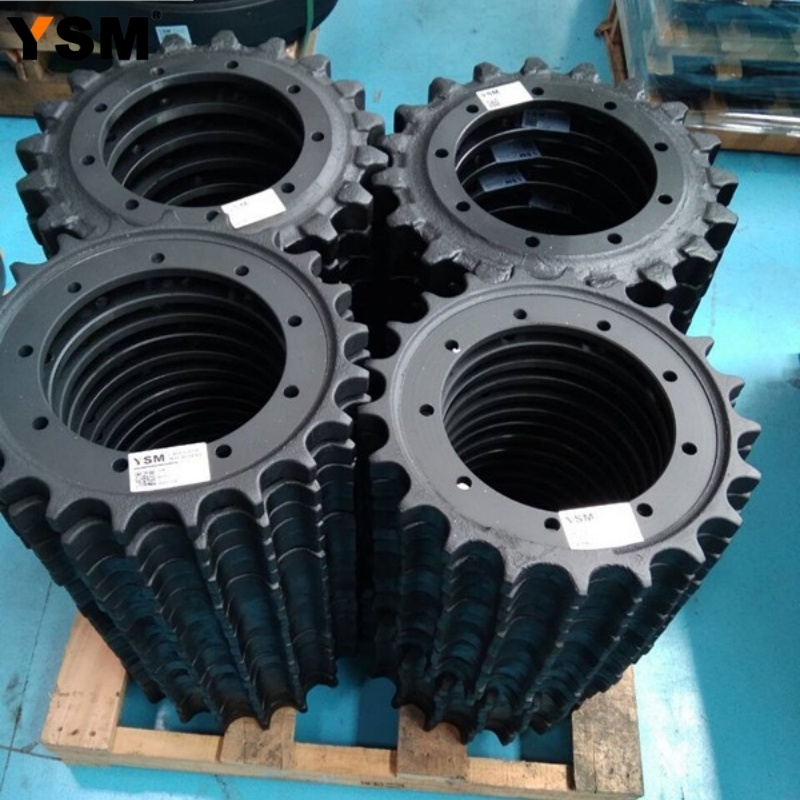
Inspect the sprocket teeth for hooking, sharpening, root wear, side polishing, cracks and packed material. Compare the profile around the full circumference when safe access permits. Tooth condition should be evaluated with chain pitch and external bushing wear.
A new chain engaging a severely worn sprocket, or a new sprocket working with a highly worn chain, can create poor mating contact. Whether either component can remain in service depends on measurements, profile, reuse criteria and planned working hours.
Oil around the drive end can travel from more than one source. Clean the area and locate the highest fresh wet point before diagnosing a final-drive leak. Oil-level checks, sampling and disassembly must follow the exact machine procedure.
Track Shoes, Guards and Ground Conditions
Hyundai's HX220A L brochure describes track-chain arrangements with double- or triple-grouser shoes, depending on configuration. Confirm what is installed instead of assuming one shoe design from the model name.
Inspect shoes for bent wings, worn grousers, plate cracks, elongated holes and movement on the links. Loose hardware can damage the shoe and seating surfaces. Installation requires the correct bolts, nuts, preparation and tightening procedure.
Shoe width is an application choice as well as a fitment dimension. Wider shoes improve flotation in soft ground but increase bending leverage and side load on firm or rocky surfaces. Use an approved width that balances flotation, stability and the real work cycle.
Guards may reduce some impact exposure while retaining packed material in other conditions. Clean behind fitted guards and check for bending, loose mounts and fresh chain contact.
HX220A L Uneven-Wear Pattern Table
| Observed pattern | Possible contributors | Next check |
|---|---|---|
| One side wears faster | Slope work, turning direction, travel pattern, packing or geometry | Compare operating history, all nine roller positions, idler guidance and chain measurements |
| One roller leaks or stays still | Seal damage, impact, internal wear or seizure | Confirm rotation safely and inspect neighboring link-rail contact |
| Several flanges polish on one side | Side loading, chain guidance, idler position or alignment | Map contact from front idler through all rollers to the sprocket |
| Sprocket teeth hook or sharpen | Chain pitch and bushing engagement wear | Measure chain and inspect external bushing surfaces |
| Track becomes tight during work | Material packing or incorrect measuring condition | Clean and repeat the manual-specific tension check |
| Shoes move on links | Loss of clamp, damaged holes, hardware or seating faces | Inspect the complete bolted joint and both link pads |
The table organizes inspection and does not confirm a single cause. Keep left, right and roller-position records so that a workshop can reproduce the observation.
Maintenance and Replacement Planning
A complete survey should record link and bushing wear, every lower and carrier roller, idlers, sprockets, shoes, hardware, guards and adjustment position. Use calibrated tools and the specified reference points. Dirt, burrs and tool angle can change measurements.
Track tension has no safe universal sag value. A value from another Hyundai model or a forum may use different preparation and measuring points. Follow the current manual for the exact HX220A L serial range and installed track group.
Plan mating components together. Replacing only the most visible worn part can leave poor chain-to-sprocket or rail-to-roller contact. At the same time, do not replace serviceable components without measurements and applicable limits.
After parts installation, verify the specified hardware procedure, track tension, free movement, leakage and abnormal contact. Establish a new baseline after the initial controlled inspection interval defined by the service information.
HX220A L Undercarriage Parts Fitment Checklist
For a reliable replacement-parts review, send:
- equipment brand and complete model exactly as shown on the plate;
- serial number or PIN and a clear identification-plate photograph;
- part name, required quantity and readable part number where available;
- overall, side, mounting and damaged-area photographs;
- requested dimensions with clearly identified measuring points;
- roller position and left or right side where relevant;
- shoe width, grouser type, bolt pattern and master-connection details;
- track-chain pitch and link count when requested;
- destination country and typical soil, rock, travel, slope and impact conditions.
HX220A L, HX220L, HX220NL and related model names must not be assumed interchangeable. Compatibility and availability must be confirmed before ordering.
Frequently Asked Questions
How many lower rollers does the HX220A L have?
The current Hyundai Europe product page states nine bottom rollers. Confirm the physical machine and serial-specific parts information because market or production configurations can differ.
Is HX220AL the same as HX220A L?
Some listings remove spaces, but a name format alone is not enough for fitment. Use the identification plate, serial number and part information. Do not substitute HX220L or HX220NL based on similar spelling.
Can one leaking track roller be replaced by itself?
It may be possible when the rest of the system remains within applicable limits, but inspect all roller positions, chain rails and mating components before deciding.
What causes one track side to wear faster?
Slope work, repeated turns, travel direction, packing, shoe selection, guidance and geometry can contribute. Compare operating records and complete measurements.
Can a universal track-tension value be used?
No. Machine preparation, measuring points and acceptable values must come from the correct HX220A L operation and maintenance information.
Technical References
- HD Hyundai Construction Equipment Europe: HX220A L - current model identity, operating-weight context and nine-bottom-roller statement.
- HD Hyundai: HX220A L Product Brochure - described undercarriage components and shoe arrangements.
- HD Hyundai: Undercarriage Parts Book - part categories and serial-specific applicability warning.
- Komatsu: Do Not Overlook the Undercarriage - general cleaning, inspection, shoe-width and operating-practice guidance.
This independent educational guide is not affiliated with or endorsed by HD Hyundai Construction Equipment. Hyundai and the model names are trademarks of their respective owner. Always follow the operation and maintenance manual, service instructions, wear chart and site safety procedures for the exact machine.
Ask About HX220A L Undercarriage Parts
We can check suitable supply options for track rollers, carrier rollers, front idlers, sprockets, track chains, track shoes, track assemblies and related hardware after reviewing the exact machine and application.
Corporate Email: sales@china-ysm.com
WhatsApp: +86-18606961587
For a fitment check, send the equipment brand, complete model and suffix, serial number or PIN, part name, part number, clear photos, requested dimensions, quantity, destination country and working conditions. Compatibility and availability must be confirmed before ordering.