
Used Equipment Buying Guide | Crawler Dozer
Used Bulldozer Undercarriage Inspection Before Buying
The undercarriage of a used bulldozer can look acceptable in seller photos while hiding uneven wear, mismatched replacement parts, leaking rollers, worn chains or a track adjuster that cannot hold its setting. Paint, hour-meter readings and a brief travel video do not establish remaining life. A useful pre-purchase inspection identifies the exact machine, measures both sides consistently and turns every finding into a documented repair or fitment question before a deposit is paid.
Verify the Used Bulldozer Identity and History
Begin with the machine identification plate, not the auction title. A base model may cover different series, suffixes, track gauges, shoe widths, undercarriage systems and regional builds. Record the complete model, serial number or PIN, blade and rear-equipment configuration, hour meter and any build information available through the correct parts system.
| Evidence to request | Why it matters | Risk if missing |
|---|---|---|
| Serial/PIN plate photo | Connects the machine to the correct build and parts record | Parts may be selected from the wrong series or configuration |
| Service and repair history | Shows when chains, shoes, rollers, idlers, segments or adjusters were changed | New paint can hide a mixed-age undercarriage |
| Hour-meter and control-module records | Helps compare displayed hours with service evidence | Hours alone can be incomplete or misleading |
| Previous wear reports | Provides a trend instead of one inspection snapshot | Current wear rate and recent changes remain unknown |
| Operating application | Rock, sand, clay, waste, slope and reverse duty produce different patterns | The replacement plan may not match the buyer's job |
| Part invoices or installed numbers | Helps identify conversions and non-original assemblies | Current components may differ from the base-model assumption |
A clean serial plate does not prove that every installed undercarriage component matches the original build. Use the plate as the starting point, then confirm what is physically installed.
Prepare a Repeatable Pre-Purchase Inspection
Bring a camera, flashlight, inspection mirror, straightedge, tape, suitable calipers or depth gauges, removable markers, clean cloths and the correct OEM wear chart or electronic measurement system. If the seller will not allow cleaning or consistent measurements, record the limitation in the purchase report.
- Photograph the complete machine, serial plate and both undercarriages before cleaning.
- Record the ground condition, machine position and temperature.
- Clean enough material to expose the chain, roller surfaces, idlers, sprocket pockets, guards and leakage evidence.
- Label left and right sides and number roller positions from front to rear.
- Use the same tool and measurement method on both sides.
- Photograph every measurement with its location and reference point visible.
- Separate visual observations from measured results and seller statements.
Fresh washing can remove leak evidence, while heavy packing can hide damage and change apparent track tension. Ask the seller to preserve the machine condition until the initial photographs are complete.
Inspect Track Chains, Pins and Bushings
Track-chain wear should be measured by the procedure for the exact chain design. A seller may describe a chain as "70 percent" or "nearly new," but that statement has little value without the measured dimension, location, new specification and service limit.
Chain inspection points
- Pitch or approved link measurement: measure the defined number of links with the specified track condition and pin-center references.
- Rail height and profile: compare inner and outer rail wear, front-to-rear patterns and left-to-right differences.
- Pin and bushing condition: inspect for cracks, pitting, abnormal rotation, dry-joint clues, uneven contact and displaced retention.
- Joint articulation: look for a link that stays stiff as neighbouring joints bend around the idler or sprocket.
- Link-side contact: fresh polishing can indicate guide, roller-flange, idler or frame alignment concerns.
- Repair consistency: identify replaced links, mixed assemblies, welds or hardware that differ between sides.
Track sag is an adjustment check, not a direct measurement of remaining chain life. A worn chain can be adjusted to look tight for a photograph. Conversely, a serviceable chain can look loose if the machine is positioned differently from the manual method.
Inspect Track Shoes, Grousers and Fasteners
| Area | What to inspect | What the finding may indicate |
|---|---|---|
| Grouser height and profile | Consistent approved measurement across both sides | Traction loss, abrasive wear or different replacement history |
| Shoe plate | Cracks, bending, edge wear, impact marks and distortion | Rock impact, shoe width/application mismatch or fatigue |
| Bolt holes and seats | Elongation, fretting, polishing and damaged contact surfaces | Loose hardware or movement between shoe and link |
| Bolts and nuts | Missing, loose, mixed, stretched or visibly damaged hardware | Incorrect installation or neglected follow-up inspection |
| Shoe width and type | Same specification on both sides and appropriate for the intended job | Possible conversion, mixed parts or unsuitable ground-pressure choice |
Do not assume the widest shoe is the best value. Wider shoes can improve flotation in soft ground but may add leverage and stress in high-impact rock conditions. The buyer should evaluate the installed configuration against the next job, not only the seller's previous application.
Inspect Rollers, Idlers and Sprockets
Lower and carrier rollers
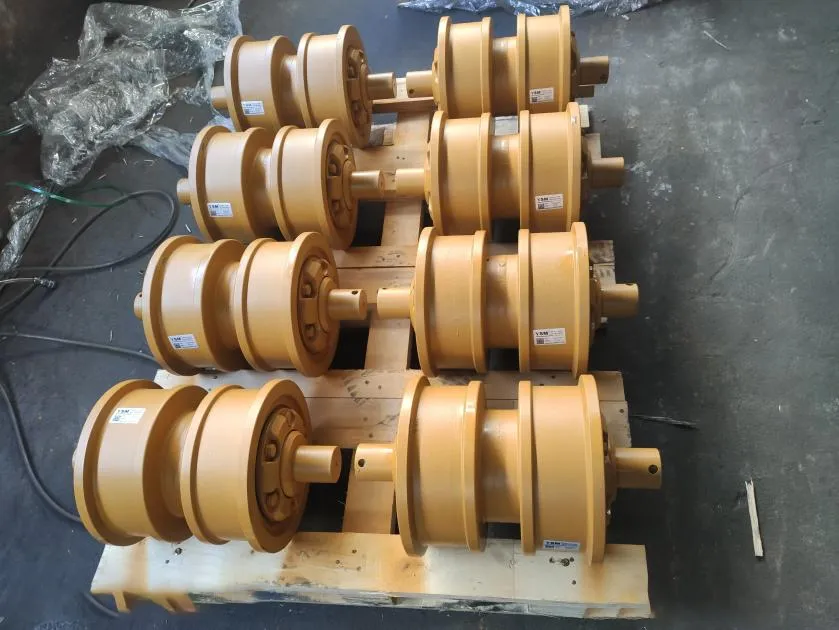
Check each roller for leakage, cracks, shell damage, abnormal tread or flange wear, loose mounting and packed material. A clean, newly painted roller can still have little measurable wear material remaining. Ultrasonic or approved dimensional measurement can provide evidence that a distant photograph cannot.
Compare every roller by side and position. One new roller among worn neighbours may show a repair, but it can also indicate that the previous failure was treated without addressing alignment, debris or track condition.
Front idler and guidance
Inspect tread and flange wear, leakage, side clearance, guide plates, abnormal position and fresh side contact. The idler works with the recoil and tension system; a problem in guidance or adjuster movement may show up as uneven wear elsewhere.
Drive sprocket or segments
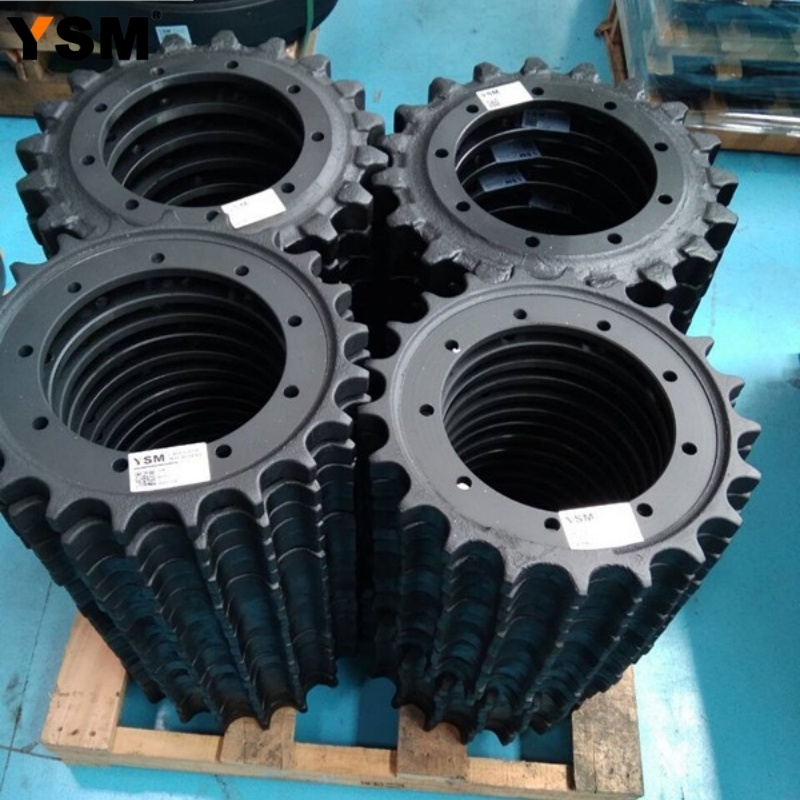
Inspect tooth or pocket profile, cracks, chips, one-sided contact, mounting hardware and the relationship with the chain bushings. Sharp appearance alone is not a complete measurement. A new segment set on a worn chain, or a new chain on badly worn segments, may create poor engagement.
Inspect Track Frames, Guards and Support Areas
Examine track frames, roller guards, guide guards, equalizer-bar and pivot areas, mounting points and final-drive housings. Look for cracks, deformation, fresh welds, oil traces, missing bolts and uneven frame position. A weld is not automatically unacceptable, but the buyer needs the repair procedure, date and qualified inspection evidence.
Check final-drive oil level and sampling history through the exact manual and qualified inspection process. External leakage, loose mounting or abnormal noise requires further diagnosis. Do not treat a worn undercarriage as proof of an internal final-drive fault.
Compare blade, push-arm or C-frame wear and rear attachment condition because severe impact or asymmetric use can help explain undercarriage patterns. The purchase decision should consider the complete machine, even when this article focuses on the tracks.
Turn the Inspection Into a Purchase Report
A useful report lists the measured value, OEM new dimension, service limit, calculated wear only where the approved method supports it, risk level and required action. Keep seller statements in a separate column. Use photographs linked to each side and roller position.
| Report field | Good practice | Avoid |
|---|---|---|
| Machine identity | Complete model, suffix, serial/PIN and configuration | Base model from the listing title only |
| Measurement | Value, units, tool, location and method | "Looks about half worn" |
| Reference | Correct serial-specific chart or service data | Limits copied from another model |
| Condition | Leak, crack, wear pattern, movement or missing hardware | One overall grade for the entire undercarriage |
| Action | Monitor, verify, repair before use or include in replacement plan | Guaranteed remaining hours |
For remote purchases, request uncut videos of the serial plate, cold start, complete walk-around and approved travel checks, plus measurement photos with visible references. Polished marketing video cannot replace an independent inspection.
Replacement Parts Fitment Information
If the inspection identifies likely replacement needs, collect the equipment brand, complete model and suffix, serial number or PIN, part name, current part number, clear photographs, requested dimensions, quantity, destination country and intended working condition.
For chains and shoes, add link count, approved pitch measurement, shoe width, bolt pattern and joint type. For rollers and idlers, add mounting arrangement, bolt spacing, flange or tread measurements and position. For sprockets, add segment or rim type, mounting pattern and chain data.
A quotation is not a wear report, and a parts list is not confirmation that the machine is worth buying. Use the inspection to define risk, then verify compatibility and availability separately before ordering.
Frequently Asked Questions
Can bulldozer undercarriage wear be judged from hours?
No. Ground conditions, impact, travel, turning, track tension, shoe choice and maintenance can produce very different wear at similar hours.
Is a seller's wear percentage reliable?
Only when it is supported by the correct component measurements, new dimensions, service limits and OEM method. Ask for the report.
Should both sides have the same wear?
Not necessarily, but a large difference requires explanation. Turning habits, slopes, alignment, repairs and component condition can create unequal wear.
Can fresh paint hide undercarriage problems?
Paint may cover leaks, cracks, fretting and replacement differences. Measurements and close inspection remain necessary.
What is the most important document for a serious purchase?
A serial-specific, measured undercarriage report from a qualified inspector is more useful than general photos or unsupported remaining-life claims.
Technical References
- Caterpillar: Certified Used Inspection - inspection preparation, measurement tools, photographs and operational checks.
- Komatsu: Undercarriage Inspections - ultrasonic measurement and documented reports for tracked equipment.
- Caterpillar: Undercarriage for Dozers - component monitoring, daily inspection and application factors.
- Caterpillar: How to Check Dozer Track Tension - cleaning, measurement differences and manual-specific values.
This guide does not replace a serial-specific used-equipment inspection, OEM wear chart or service manual. Lifting, track adjustment, fluid sampling and operational testing require the correct procedure and qualified personnel.
Ask About Bulldozer Undercarriage Parts After the Inspection
We can check suitable supply options for track rollers, carrier rollers, idlers, sprocket segments, track chains, track shoes, track assemblies, adjuster-related components and track fasteners after reviewing the measured machine information.
Corporate Email: sales@china-ysm.com
WhatsApp: +86-18606961587
For a fitment check, send the equipment brand, complete model and suffix, serial number or PIN, part name, part number, clear photos, requested dimensions, quantity, destination country and working condition. Compatibility and availability must be confirmed before ordering.